Department of Rehabilitation Medicine, Nara Medical University, 840 Shijo-cho, Kashihara, Nara, 634-8522, Japan.
Department of Orthopedic Surgery, Nara Medical University, Nara, Japan.
World J Surg Oncol. 2020 Jul 25;18(1):187. doi: 10.1186/s12957-020-01964-y.
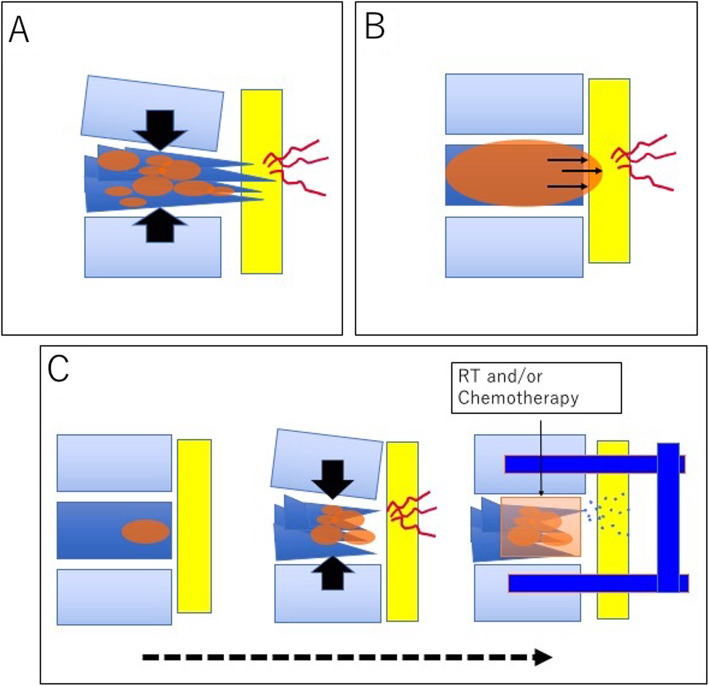
Neoplastic spinal cord compression is a cause of severe disability in cancer patients. To prevent irreversible paraplegia, a structured strategy is required to address the various impairments present in cancer patients. In this study, we aimed to identify the status where rehabilitation with minimally invasive spine stabilization (MISt) effectively improves ADL.
We retrospectively reviewed 27 consecutive patients with neoplastic spinal compression who were treated with MISt. We classified the impairments of patients through our multidisciplinary tumor board based on spine-specific factors, skeletal instability, and tumor growth. The neurological deficits, progress of pathological fracture, incidence of vertebral collapse, and postoperative implant failure were examined. Changes of the Barthel index (BI) scores before and after surgery were investigated throughout the clinical courses.
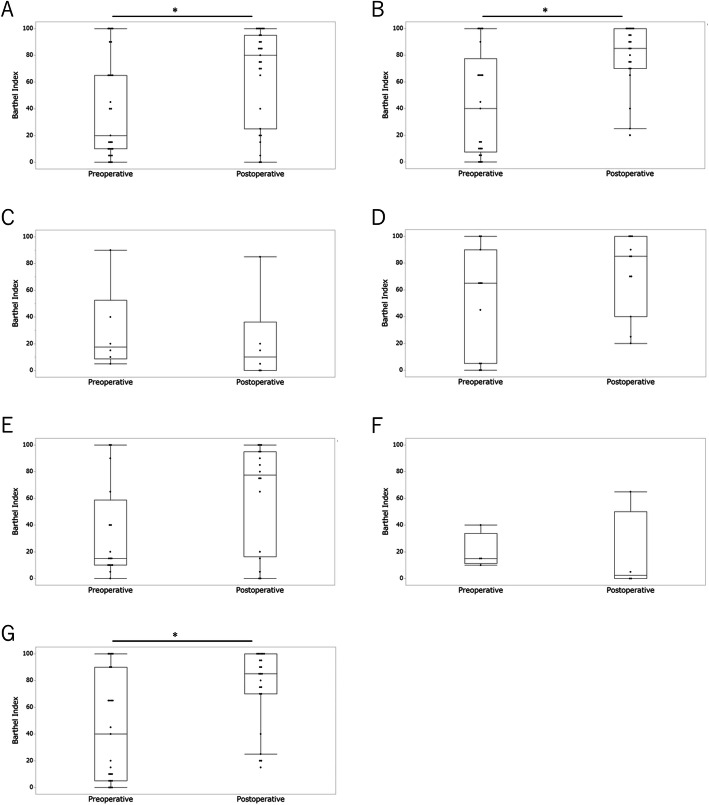
The average duration to ambulation was 7.19 ± 11 days, and we observed no collapse or progression of paralysis except in four cases of complete motor paraplegia before the surgery. Neurological deficiency was improved to or maintained at Frankel's grade E in 16 patients, remained unchanged in 6 patients (in grades B, C, D), and worsened in 5 patients. BI score comparisons before and after surgery in all patients showed statistically significant increments (p < 0.05). On further analysis, we noted good functional prognosis in patients capable of ambulation within 7 days (p < 0.05) and in patients who could survive longer than 3 months after the surgery (p < 0.05).
In various cancer patients with neoplastic spinal cord compression, skeletal instability as the primary impairment is a good indication for MISt, as the patients showed early ambulation with improved BI scores.
肿瘤性脊髓压迫是癌症患者严重残疾的原因。为了防止不可逆转的截瘫,需要采用结构化策略来解决癌症患者存在的各种功能障碍。在本研究中,我们旨在确定微创脊柱稳定术(MISt)康复治疗能有效改善日常生活活动能力(ADL)的状况。
我们回顾性分析了 27 例接受 MISt 治疗的肿瘤性脊髓压迫患者。我们根据脊柱特定因素、骨骼不稳定和肿瘤生长情况,通过多学科肿瘤委员会对患者的损伤进行分类。检查了神经功能缺损、病理骨折的进展、椎体塌陷的发生率和术后植入物失败的情况。通过整个临床过程调查了手术前后 Barthel 指数(BI)评分的变化。
平均行走时间为 7.19±11 天,除术前完全性运动性截瘫的 4 例外,未观察到塌陷或瘫痪进展。16 例患者的神经功能缺损改善至或保持在 Frankel E 级,6 例患者(B、C、D 级)保持不变,5 例患者恶化。所有患者手术前后 BI 评分比较均有统计学意义(p<0.05)。进一步分析表明,在 7 天内能够行走的患者(p<0.05)和术后能存活 3 个月以上的患者(p<0.05),功能预后良好。
在各种患有肿瘤性脊髓压迫的癌症患者中,骨骼不稳定是 MISt 的良好适应证,因为患者在改善 BI 评分的情况下能够早期行走。