Kwan Mun Keong, Lee Chee Kean, Chan Chris Yin Wei
Department of Orthopaedic Surgery, Faculty of Medicine, University of Malaya, Kuala Lumpur, Malaysia.
Asian Spine J. 2016 Feb;10(1):99-110. doi: 10.4184/asj.2016.10.1.99. Epub 2016 Feb 16.
Prospective cohort study.
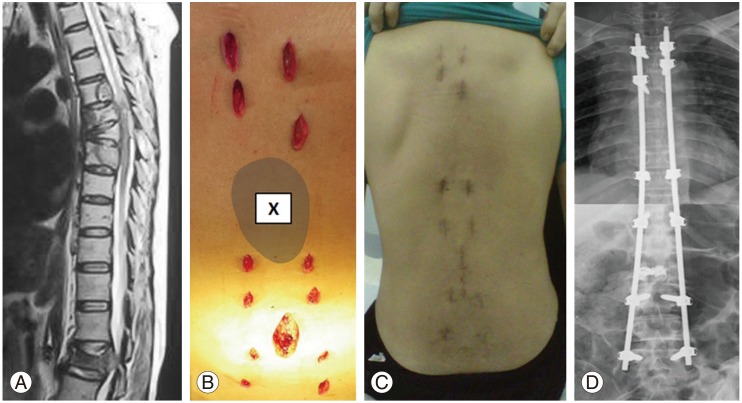
To report the outcome of 50 patients with spinal metastases treated with minimally invasive stabilization (MISt) using fluoroscopic guided percutaneous pedicle screws with/without minimally invasive decompression.
The advent of minimally invasive percutaneous pedicle screw stabilization system has revolutionized the treatment of spinal metastasis.
Between 2008 and 2013, 50 cases of spinal metastasis with pathological fracture(s) with/without neurology deficit were treated by MISt at our institution. The patients were assessed by Tomita score, pain score, operation time, blood loss, neurological recovery, time to ambulation and survival.
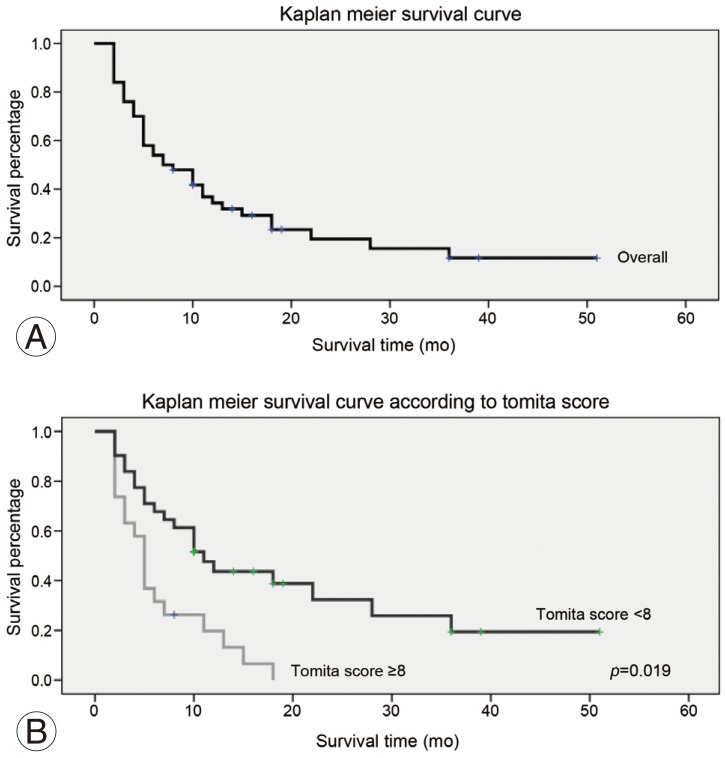
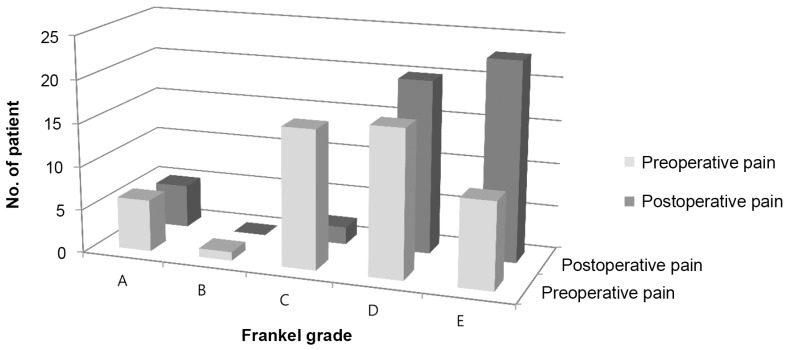
The mean Tomita score was 6.3±2.4. Thirty seven patients (74.0%) required minimally invasive decompression in addition to MISt. The mean operating time was 2.3±0.5 hours for MISt alone and 3.4±1.2 hours for MISt with decompression. Mean blood loss for MISt alone and MISt with decompression was 0.4±0.2 L and 1.7±0.9 L, respectively. MISt provided a statistically significant reduction in visual analog scale pain score with mean preoperative score of 7.9±1.4 that was significantly decreased to 2.5±1.2 postoperatively (p=0.000). For patients with neurological deficit, 70% displayed improvement of one Frankel grade and 5% had an improvement of 2 Frankel grades. No patient was bed-ridden postoperatively, with the average time to ambulation of 3.4±1.8 days. The mean overall survival time was 11.3 months (range, 2-51 months). Those with a Tomita score <8 survived significantly longer than those a Tomita score ≥8 with a mean survival of 14.1±12.5 months and 6.8±4.9 months, respectively (p=0.019). There were no surgical complications, except one case of implant failure.
MISt is an acceptable treatment option for spinal metastatic patients, providing good relief of instability back pain with no major complications.
前瞻性队列研究。
报告50例脊柱转移瘤患者采用透视引导下经皮椎弓根螺钉微创稳定术(MISt)联合或不联合微创减压术的治疗结果。
微创经皮椎弓根螺钉稳定系统的出现彻底改变了脊柱转移瘤的治疗方式。
2008年至2013年期间,我院对50例伴有或不伴有神经功能缺损的脊柱转移瘤合并病理性骨折患者采用MISt治疗。通过Tomita评分、疼痛评分、手术时间、失血量、神经功能恢复情况、下床活动时间和生存率对患者进行评估。
Tomita评分均值为6.3±2.4。37例患者(74.0%)除MISt外还需要微创减压。单纯MISt的平均手术时间为2.3±0.5小时,MISt联合减压的平均手术时间为3.4±1.2小时。单纯MISt和MISt联合减压的平均失血量分别为0.4±0.2升和1.7±0.9升。MISt使视觉模拟量表疼痛评分显著降低,术前平均评分为7.9±1.4,术后显著降至2.5±1.2(p=0.000)。对于有神经功能缺损的患者,70%的患者Frankel分级提高一级,5%的患者Frankel分级提高两级。术后无患者卧床,平均下床活动时间为3.4±1.8天。平均总生存时间为11.3个月(范围2 - 51个月)。Tomita评分<8的患者比Tomita评分≥8的患者生存时间显著更长,平均生存时间分别为14.1±12.5个月和6.8±4.9个月(p=0.019)。除1例植入物失败外,无手术并发症。
MISt是脊柱转移瘤患者可接受的治疗选择,能有效缓解不稳定型背痛,且无重大并发症。