Department of Bacterial and Parasitic Diseases, Armed Forces Research Institute of Medical Sciences, 315/6 Rajvithi Road, Bangkok, 10400, Thailand.
Walter Reed Army Institute of Research, Silver Spring, Maryland, 20910, USA.
Malar J. 2020 Jul 25;19(1):269. doi: 10.1186/s12936-020-03339-w.
High rates of dihydroartemisinin-piperaquine (DHA-PPQ) treatment failures have been documented for uncomplicated Plasmodium falciparum in Cambodia. The genetic markers plasmepsin 2 (pfpm2), exonuclease (pfexo) and chloroquine resistance transporter (pfcrt) genes are associated with PPQ resistance and are used for monitoring the prevalence of drug resistance and guiding malaria drug treatment policy.
To examine the relative contribution of each marker to PPQ resistance, in vitro culture and the PPQ survival assay were performed on seventeen P. falciparum isolates from northern Cambodia, and the presence of E415G-Exo and pfcrt mutations (T93S, H97Y, F145I, I218F, M343L, C350R, and G353V) as well as pfpm2 copy number polymorphisms were determined. Parasites were then cloned by limiting dilution and the cloned parasites were tested for drug susceptibility. Isobolographic analysis of several drug combinations for standard clones and newly cloned P. falciparum Cambodian isolates was also determined.
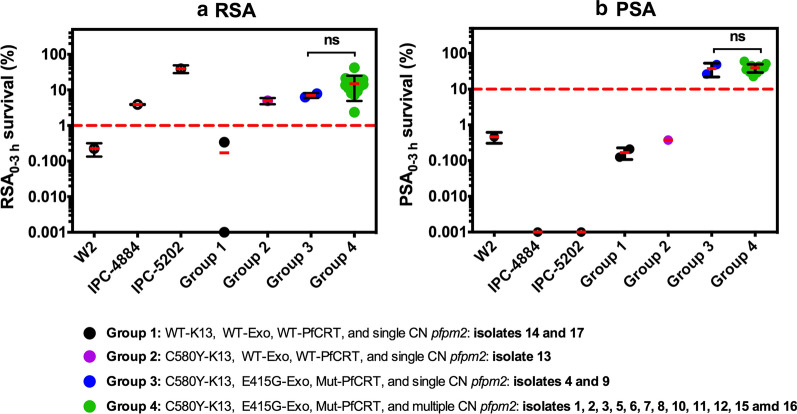
The characterization of culture-adapted isolates revealed that the presence of novel pfcrt mutations (T93S, H97Y, F145I, and I218F) with E415G-Exo mutation can confer PPQ-resistance, in the absence of pfpm2 amplification. In vitro testing of PPQ resistant parasites demonstrated a bimodal dose-response, the existence of a swollen digestive vacuole phenotype, and an increased susceptibility to quinine, chloroquine, mefloquine and lumefantrine. To further characterize drug sensitivity, parental parasites were cloned in which a clonal line, 14-B5, was identified as sensitive to artemisinin and piperaquine, but resistant to chloroquine. Assessment of the clone against a panel of drug combinations revealed antagonistic activity for six different drug combinations. However, mefloquine-proguanil and atovaquone-proguanil combinations revealed synergistic antimalarial activity.
Surveillance for PPQ resistance in regions relying on DHA-PPQ as the first-line treatment is dependent on the monitoring of molecular markers of drug resistance. P. falciparum harbouring novel pfcrt mutations with E415G-exo mutations displayed PPQ resistant phenotype. The presence of pfpm2 amplification was not required to render parasites PPQ resistant suggesting that the increase in pfpm2 copy number alone is not the sole modulator of PPQ resistance. Genetic background of circulating field isolates appear to play a role in drug susceptibility and biological responses induced by drug combinations. The use of latest field isolates may be necessary for assessment of relevant drug combinations against P. falciparum strains and when down-selecting novel drug candidates.
在柬埔寨,无并发症恶性疟原虫对双氢青蒿素-哌喹(DHA-PPQ)的治疗失败率很高。疟原虫蛋白酶 2(pfpm2)、核酸外切酶(pfexo)和氯喹耐药转运蛋白(pfcrt)基因与 PPQ 耐药有关,可用于监测耐药性的流行情况并指导疟疾药物治疗政策。
为了研究每个标记物对 PPQ 耐药性的相对贡献,对来自柬埔寨北部的 17 株恶性疟原虫进行了体外培养和 PPQ 生存测定,并确定了 E415G-Exo 和 pfcrt 突变(T93S、H97Y、F145I、I218F、M343L、C350R 和 G353V)以及 pfpm2 拷贝数多态性的存在。然后通过限制稀释对寄生虫进行克隆,并测试克隆寄生虫对药物的敏感性。还对标准克隆和新克隆的柬埔寨恶性疟原虫分离株的几种药物组合进行了棋盘式分析。
对适应培养的分离株的特征描述表明,在没有 pfpm2 扩增的情况下,存在新型 pfcrt 突变(T93S、H97Y、F145I 和 I218F)与 E415G-Exo 突变可导致 PPQ 耐药。对 PPQ 耐药寄生虫的体外检测显示出双峰剂量反应,存在肿胀的消化泡表型,对奎宁、氯喹、甲氟喹和青蒿琥酯的敏感性增加。为了进一步表征药物敏感性,对亲本寄生虫进行了克隆,其中克隆系 14-B5 被鉴定为对青蒿素和哌喹敏感,但对氯喹耐药。对药物组合进行评估显示,有 6 种不同的药物组合具有拮抗活性。然而,甲氟喹-丙氧喹和阿托伐醌-丙氧喹组合显示出协同抗疟活性。
在依赖 DHA-PPQ 作为一线治疗的地区监测 PPQ 耐药性,取决于对耐药性分子标记物的监测。携带 E415G-exo 突变的新型 pfcrt 突变的恶性疟原虫表现出 PPQ 耐药表型。不需要 pfpm2 扩增即可使寄生虫产生 PPQ 耐药性,这表明 pfpm2 拷贝数的增加本身并不是导致 PPQ 耐药的唯一调节剂。循环田间分离株的遗传背景似乎在药物敏感性和药物组合诱导的生物学反应中发挥作用。使用最新的田间分离株可能对于评估针对恶性疟原虫株的相关药物组合以及在选择新型药物候选物时是必要的。