Lifelong Health, South Australian Health & Medical Research Institute, Adelaide, SA, 5000, Australia.
Lifelong Health, South Australian Health & Medical Research Institute, Adelaide, SA, 5000, Australia; School of Biomedical Sciences, University of Adelaide, Adelaide, SA, 5005, Australia.
Mol Metab. 2020 Dec;42:101054. doi: 10.1016/j.molmet.2020.101054. Epub 2020 Jul 23.
Diet-driven obesity is increasingly widespread. Its consequences pose major challenges to human health and health care systems. There are MAP kinase-interacting kinases (MNKs) in mice, MNK1 and MNK2. Studies have demonstrated that mice lacking either MNK1 or MNK2 were partially protected against high-fat diet (HFD)-induced weight gain and insulin resistance. The aims of this study were to evaluate the phenotype of mice lacking both MNKs when given an HFD, to assess whether pharmacological inhibition of MNK function also protects against diet-induced obesity (DIO) and its consequences and to probe the mechanisms underlying such protection.
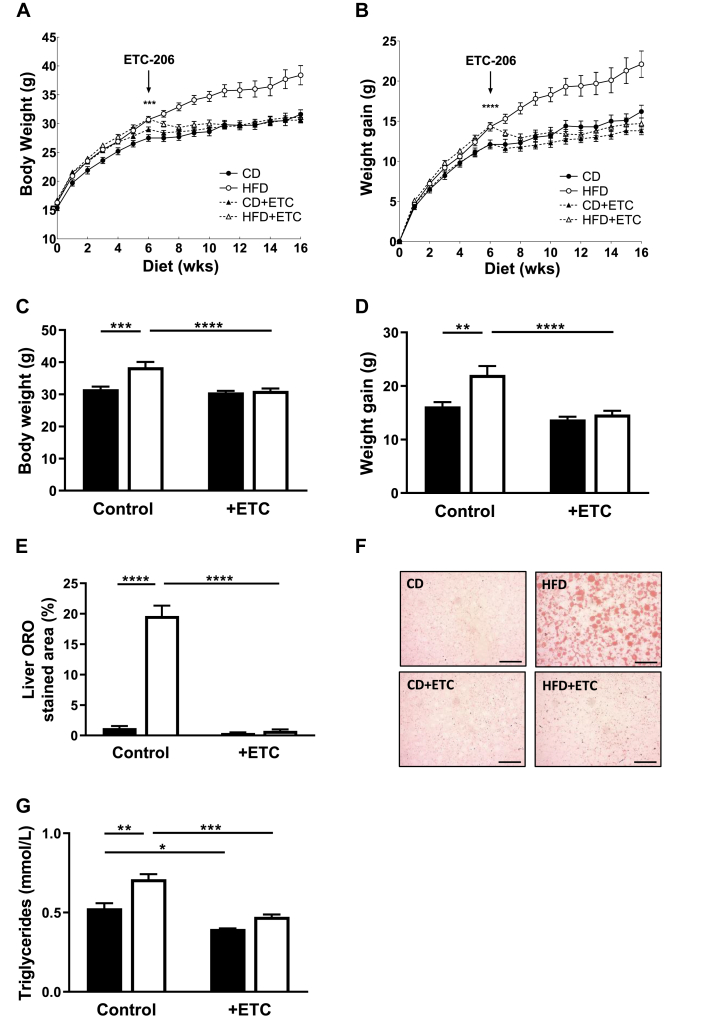
Male wild-type (WT) C57Bl6 mice or mice lacking both MNK1 and MNK2 (double knockout, DKO) were fed an HFD or control diet (CD) for up to 16 weeks. In a separate study, WT mice were also given an HFD for 6 weeks, after which half were treated with the recently-developed MNK inhibitor ETC-206 daily for 10 more weeks while continuing an HFD. Metabolites and other parameters were measured, and the expression of selected mRNAs and proteins was assessed.
MNK-DKO mice were almost completely protected from HFD-induced obesity. Higher energy expenditure (EE) in MNK-DKO mice was observed, which probably reflects the changes in a number of genes or proteins linked to lipolysis, mitochondrial function/biogenesis, oxidative metabolism, and/or ATP consumption. The MNK inhibitor ETC-206 also prevented HFD-induced weight gain, confirming that the activity of the MNKs facilitates weight gain due to excessive caloric consumption.
Disabling MNKs in mice, either genetically or pharmacologically, strongly prevents weight gain on a calorie-rich diet. This finding likely results from increased energy utilisation, involving greater ATP consumption, mitochondrial oxidative metabolism, and other processes.
饮食引起的肥胖症越来越普遍。其后果给人类健康和医疗保健系统带来了重大挑战。在小鼠中存在丝裂原活化蛋白激酶相互作用激酶(MNKs),即 MNK1 和 MNK2。研究表明,缺乏 MNK1 或 MNK2 的小鼠对高脂肪饮食(HFD)诱导的体重增加和胰岛素抵抗有一定程度的保护作用。本研究的目的是评估给予 HFD 时缺乏两种 MNK 的小鼠的表型,评估 MNK 功能的药理学抑制是否也能预防饮食引起的肥胖(DIO)及其后果,并探讨这种保护的机制。
雄性野生型(WT)C57Bl6 小鼠或缺乏 MNK1 和 MNK2 的双敲除(DKO)小鼠分别喂食 HFD 或对照饮食(CD)长达 16 周。在另一项研究中,WT 小鼠也喂食 HFD 6 周,之后一半小鼠用最近开发的 MNK 抑制剂 ETC-206 每天治疗 10 周,同时继续喂食 HFD。测量代谢物和其他参数,并评估选定的 mRNA 和蛋白质的表达。
MNK-DKO 小鼠几乎完全免受 HFD 诱导的肥胖。在 MNK-DKO 小鼠中观察到更高的能量消耗(EE),这可能反映了与脂肪分解、线粒体功能/生物发生、氧化代谢和/或 ATP 消耗相关的许多基因或蛋白质的变化。MNK 抑制剂 ETC-206 也阻止了 HFD 诱导的体重增加,证实了 MNKs 的活性促进了由于过量热量摄入导致的体重增加。
在小鼠中无论是遗传还是药理学上抑制 MNKs,都能强烈阻止高热量饮食引起的体重增加。这一发现可能是由于能量利用的增加,包括更大的 ATP 消耗、线粒体氧化代谢和其他过程。