Li Hui, You Liji, Tian Yufeng, Guo Jing, Fang Xianbao, Zhou Chenmin, Shi Lanying, Su You-Qiang
State Key Laboratory of Reproductive Medicine Nanjing Medical University Nanjing 211166 P. R. China.
Women's Hospital of Nanjing Medical University Nanjing Maternity and Child Health Hospital Nanjing Medical University Nanjing 211166 P. R. China.
Adv Sci (Weinh). 2020 Jun 3;7(14):2000531. doi: 10.1002/advs.202000531. eCollection 2020 Jul.
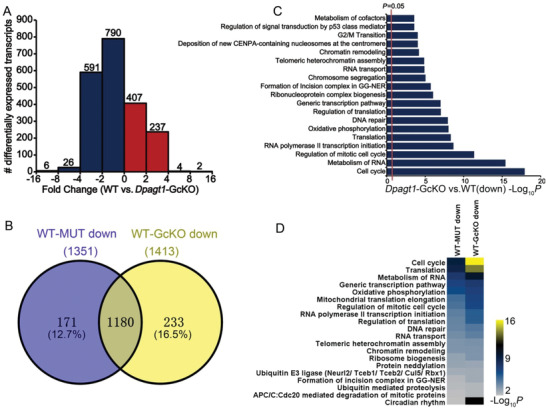
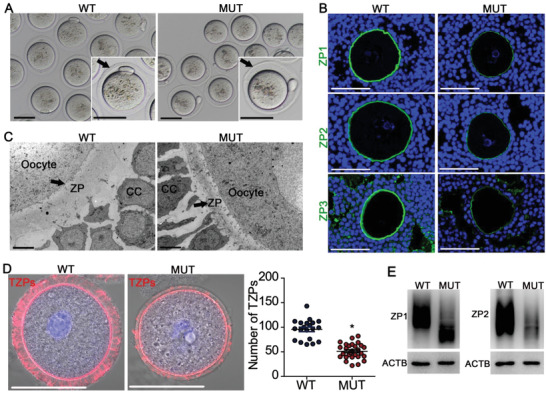
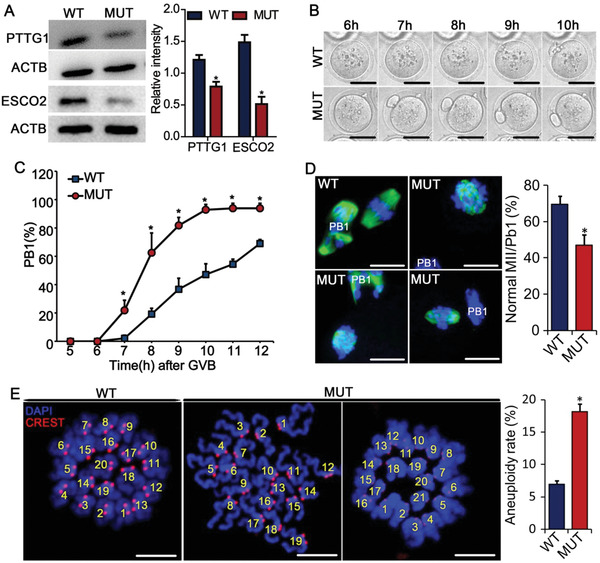
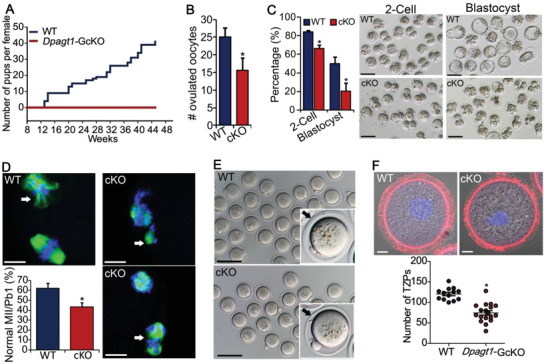
Post-translational modification of proteins by -linked glycosylation is crucial for many life processes. However, the exact contribution of -glycosylation to mammalian female reproduction remains largely undefined. Here, DPAGT1, the enzyme that catalyzes the first step of protein -glycosylation, is identified to be indispensable for oocyte development in mice. missense mutation (c. 497A>G; p. Asp166Gly) causes female subfertility without grossly affecting other functions. Mutant females ovulate fewer eggs owing to defective development of growing follicles. Mutant oocytes have a thin and fragile zona pellucida (ZP) due to the reduction in glycosylation of ZP proteins, and display poor developmental competence after fertilization in vitro. Moreover, completion of the first meiosis is accelerated in mutant oocytes, which is coincident with the elevation of aneuploidy. Mechanistically, transcriptomic analysis reveals the downregulation of a number of transcripts essential for oocyte meiotic progression and preimplantation development (e.g., , , , and ) in mutant oocytes, which could account for the defects observed. Furthermore, conditional knockout of in oocytes recapitulates the phenotypes observed in mutant females, and causes complete infertility. Taken together, these data indicate that protein -glycosylation in oocytes is essential for female fertility in mammals by specific control of oocyte development.
蛋白质的N-连接糖基化修饰对许多生命过程至关重要。然而,N-糖基化对哺乳动物雌性生殖的确切贡献在很大程度上仍不明确。在这里,催化蛋白质N-糖基化第一步的酶DPAGT1被确定为小鼠卵母细胞发育所必需的。一个错义突变(c.497A>G;p.Asp166Gly)导致雌性生育力低下,而对其他功能没有明显影响。突变雌性由于生长卵泡发育缺陷而排卵较少。突变卵母细胞由于透明带(ZP)蛋白糖基化减少而具有薄且脆弱的透明带,并在体外受精后显示出较差的发育能力。此外,突变卵母细胞中第一次减数分裂的完成加速,这与非整倍体的增加一致。从机制上讲,转录组分析揭示了突变卵母细胞中许多对卵母细胞减数分裂进程和植入前发育至关重要的转录本(如、、、和)的下调,这可以解释所观察到的缺陷。此外,卵母细胞中DPAGT1的条件性敲除重现了在DPAGT1突变雌性中观察到的表型,并导致完全不育。综上所述,这些数据表明卵母细胞中的蛋白质N-糖基化通过对卵母细胞发育的特定控制对哺乳动物雌性生育至关重要。