Mach Katharine J, Adger W Neil, Buhaug Halvard, Burke Marshall, Fearon James D, Field Christopher B, Hendrix Cullen S, Kraan Caroline M, Maystadt Jean-Francois, O'Loughlin John, Roessler Philip, Scheffran Jürgen, Schultz Kenneth A, von Uexkull Nina
Rosenstiel School of Marine and Atmospheric Science University of Miami Miami FL USA.
Leonard and Jayne Abess Center for Ecosystem Science and Policy University of Miami Coral Gables FL USA.
Earths Future. 2020 Jul;8(7):e2020EF001532. doi: 10.1029/2020EF001532. Epub 2020 Jul 3.
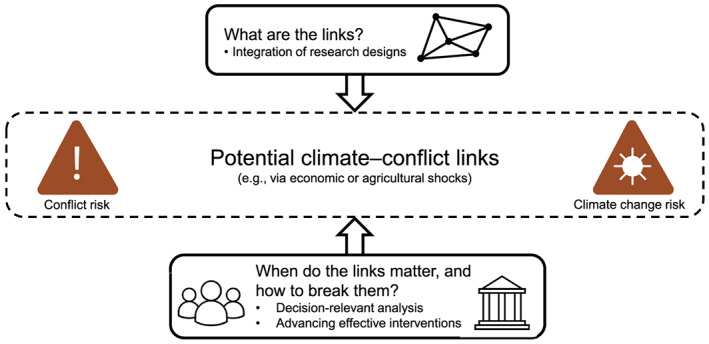
The potential links between climate and conflict are well studied, yet disagreement about the specific mechanisms and their significance for societies persists. Here, we build on assessment of the relationship between climate and organized armed conflict to define crosscutting priorities for future directions of research. They include (1) deepening insight into climate-conflict linkages and conditions under which they manifest, (2) ambitiously integrating research designs, (3) systematically exploring future risks and response options, responsive to ongoing decision-making, and (4) evaluating the effectiveness of interventions to manage climate-conflict links. The implications of this expanding scientific domain unfold in real time.
气候与冲突之间的潜在联系已得到充分研究,但对于具体机制及其对社会的重要性仍存在分歧。在此,我们基于对气候与有组织武装冲突之间关系的评估,来确定未来研究方向的交叉优先事项。这些优先事项包括:(1)深入洞察气候与冲突的联系以及它们显现的条件;(2)大力整合研究设计;(3)系统地探索未来风险和应对选项,以响应正在进行的决策;(4)评估管理气候与冲突联系的干预措施的有效性。这一不断扩展的科学领域的影响正在实时显现。