Sano Motoaki
Department of Cardiology, Keio University School of Medicine, Graduate School of Medicine, 35, Shinanomachi, Shinjuku-ku 160-8582, Japan.
Ther Adv Cardiovasc Dis. 2020 Jan-Dec;14:1753944720939383. doi: 10.1177/1753944720939383.
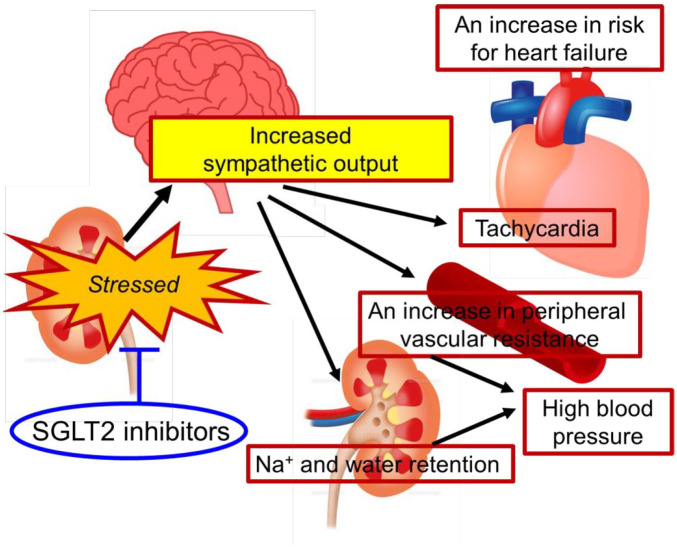
This review focuses on the pathogenic role of sodium glucose cotransporter (SGLT)-2 in the development of renal dysfunction and heart failure in patients with diabetes, by emphasizing the concept of reno-cardiac syndrome (kidney injury worsens cardiac condition) and by substantiating the deleterious effect of sympathetic overdrive in this context. Furthermore, the review proposes a mechanistic hypothesis to explain the benefits of SGLT2 inhibitors, specifically that SGLT-2 inhibitors reduce sympathetic activation at the renal level. To illustrate this point, several examples from both animal experiments and clinical observations are introduced. The bidirectional interaction of the heart and kidney were deeply implicated as an exacerbator of heart failure and renal failure without diabetes. Renal cortical ischemia and abnormal glucose metabolism of tubular epithelial cells are likely to exist as common pathologies in nondiabetic heart failure patients. It is no wonder why SGLT-2 inhibitors are specifically being studied even in the absence of diabetes, both for heart failure and also for renal failure.
本综述着重探讨了钠-葡萄糖协同转运蛋白(SGLT)-2在糖尿病患者肾功能不全和心力衰竭发展过程中的致病作用,强调了心肾综合征(肾脏损伤加重心脏状况)的概念,并证实了交感神经过度兴奋在这种情况下的有害影响。此外,该综述提出了一个机制假说,以解释SGLT2抑制剂的益处,具体而言,SGLT-2抑制剂可降低肾脏水平的交感神经激活。为说明这一点,引入了动物实验和临床观察中的几个例子。心脏和肾脏的双向相互作用被认为是无糖尿病心力衰竭和肾衰竭的恶化因素。肾皮质缺血和肾小管上皮细胞异常糖代谢可能是非糖尿病心力衰竭患者的常见病理情况。难怪即使在没有糖尿病的情况下,SGLT-2抑制剂也在针对心力衰竭和肾衰竭进行专门研究。