School of Pharmacy, Shanghai University of Traditional Chinese Medicine, Shanghai, China.
Shanghai Innovation Center of Health Service, Shanghai University of Traditional Chinese Medicine, Shanghai, China.
Int J Immunopathol Pharmacol. 2020 Jan-Dec;34:2058738420945078. doi: 10.1177/2058738420945078.
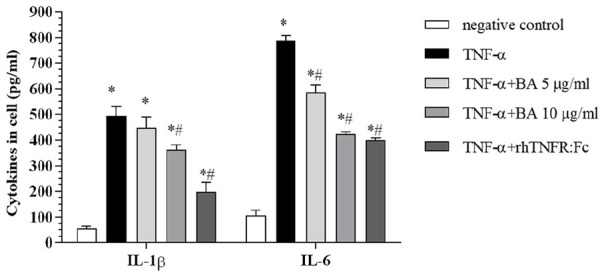
Betulinic acid (BA) inhibits the migration, invasion, and cytoskeletal reorganization of fibroblast-like synoviocytes (RA-FLS) in patients with rheumatoid arthritis. Here, to further explore the mechanism of action of BA in collagen-induced arthritis (CIA) rats, we investigated the pharmacodynamic effects of BA on synovial inflammation in a rat model of type II CIA. After inducing hind paw swelling, the rats were divided into four groups: healthy controls (normal), and rats that underwent CIA and received methotrexate treatment (MTX), BA treatment (BA), or no treatment (CIA). Body weight and hind paw swelling were determined regularly, and arthritis scores were calculated weekly. On day 35, rats were sacrificed and their hind ankle joints sectioned and stained with hematoxylin and eosin for histopathological evaluation. BA significantly reduced CIA-induced hind paw swelling, synovial tissue proliferation, cartilage destruction, and vasospasm. BA treatment also decreased serum interleukin (IL)-1β, IL-6, and tumor necrosis factor-alpha (TNF-α) levels in rats with CIA. The CCK-8 assay was used to detect the proliferation of isolated vimentinCD68 RA-FLS; RA-FLS were stimulated with TNF-α in vitro. BA significantly inhibited TNF-α-stimulated RA-FLS proliferation, as well as IL-1β and IL-6 secretion. BA also downregulated the transcription of vascular endothelial growth factor (VEGF) and transforming growth factor β (TGF-β) and decreased the expression of the NF-кB pathway proteins (NF-kB-P65, IkBα, and IKKα/β) in the TNF-α-stimulated RA-FLS. These results indicate that BA alleviated the symptoms of CIA by inhibiting synoviocyte proliferation, modifying TNF-α- and NF-кB-related inflammatory pathways, and downregulating inflammatory mediators and growth factors including IL-1β, IL-6, VEGF, and TGF-β.
桦木酸 (BA) 抑制类风湿关节炎患者成纤维样滑膜细胞 (RA-FLS) 的迁移、侵袭和细胞骨架重排。在这里,为了进一步探讨 BA 在胶原诱导性关节炎 (CIA) 大鼠中的作用机制,我们研究了 BA 对 II 型 CIA 大鼠滑膜炎症的药效作用。在诱导后足肿胀后,将大鼠分为四组:健康对照组 (正常)、接受甲氨蝶呤治疗的 CIA 大鼠 (MTX)、BA 治疗的 CIA 大鼠 (BA) 或未治疗的 CIA 大鼠 (CIA)。定期测定体重和后足肿胀,每周计算关节炎评分。第 35 天,处死大鼠,取后踝关节进行苏木精和伊红染色,进行组织病理学评价。BA 显著减轻 CIA 诱导的后足肿胀、滑膜组织增生、软骨破坏和血管痉挛。BA 治疗还降低了 CIA 大鼠血清白细胞介素 (IL)-1β、IL-6 和肿瘤坏死因子-α (TNF-α) 水平。用 CCK-8 法检测分离的波形蛋白 CD68 RA-FLS 的增殖;体外用 TNF-α刺激 RA-FLS。BA 显著抑制 TNF-α刺激的 RA-FLS 增殖以及 IL-1β 和 IL-6 的分泌。BA 还下调了 TNF-α刺激的 RA-FLS 中血管内皮生长因子 (VEGF) 和转化生长因子-β (TGF-β) 的转录,并降低了 NF-κB 通路蛋白 (NF-κB-P65、IkBα 和 IKKα/β) 的表达。这些结果表明,BA 通过抑制滑膜细胞增殖、修饰 TNF-α 和 NF-κB 相关炎症通路以及下调包括 IL-1β、IL-6、VEGF 和 TGF-β 在内的炎症介质和生长因子,缓解 CIA 症状。