School of Biological Sciences, University of Utah, Salt Lake City, UT 84112.
Department of Biological Science, California State University, Fullerton, CA 92834.
Proc Natl Acad Sci U S A. 2020 Aug 4;117(31):18161-18168. doi: 10.1073/pnas.2008345117. Epub 2020 Jul 27.
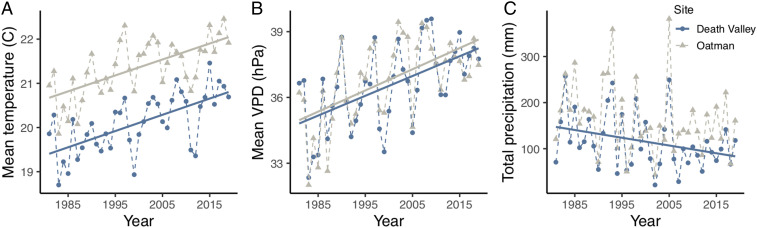
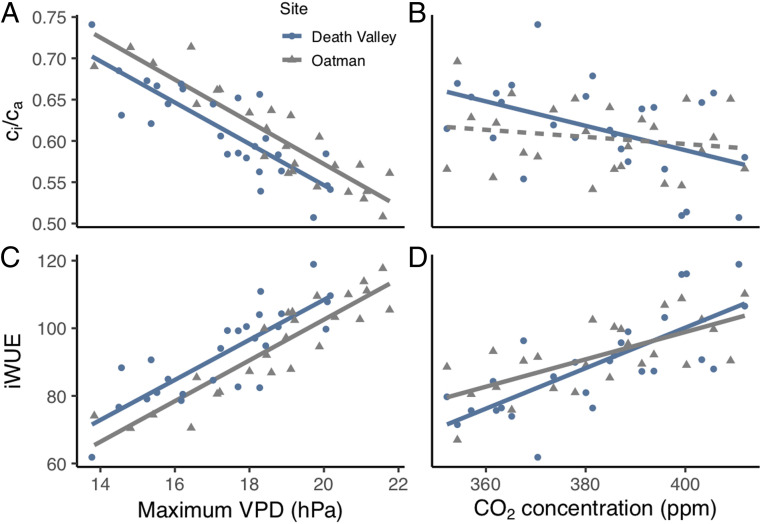
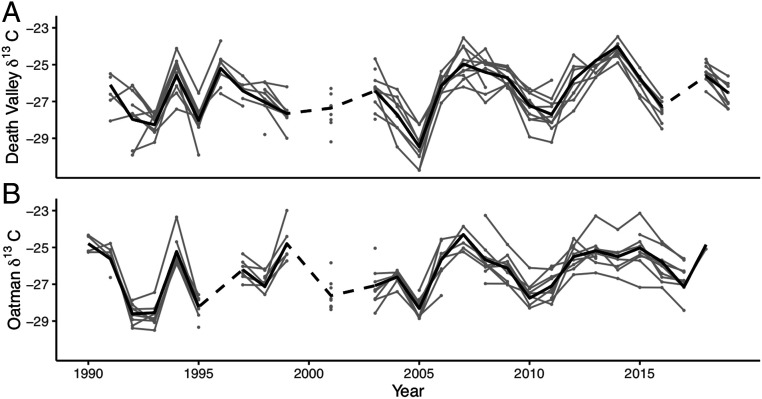
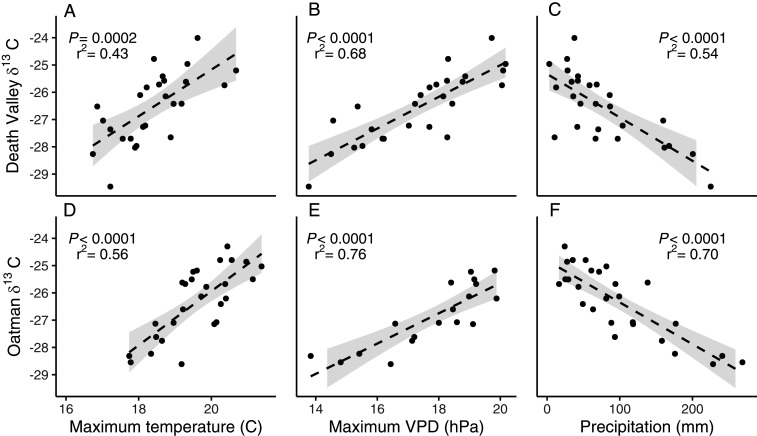
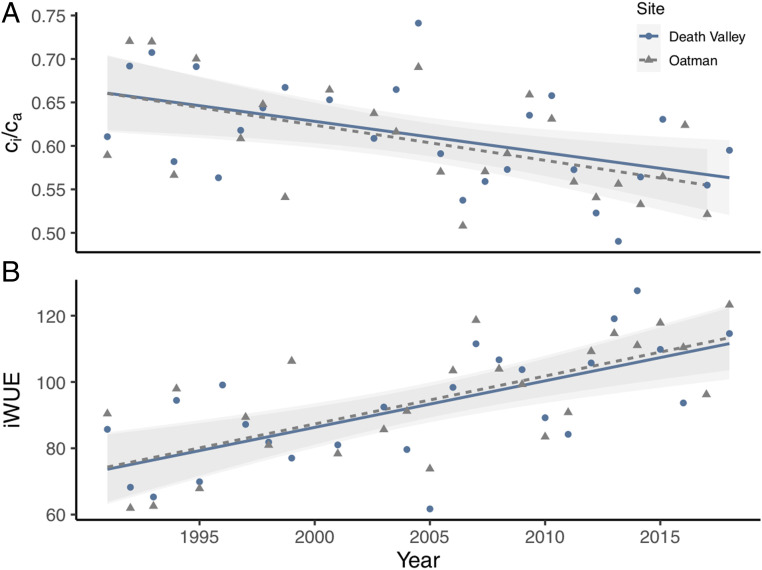
While tree rings have enabled interannual examination of the influence of climate on trees, this is not possible for most shrubs. Here, we leverage a multidecadal record of annual foliar carbon isotope ratio collections coupled with 39 y of survey data from two populations of the drought-deciduous desert shrub to provide insight into water-use dynamics and climate. This carbon isotope record provides a unique opportunity to examine the response of desert shrubs to increasing temperature and water stress in a region where climate is changing rapidly. Population mean carbon isotope ratios fluctuated predictably in response to interannual variations in temperature, vapor pressure deficit, and precipitation, and responses were similar among individuals. We leveraged the well-established relationships between leaf carbon isotope ratios and the ratio of intracellular to ambient CO concentrations to calculate intrinsic water-use efficiency (iWUE) of the plants and to quantify plant responses to long-term environmental change. The population mean iWUE value increased by 53 to 58% over the study period, much more than the 20 to 30% increase that has been measured in forests [J. Peñuelas, J. G. Canadell, R. Ogaya, 20, 597-608 (2011)]. Changes were associated with both increased CO concentration and increased water stress. Individuals whose lifetimes spanned the entire study period exhibited increases in iWUE that were very similar to the population mean, suggesting that there was significant plasticity within individuals rather than selection at the population scale.
虽然树木年轮使人们能够检查气候对树木的影响,但对于大多数灌木来说,这是不可能的。在这里,我们利用多年的年度叶片碳同位素比收集记录,并结合两个干旱落叶灌木种群的 39 年调查数据,深入了解水利用动态和气候。这个碳同位素记录为研究在气候快速变化的地区,荒漠灌木对温度升高和水分胁迫的响应提供了独特的机会。种群平均碳同位素比率可预测地响应于年际温度、蒸气压亏缺和降水的变化,个体之间的响应相似。我们利用叶片碳同位素比率与细胞内与环境 CO 浓度比之间的既定关系,计算植物的内在水分利用效率 (iWUE),并量化植物对长期环境变化的响应。在研究期间,种群平均 iWUE 值增加了 53%至 58%,远高于森林中测量到的 20%至 30%的增加[J. Peñuelas、J. G. Canadell、R. Ogaya,20,597-608(2011)]。这些变化与 CO 浓度的增加和水分胁迫的增加有关。在整个研究期间经历了一生的个体表现出的 iWUE 增加与种群平均值非常相似,这表明个体内部存在显著的可塑性,而不是种群尺度上的选择。