Kim Yunho, Kim Jeeyoung, Nam Heesung, Kim Hyun Dong, Eom Mi Ja, Jung Sang Hoon, Han Nami
Department of Physical Medicine and Rehabilitation, Inje University Busan Paik Hospital, Inje University College of Medicine, Busan, Korea.
Ann Rehabil Med. 2020 Aug;44(4):273-283. doi: 10.5535/arm.19125. Epub 2020 Jul 28.
To examine the correlation between ultrasonographic trunk muscle parameters and balance scales in mild acute stroke patients.
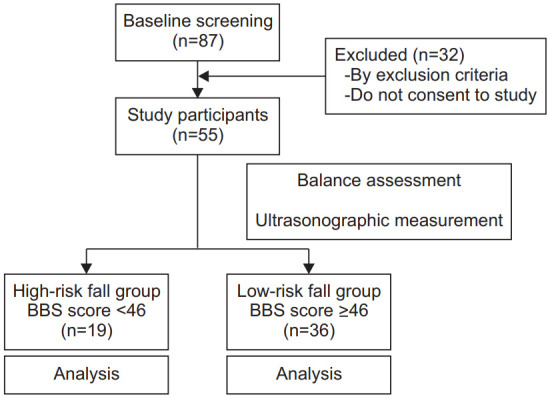
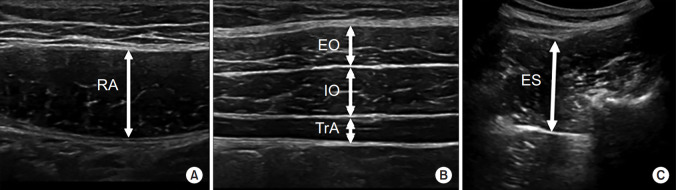
A total of 55 stroke patients with hemiparesis and motor power grade ≥4 in the manual motor test were included. The Scale for the Assessment and Rating of Ataxia (SARA), Berg Balance Scale (BBS), Timed Up and Go Test (TUG), and Trunk Control Test (TCT) were used to evaluate patient balance function. Ultrasonographic parameters were measured on both non-paretic and paretic sides of the rectus abdominis, external oblique, internal oblique, transversus abdominis, and erector spinae muscles. Resting thickness and contraction thickness were measured in all muscles, and contractility and contractility ratio were calculated based on measured thicknesses. The differences between paretic and non-paretic muscle parameters, and the correlation between ultrasonographic parameters and balance scales were analyzed. Stroke patients were divided into two groups according to their fall risk. Ultrasonographic measurements between the two groups were compared.
All muscles' contraction thickness and contractility were significantly different between paretic and non-paretic sides (p<0.001). Contractility ratios of all trunk muscles showed a significant correlation with SARA, BBS, TUG, and TCT (p<0.05). Contractility ratios of all muscles were significantly different between high- and low-risk fall groups (p<0.05).
The contractility ratio in stroke patients reflects their balance disturbance and fall risk and it may serve as a new parameter for ultrasound imaging of trunk muscles.
探讨轻度急性卒中患者超声检查的躯干肌肉参数与平衡量表之间的相关性。
纳入55例在徒手肌力测试中存在偏瘫且运动力量等级≥4级的卒中患者。采用共济失调评估与分级量表(SARA)、伯格平衡量表(BBS)、起立行走测试(TUG)和躯干控制测试(TCT)评估患者的平衡功能。在腹直肌、腹外斜肌、腹内斜肌、腹横肌和竖脊肌的非瘫痪侧和瘫痪侧测量超声参数。测量所有肌肉的静息厚度和收缩厚度,并根据测量厚度计算收缩性和收缩率。分析瘫痪侧与非瘫痪侧肌肉参数的差异,以及超声参数与平衡量表之间的相关性。根据跌倒风险将卒中患者分为两组。比较两组之间的超声测量结果。
瘫痪侧与非瘫痪侧所有肌肉的收缩厚度和收缩性均存在显著差异(p<0.001)。所有躯干肌肉的收缩率与SARA、BBS、TUG和TCT均呈显著相关性(p<0.05)。高跌倒风险组和低跌倒风险组所有肌肉的收缩率均存在显著差异(p<0.05)。
卒中患者的收缩率反映了他们的平衡障碍和跌倒风险,它可能作为躯干肌肉超声成像的一个新参数。