INSERM, Biologie Intégrée du Globule Rouge/UMR_S1134/BIGR, Université de Paris, F-75006 Paris, France.
INSERM, Biologie Intégrée du Globule Rouge/UMR_S1134/BIGR, Université des Antilles, F-75006 Paris, France.
Int J Mol Sci. 2020 Jul 24;21(15):5263. doi: 10.3390/ijms21155263.
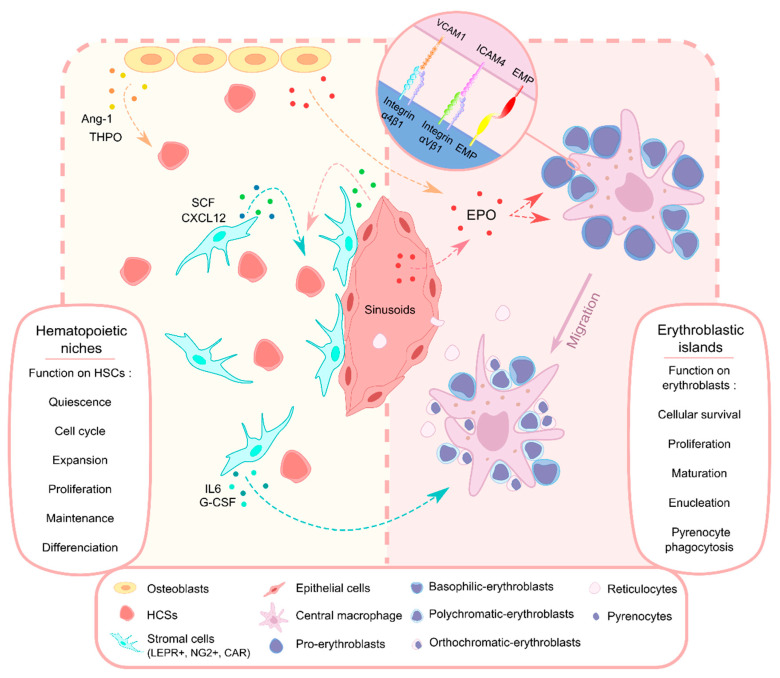
Human erythropoiesis is a complex process leading to the production of mature, enucleated erythrocytes (RBCs). It occurs mainly at bone marrow (BM), where hematopoietic stem cells (HSCs) are engaged in the early erythroid differentiation to commit into erythroid progenitor cells (burst-forming unit erythroid (BFU-E) and colony-forming unit erythroid (CFU-E)). Then, during the terminal differentiation, several erythropoietin-induced signaling pathways trigger the differentiation of CFU-E on successive stages from pro-erythroblast to reticulocytes. The latter are released into the circulation, finalizing their maturation into functional RBCs. This process is finely regulated by the physiological environment including the erythroblast-macrophage interaction in the erythroblastic island (EBI). Several human diseases have been associated with ineffective erythropoiesis, either by a defective or an excessive production of RBCs, as well as an increase or a hemoglobinization defect. Fully understanding the production of mature red blood cells is crucial for the comprehension of erythroid pathologies as well as to the field of transfusion. Many experimental approaches have been carried out to achieve a complete differentiation in vitro to produce functional biconcave mature RBCs. However, the various protocols usually fail to achieve enough quantities of completely mature RBCs. In this review, we focus on the evolution of erythropoiesis studies over the years, taking special interest in efforts that were made to include the microenvironment and erythroblastic islands paradigm. These more physiological approaches will contribute to a deeper comprehension of erythropoiesis, improve the treatment of dyserythropoietic disorders, and break through the barriers in massive RBCs production for transfusion.
人类红细胞生成是一个复杂的过程,导致成熟的无核红细胞(RBC)的产生。它主要发生在骨髓(BM)中,造血干细胞(HSCs)参与早期的红细胞分化,从而Commit 到红细胞祖细胞(爆式形成单位红细胞(BFU-E)和集落形成单位红细胞(CFU-E))。然后,在终末分化过程中,几种促红细胞生成素诱导的信号通路触发 CFU-E 在连续阶段从原红细胞到网织红细胞的分化。后者被释放到循环中,完成其成熟为功能性 RBC。这个过程由生理环境精细调节,包括红细胞 - 巨噬细胞在红细胞生成岛(EBI)中的相互作用。几种人类疾病与无效红细胞生成有关,要么是由于 RBC 的产生缺陷或过度,要么是由于 RBC 的增加或血红蛋白化缺陷。完全理解成熟红细胞的产生对于理解红细胞病理学以及输血领域至关重要。已经进行了许多实验方法来实现体外完全分化,以产生功能性双凹面成熟 RBC。然而,各种方案通常无法获得足够数量的完全成熟的 RBC。在这篇综述中,我们重点介绍了红细胞生成研究多年来的发展,特别关注了纳入微环境和红细胞生成岛范式的努力。这些更生理的方法将有助于更深入地理解红细胞生成,改善对红细胞生成障碍性疾病的治疗,并突破输血中大量 RBC 生产的障碍。