Department of Social Work, University of Rajshahi, Rajshahi, Bangladesh.
Department of Health and Caring Sciences, Faculty of Health and Life Sciences, Linnaeus University, Kalmar, Sweden.
PLoS One. 2020 Jul 28;15(7):e0236733. doi: 10.1371/journal.pone.0236733. eCollection 2020.
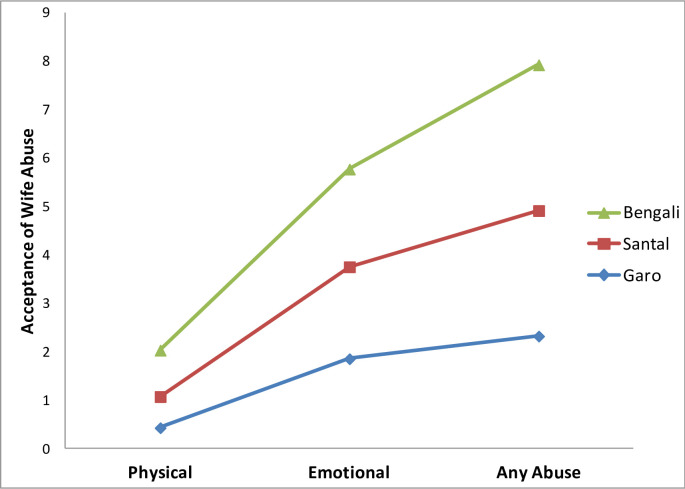
Studies on wife abuse in Bangladesh predominantly include the mainstream Bengali population, although there are at least 27 ethnic minority communities including a few 'female-centered' matrilineal groups living in the country. This study explored ethnic differences in the attitudinal acceptance of wife abuse among matrilineal ethnic minority Garo, patrilineal ethnic minority Santal, and mainstream patriarchal Bengali communities in rural Bangladesh. Adopting a cross-sectional design, the study included 1,929 women and men randomly selected from 24 Garo, Santal, and Bengali villages. Multivariate Poisson regression was performed to predict the number of contextual events, where the respondents attitudinally endorsed wife abuse. Of the sample, 33.2% were from Garo, 33.2% from Santal, and 33.6% from the Bengali communities. The acceptance of wife abuse was high in the sample; specifically, 34.1% of the respondents accepted physical wife abuse, 67.5% accepted emotional abuse, and 71.6% accepted any abuse (either physical or emotional) at least on one contextual reason provided in a 10-item scale. The mean for accepting any abuse was 3.0 (SD = 2.8), emotional abuse 2.3 (SD = 2.2), and physical abuse 0.8 (SD = 1.4). The study showed that the rates of accepting any abuse and physical abuse were respectively 16% and 56% lower among Garo as well as 14% and 33% lower among Santal than that of the Bengali community. Data also revealed that individual level factors like younger age, higher education, prestigious occupation as well as family level factors such as higher income, female mobility, and female family authority were inversely associated with the acceptance of wife abuse in the sample. It appears that the gender regime of a society has a great influence on the attitudes toward wife abuse. We argue that a comprehensive socio-cultural transformation of the patriarchal societies into a gender equal order is imperative for the prevention of widespread wife abuse in the country.
孟加拉国的关于配偶虐待的研究主要包括主流的孟加拉人,尽管该国至少还有 27 个少数民族社区,其中包括一些以女性为中心的母系群体。本研究探讨了孟加拉国农村地区母系少数民族加罗人、父系少数民族桑塔尔人和主流父权制孟加拉人社区在对配偶虐待的态度接受方面的种族差异。采用横断面设计,研究包括从 24 个加罗、桑塔尔和孟加拉村庄中随机抽取的 1929 名男女。多元泊松回归用于预测受访者在态度上认可配偶虐待的情况下,出现的情境事件数量。在样本中,33.2%来自加罗族,33.2%来自桑塔尔族,33.6%来自孟加拉族社区。样本中对配偶虐待的接受程度较高;具体而言,34.1%的受访者接受身体虐待,67.5%接受情感虐待,71.6%在提供的 10 项量表的至少一个情境原因中接受任何形式的虐待(身体或情感)。接受任何形式的虐待的平均得分为 3.0(标准差=2.8),情感虐待为 2.3(标准差=2.2),身体虐待为 0.8(标准差=1.4)。研究表明,加罗族对任何形式的虐待和身体虐待的接受率分别比孟加拉族低 16%和 56%,桑塔尔族对任何形式的虐待和身体虐待的接受率分别比孟加拉族低 14%和 33%。数据还显示,个体层面的因素,如年龄较小、较高的教育程度、有声望的职业,以及家庭层面的因素,如较高的收入、女性的流动性和女性的家庭权威,与样本中对配偶虐待的接受程度呈负相关。这表明一个社会的性别制度对配偶虐待的态度有很大的影响。我们认为,将父权制社会全面转变为性别平等的社会秩序,对于防止该国普遍存在的配偶虐待至关重要。