Department of Entomology and Nematology, University of California Davis, Davis, California, United States of America.
Department of Global Community Health and Behavioral Sciences, Tulane School of Public Health and Tropical Medicine, New Orleans, Louisiana, United States of America.
PLoS Negl Trop Dis. 2020 Jul 28;14(7):e0008477. doi: 10.1371/journal.pntd.0008477. eCollection 2020 Jul.
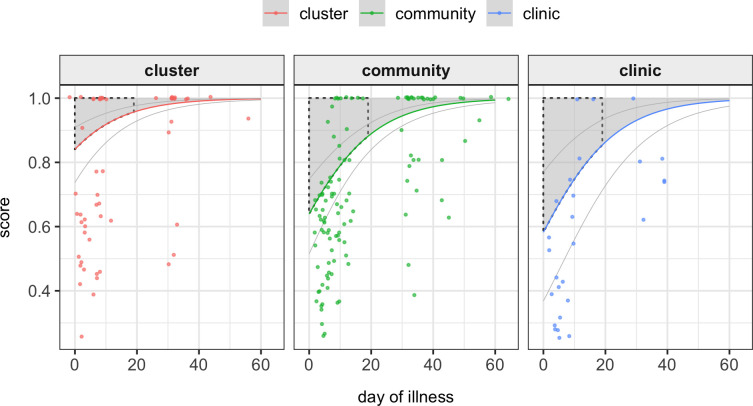
Previous studies measuring the health-related quality of life (HRQoL) of individuals with dengue focused on treatment seeking populations. However, the vast majority of global dengue cases are unlikely to be detected by health systems. Representative measurements of HRQoL should therefore include patients with disease not likely to trigger treatment-seeking behavior. This study based in Iquitos, Peru used the Quality of Wellbeing Scale-Self Administered, a survey that enquires about not only physical health, but also psychological health, self-care, mobility, and usual social activities, and rates HRQoL between 0 (death) and 1 (optimum function), to evaluate the impact of dengue on HRQoL. In order to enroll treatment and non treatment-seeking participants, three modalities of participant recruitment were used. In addition to clinic and community-based febrile surveillance, a contact-cluster methodology was also employed to identify infected individuals less likely to seek treatment. We measured changes in HRQoL and identified common areas of health impairment in 73 virologically confirmed dengue cases at 3 time points during the participant's illness; the early-acute (days 0-6 post symptom onset), late-acute (days 7-20), and convalescent illness phases (days 21 +). Participants reported HRQoL related impairments at significantly higher frequency during the early-acute versus convalescent illness phase (Fisher's exact: P<0.01). There was substantial heterogeneity in scores during each illness phase with median scores in the early-acute, late-acute and convalescent phases of 0.56 (IQR: 0.41-0.64), 0.70 (IQR: 0.57-0.94), and 1 (IQR: 0.80-1.00), respectively. In all illness phases participants recruited in clinics had on average the lowest HRQoL scores where as those recruited in the contact clusters had the highest. Only 1 individual who was recruited in the contact-clusters had no reduction in HRQoL score during their illness. These data illustrate that dengue should be considered as a disease that may have significant implications for not only physical health but also psychological health and social functioning. The impact of dengue on the HRQoL of non-treatment-seeking individuals, although lower than the impact among treatment-seeking individuals, is not necessarily trivial.
先前的研究主要关注寻求治疗的登革热患者的健康相关生活质量(HRQoL)。然而,全球绝大多数登革热病例不太可能被卫生系统发现。因此,代表性的 HRQoL 测量应该包括不太可能引发求医行为的疾病患者。这项在秘鲁伊基托斯进行的研究使用了自我管理的福利量表,该调查不仅询问了身体健康状况,还询问了心理健康、自我护理、活动能力和正常社交活动,并以 0(死亡)到 1(最佳功能)的评分来评估登革热对 HRQoL 的影响。为了招募治疗和非治疗寻求的参与者,采用了三种招募方式。除了诊所和社区发热监测外,还采用了接触聚类方法来确定不太可能寻求治疗的感染个体。我们在参与者患病的 3 个时间点测量了 73 例病毒学确诊的登革热病例的 HRQoL 变化,并确定了常见的健康损害领域;早期急性(症状出现后 0-6 天)、晚期急性(第 7-20 天)和恢复期(第 21 天及以后)。与恢复期相比,参与者在早期急性阶段报告 HRQoL 相关损害的频率明显更高(Fisher 精确检验:P<0.01)。在每个疾病阶段的评分都存在很大的异质性,早期急性、晚期急性和恢复期的中位数评分为 0.56(IQR:0.41-0.64)、0.70(IQR:0.57-0.94)和 1(IQR:0.80-1.00)。在所有疾病阶段,在诊所招募的参与者的 HRQoL 评分平均最低,而在接触聚类中招募的参与者的 HRQoL 评分最高。在接触聚类中招募的只有 1 名参与者在患病期间 HRQoL 评分没有下降。这些数据表明,登革热不仅可能对身体健康,而且可能对心理健康和社会功能产生重大影响,应被视为一种疾病。非治疗寻求者的登革热对 HRQoL 的影响虽然低于治疗寻求者,但并非微不足道。