Suo Bing, Wu Caiyu, Mei Fen
General Hospital of Heilongjiang Province Land Reclamation Bureau, Harbin, Heilongjiang 150088, P.R. China.
Department of Medical Laboratory, The Central Hospital of Wuhan, Tongji Medical College, Huazhong University of Science and Technology, Wuhan, Hubei 430014, P.R. China.
Oncol Lett. 2020 Aug;20(2):1263-1269. doi: 10.3892/ol.2020.11677. Epub 2020 May 28.
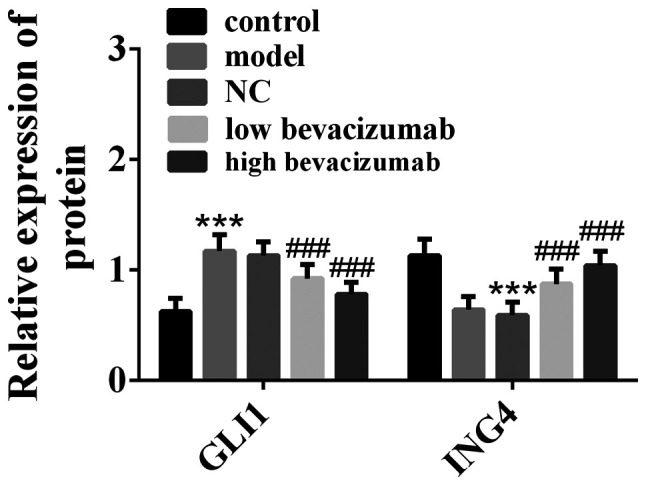
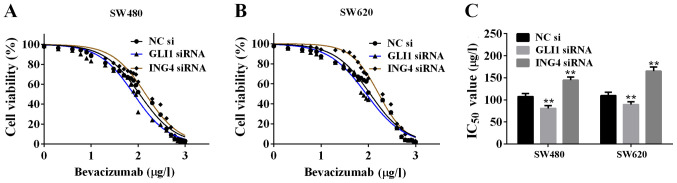
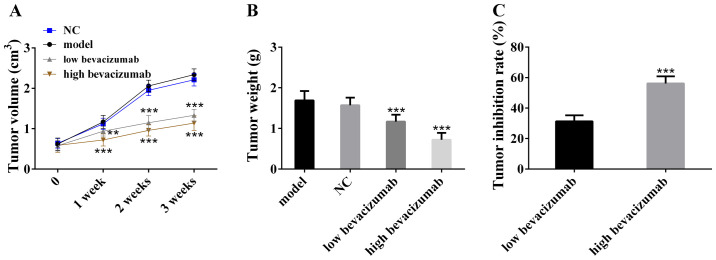
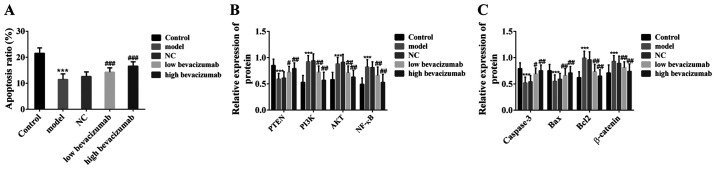
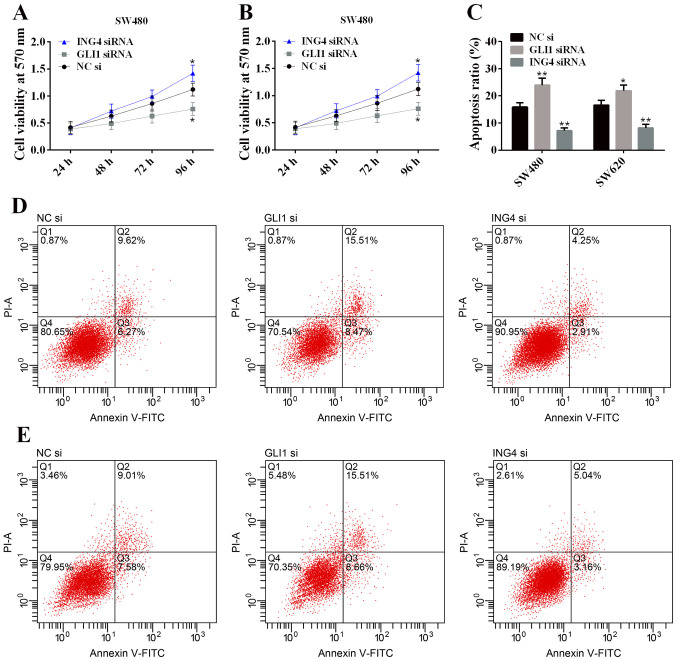
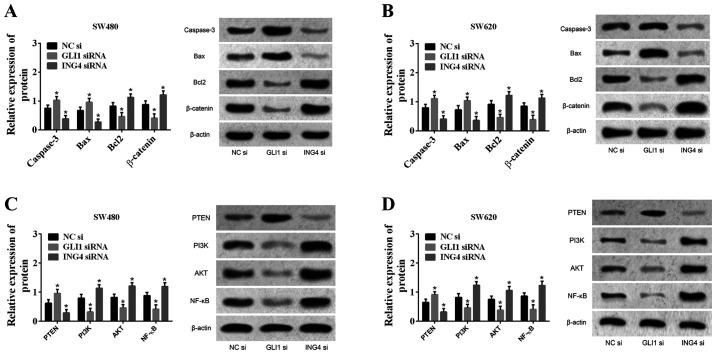
This study aimed to investigate the effect of bevacizumab on GLI1 and ING4 expression in colon cancer animal model. Colon cancer model in rats was induced by azoxymethane (AOM). Bevacizumab was used for the treatment of colon cancer rats. Tumor volume and weight were measured, tumor growth curve was visualized and tumor inhibition rate was calculated. GLI1 and ING4 of colon cancer cells were silencing expressed. Western blot analysis was used to detect the expressions of GLI1, ING4, caspase-3, Bax, β-catenin, Bcl2, PTEN, PI3K, Akt, NF-κB. The apoptosis rate was detected by flow cytometry. MTT assay was used to detect cell activity to get IC value. After AOM induced colon cancer model in rats, the expressions of ING4, caspase-3, Bax and PTEN were downregulated, the expressions of GLI1, β-catenin, Bcl2, PI3K, Akt and NF-κB were upregulated and the apoptosis rate was downregulated. After bevacizumab treatment, the tumor volume and weight decreased, the expressions of ING4, caspase-3, Bax, PTEN were upregulated, the expressions of GLI1, β-catenin, Bcl2, PI3K, Akt, NF-κB were downregulated, and the cell apoptosis rate increased. Cell experiments showed that GLI1 promotes tumor growth and reduces the sensitivity of bevacizumab, while ING4 inhibits tumor growth and increases the sensitivity of bevacizumab. Bevacizumab inhibits the growth of colon cancer tumor by upregulating ING4 and downregulating GLI1.
本研究旨在探讨贝伐单抗对结肠癌动物模型中GLI1和ING4表达的影响。用氧化偶氮甲烷(AOM)诱导大鼠结肠癌模型。使用贝伐单抗治疗结肠癌大鼠。测量肿瘤体积和重量,绘制肿瘤生长曲线并计算肿瘤抑制率。对结肠癌细胞中的GLI1和ING4进行沉默表达。采用蛋白质免疫印迹分析检测GLI1、ING4、半胱天冬酶-3、Bax、β-连环蛋白、Bcl-2、PTEN、PI3K、Akt、核因子-κB的表达。通过流式细胞术检测细胞凋亡率。采用MTT法检测细胞活性以获得IC值。在AOM诱导大鼠结肠癌模型后,ING4、半胱天冬酶-3、Bax和PTEN的表达下调,GLI1、β-连环蛋白、Bcl-2、PI3K、Akt和核因子-κB的表达上调,细胞凋亡率下调。贝伐单抗治疗后,肿瘤体积和重量减小,ING4、半胱天冬酶-3、Bax、PTEN的表达上调,GLI1、β-连环蛋白、Bcl-2、PI3K、Akt、核因子-κB的表达下调,细胞凋亡率增加。细胞实验表明,GLI1促进肿瘤生长并降低对贝伐单抗的敏感性,而ING4抑制肿瘤生长并增加对贝伐单抗的敏感性。贝伐单抗通过上调ING4和下调GLI1来抑制结肠癌肿瘤的生长。