Department of Cell Biology and Anatomy, University of South Carolina School of Medicine, Columbia, SC 29209.
Department of Statistics, University of South Carolina, Columbia, SC 29208.
Theranostics. 2020 Jul 9;10(18):8365-8381. doi: 10.7150/thno.45395. eCollection 2020.
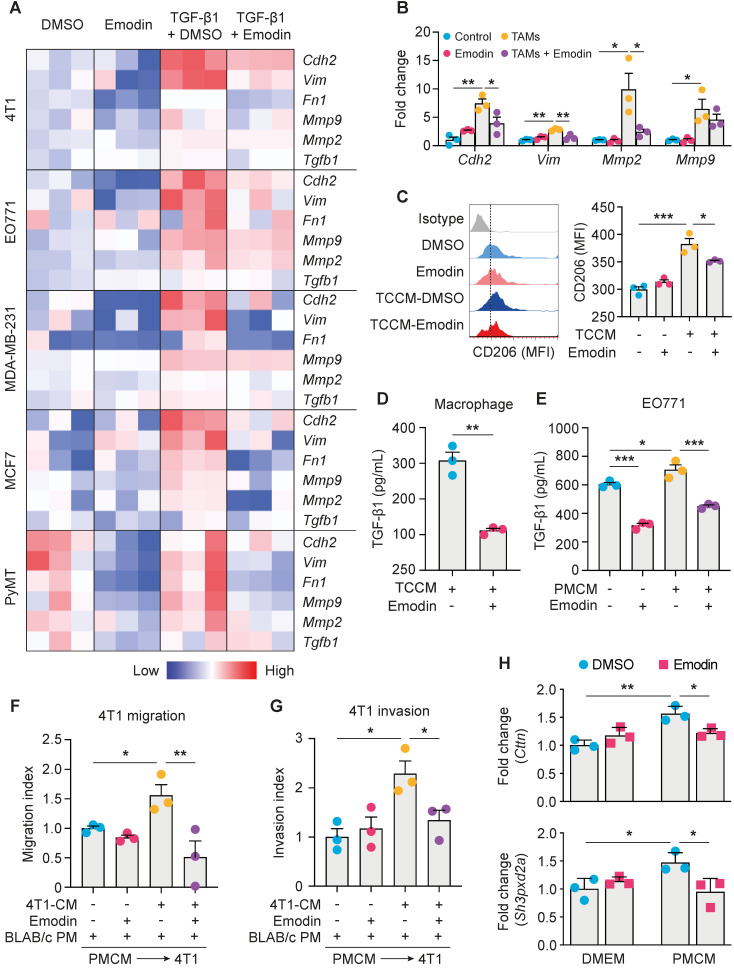
Our previous studies demonstrated that the natural compound emodin blocks the tumor-promoting feedforward interactions between cancer cells and macrophages, and thus ameliorates the immunosuppressive state of the tumor microenvironment. Since tumor-associated macrophages (TAMs) also affect epithelial mesenchymal-transition (EMT) and cancer stem cell (CSC) formation, here we aimed to test if emodin as a neoadjuvant therapy halts breast cancer metastasis by attenuating TAM-induced EMT and CSC formation of breast cancer cells. Bioinformatical analysis was performed to examine the correlation between macrophage abundance and EMT/CSC markers in human breast tumors. Cell culture and co-culture studies were performed to test if emodin suppresses TGF-β1 or macrophage-induced EMT and CSC formation of breast cancer cells, and if it inhibits breast cancer cell migration and invasion. Using mouse models, we tested if short-term administration of emodin before surgical removal of breast tumors halts breast cancer post-surgery metastatic recurrence in the lungs. The effects of emodin on TGF-β1 signaling pathways in breast cancer cells were examined by western blots and immunofluorescent imaging. Macrophage abundance positively correlates with EMT and CSC markers in human breast tumors. Emodin suppressed TGF-β1 production in breast cancer cells and macrophages and attenuated TGF-β1 or macrophage-induced EMT and CSC formation of breast cancer cells. Short-term administration of emodin before surgery halted breast cancer post-surgery metastatic recurrence in the lungs by reducing tumor-promoting macrophages and suppressing EMT and CSC formation in the primary tumors. Mechanistic studies revealed that emodin inhibited both canonical and noncanonical TGF-β1 signaling pathways in breast cancer cells and suppressed transcription factors key to EMT and CSC. Natural compound emodin suppresses EMT and CSC formation of breast cancer cells by blocking TGF-β1-mediated crosstalk between TAMs and breast cancer cells. Our study provides evidence suggesting that emodin harbors the potential for clinical development as a new effective and safe agent to halt metastatic recurrence of breast cancer.
我们之前的研究表明,天然化合物大黄素阻断了癌细胞和巨噬细胞之间促进肿瘤的前馈相互作用,从而改善了肿瘤微环境的免疫抑制状态。由于肿瘤相关巨噬细胞(TAMs)也会影响上皮间质转化(EMT)和癌症干细胞(CSC)的形成,因此我们旨在研究大黄素是否可以作为新辅助治疗药物,通过减弱 TAM 诱导的 EMT 和乳腺癌细胞 CSC 的形成来阻止乳腺癌转移。我们进行了生物信息学分析,以研究巨噬细胞丰度与人类乳腺癌中 EMT/CSC 标志物之间的相关性。进行细胞培养和共培养研究,以测试大黄素是否抑制 TGF-β1 或巨噬细胞诱导的 EMT 和乳腺癌细胞 CSC 的形成,以及是否抑制乳腺癌细胞迁移和侵袭。使用小鼠模型,我们测试了在手术切除乳腺肿瘤之前短期给予大黄素是否可以阻止乳腺肿瘤切除术后肺部的转移性复发。通过 Western blot 和免疫荧光成像,研究了大黄素对乳腺癌细胞中 TGF-β1 信号通路的影响。巨噬细胞丰度与人类乳腺癌中的 EMT 和 CSC 标志物呈正相关。大黄素抑制乳腺癌细胞和巨噬细胞中 TGF-β1 的产生,并减弱 TGF-β1 或巨噬细胞诱导的 EMT 和乳腺癌细胞 CSC 的形成。手术前短期给予大黄素可通过减少促进肿瘤的巨噬细胞并抑制原发肿瘤中的 EMT 和 CSC 形成来阻止乳腺肿瘤切除术后肺部的转移性复发。机制研究表明,大黄素抑制了乳腺癌细胞中经典和非经典 TGF-β1 信号通路,并抑制了 EMT 和 CSC 的关键转录因子。天然化合物大黄素通过阻断 TAMs 和乳腺癌细胞之间的 TGF-β1 介导的串扰来抑制乳腺癌细胞的 EMT 和 CSC 形成。我们的研究提供了证据表明,大黄素具有作为一种新的有效和安全的药物来阻止乳腺癌转移复发的临床开发潜力。