Tournayre Orianne, Leuchtmann Maxime, Filippi-Codaccioni Ondine, Trillat Marine, Piry Sylvain, Pontier Dominique, Charbonnel Nathalie, Galan Maxime
CBGP INRAE CIRAD IRD Montpellier SupAgro Université de Montpellier Montpellier France.
Nature Environnement 17 Surgères France.
Ecol Evol. 2020 May 21;10(13):6310-6332. doi: 10.1002/ece3.6362. eCollection 2020 Jul.
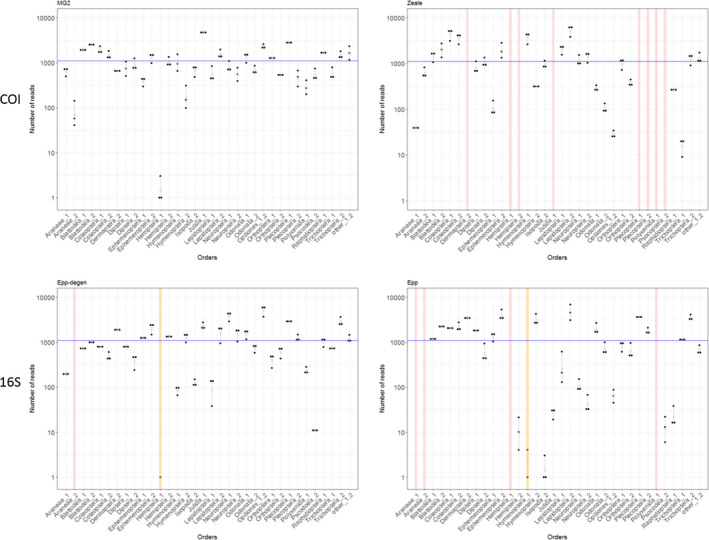
During the most recent decade, environmental DNA metabarcoding approaches have been both developed and improved to minimize the biological and technical biases in these protocols. However, challenges remain, notably those relating to primer design. In the current study, we comprehensively assessed the performance of ten COI and two 16S primer pairs for eDNA metabarcoding, including novel and previously published primers. We used a combined approach of in silico, in vivo-mock community (33 arthropod taxa from 16 orders), and guano-based analyses to identify primer sets that would maximize arthropod detection and taxonomic identification, successfully identify the predator (bat) species, and minimize the time and financial costs of the experiment. We focused on two insectivorous bat species that live together in mixed colonies: the greater horseshoe bat () and Geoffroy's bat (). We found that primer degeneracy is the main factor that influences arthropod detection in silico and mock community analyses, while amplicon length is critical for the detection of arthropods from degraded DNA samples. Our guano-based results highlight the importance of detecting and identifying both predator and prey, as guano samples can be contaminated by other insectivorous species. Moreover, we demonstrate that amplifying bat DNA does not reduce the primers' capacity to detect arthropods. We therefore recommend the simultaneous identification of predator and prey. Finally, our results suggest that up to one-third of prey occurrences may be unreliable and are probably not of primary interest in diet studies, which may decrease the relevance of combining several primer sets instead of using a single efficient one. In conclusion, this study provides a pragmatic framework for eDNA primer selection with respect to scientific and methodological constraints.
在最近十年中,环境DNA宏条形码技术不断发展和完善,以尽量减少这些方案中的生物学和技术偏差。然而,挑战依然存在,尤其是与引物设计相关的挑战。在本研究中,我们全面评估了用于环境DNA宏条形码分析的10对细胞色素氧化酶亚基I(COI)引物和2对16S引物的性能,包括新型引物和先前已发表的引物。我们采用了计算机模拟、体内模拟群落(来自16个目的33种节肢动物分类群)和基于鸟粪的分析相结合的方法,以确定能够最大限度地检测节肢动物并进行分类鉴定、成功识别捕食者(蝙蝠)物种,同时将实验的时间和财务成本降至最低的引物组。我们重点研究了两种共同生活在混合群体中的食虫蝙蝠物种:大马蹄蝠()和 Geoffroy's 蝙蝠()。我们发现引物简并性是在计算机模拟和模拟群落分析中影响节肢动物检测的主要因素,而扩增子长度对于从降解的DNA样本中检测节肢动物至关重要。我们基于鸟粪的结果突出了检测和识别捕食者与猎物的重要性,因为鸟粪样本可能会被其他食虫物种污染。此外,我们证明扩增蝙蝠DNA不会降低引物检测节肢动物的能力。因此,我们建议同时识别捕食者和猎物。最后,我们的结果表明,多达三分之一的猎物出现情况可能不可靠,可能在饮食研究中并非主要关注点,这可能会降低组合使用多种引物组而非单一高效引物组的相关性。总之,本研究为在科学和方法学限制下的环境DNA引物选择提供了一个实用框架。