Department of Clinical Sciences, Umeå University, 901 85, Umeå, Sweden.
Department of Clinical Sciences, Karolinska Institutet Danderyd Hospital, Stockholm, Sweden.
Fluids Barriers CNS. 2020 Jul 29;17(1):49. doi: 10.1186/s12987-020-00205-4.
The relationship between proteins in different CNS extracellular compartments is unknown. In this study the levels of selected proteins in three compartments in people with progressive multiple sclerosis (PMS) were compared.
During an open label, phase 1b study on intraventricular administration of rituximab for PMS, samples were collected from the interstitial space (ISS) of the brain through microdialysis. Samples were also obtained from ventricular and lumbar cerebrospinal fluid (CSF). These samples were analyzed with a multiplexed proximity extension assay, measuring the levels of 180 proteins split equally between two panels, detecting proteins associated with immunology and neurology, respectively.
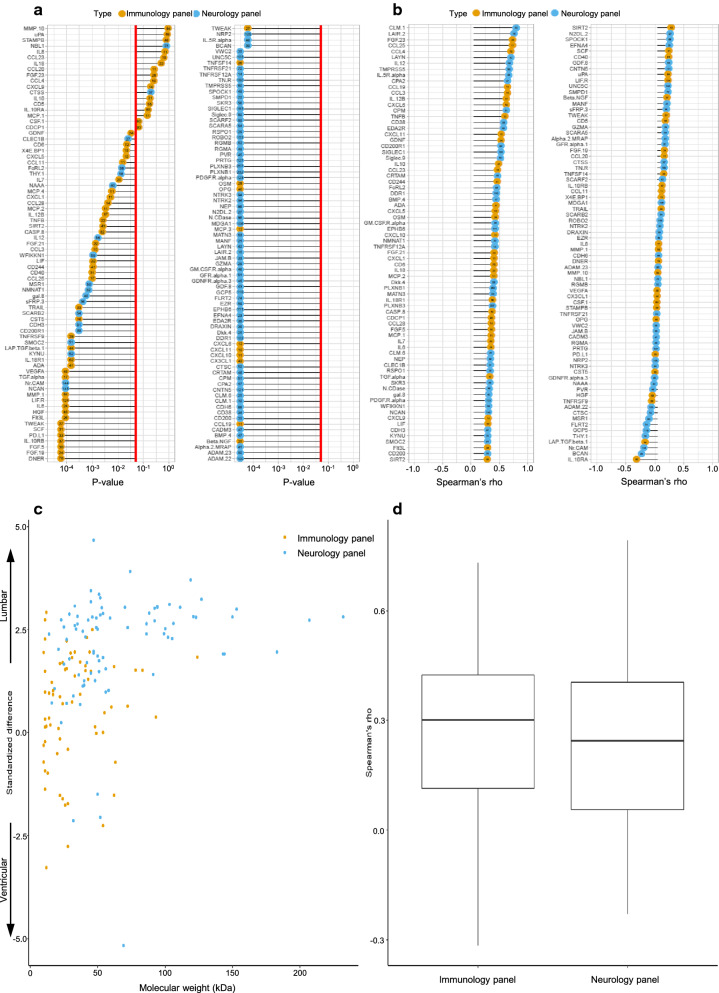
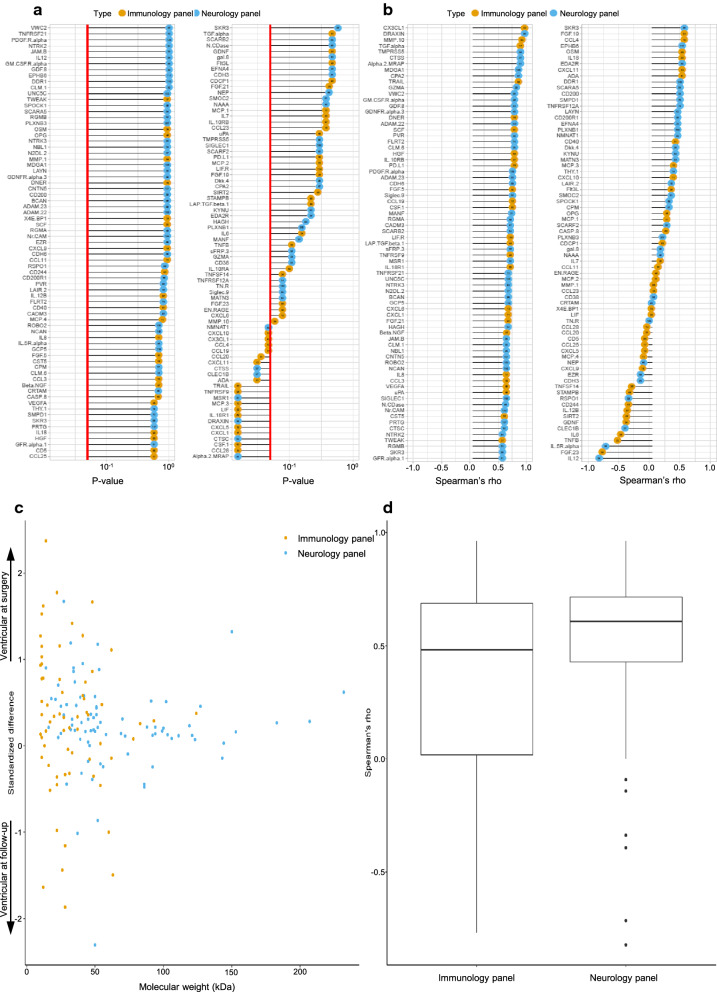
Considerable differences in concentrations were observed between the three analyzed compartments. Compared to ventricular CSF, ISS fluid contained statistically significant higher levels of 25 proteins (84% immunology panel and 16% neurology panel). Ventricular CSF contained significantly higher levels of 54 proteins (31% immunology panel and 69% neurology panel) compared to ISS fluid, and 17 proteins (76% immunology panel and 24% neurology panel) compared to lumbar CSF. Lumbar CSF showed significantly higher levels of 115 proteins (32% immunology panel and 68% neurology panel) compared to ventricular CSF. The three compartments displayed poor correlation with a median Spearman's rho of -0.1 (IQR 0.4) between ISS and ventricular CSF and 0.3 (IQR 0.4) between ventricular and lumbar CSF.
A substantial heterogeneity in the protein levels of samples obtained from different CNS compartments was seen. Therefore, data obtained from analysis of lumbar CSF should be interpreted with caution when making conclusions about pathophysiological processes in brain tissue.
不同中枢神经系统细胞外隔室中蛋白质之间的关系尚不清楚。在本研究中,比较了进展性多发性硬化症(PMS)患者三个隔室中选定蛋白质的水平。
在一项针对 PMS 患者脑室内给予利妥昔单抗的开放性、1b 期研究中,通过微透析从脑间质空间(ISS)采集样本。还从脑室和腰脊髓液(CSF)中采集样本。这些样本使用多重邻近延伸分析进行分析,该分析测量了 180 种蛋白质的水平,这些蛋白质平均分布在两个面板中,分别检测与免疫学和神经病学相关的蛋白质。
在所分析的三个隔室之间观察到浓度存在相当大的差异。与脑室 CSF 相比,ISS 液中含有统计学上显著更高水平的 25 种蛋白质(免疫学面板 84%,神经病学面板 16%)。与 ISS 液相比,脑室 CSF 中含有统计学上更高水平的 54 种蛋白质(免疫学面板 31%,神经病学面板 69%),与腰 CSF 相比,含有 17 种蛋白质(免疫学面板 76%,神经病学面板 24%)。与脑室 CSF 相比,腰 CSF 显示统计学上更高水平的 115 种蛋白质(免疫学面板 32%,神经病学面板 68%)。三个隔室之间相关性较差,ISS 和脑室 CSF 之间的中位数 Spearman's rho 为-0.1(IQR 0.4),脑室和腰 CSF 之间为 0.3(IQR 0.4)。
从不同中枢神经系统隔室获得的样本中蛋白质水平存在显著异质性。因此,在得出关于脑组织病理生理过程的结论时,应谨慎解释从腰 CSF 分析中获得的数据。