• 文献检索
  • 文档翻译
  • 深度研究
  • 学术资讯
  • Suppr Zotero 插件Zotero 插件
  • 邀请有礼
  • 套餐&价格
  • 历史记录
应用&插件
Suppr Zotero 插件Zotero 插件浏览器插件Mac 客户端Windows 客户端微信小程序
定价
高级版会员购买积分包购买API积分包
服务
文献检索文档翻译深度研究API 文档MCP 服务
关于我们
关于 Suppr公司介绍联系我们用户协议隐私条款
关注我们

Suppr 超能文献

核心技术专利:CN118964589B侵权必究
粤ICP备2023148730 号-1Suppr @ 2026

文献检索

告别复杂PubMed语法,用中文像聊天一样搜索,搜遍4000万医学文献。AI智能推荐,让科研检索更轻松。

立即免费搜索

文件翻译

保留排版,准确专业,支持PDF/Word/PPT等文件格式,支持 12+语言互译。

免费翻译文档

深度研究

AI帮你快速写综述,25分钟生成高质量综述,智能提取关键信息,辅助科研写作。

立即免费体验

与腰椎减压术后棘突间固定相比,板间稳定提供了更大的生物力学优势:有限元分析。

Interlaminar stabilization offers greater biomechanical advantage compared to interspinous stabilization after lumbar decompression: a finite element analysis.

机构信息

Department of Neurosurgery, Brigham and Women's Hospital, Harvard Medical School, 60 Fenwood Rd, BTM 4th floor, Boston, MA, 02115, USA.

Department of Orthopedics, Xi'an Jiaotong University Second Affiliated Hospital, Xi'an, China.

出版信息

J Orthop Surg Res. 2020 Jul 29;15(1):291. doi: 10.1186/s13018-020-01812-5.

DOI:10.1186/s13018-020-01812-5
PMID:32727615
原文链接:https://pmc.ncbi.nlm.nih.gov/articles/PMC7392677/
Abstract

BACKGROUND

Interlaminar stabilization and interspinous stabilization are two newer minimally invasive methods for lumbar spine stabilization, used frequently in conjunction with lumbar decompression to treat lumbar stenosis. The two methods share certain similarities, therefore, frequently being categorized together. However, the two methods offer distinct biomechanical properties, which affect their respective effectiveness and surgical success.

OBJECTIVE

To compare the biomechanical characteristics of interlaminar stabilization after lumbar decompression (ILS) and interspinous stabilization after lumbar decompression (ISS). For comparison, lumbar decompression alone (DA) and decompression with instrumented fusion (DF) were also included in the biomechanical analysis.

METHODS

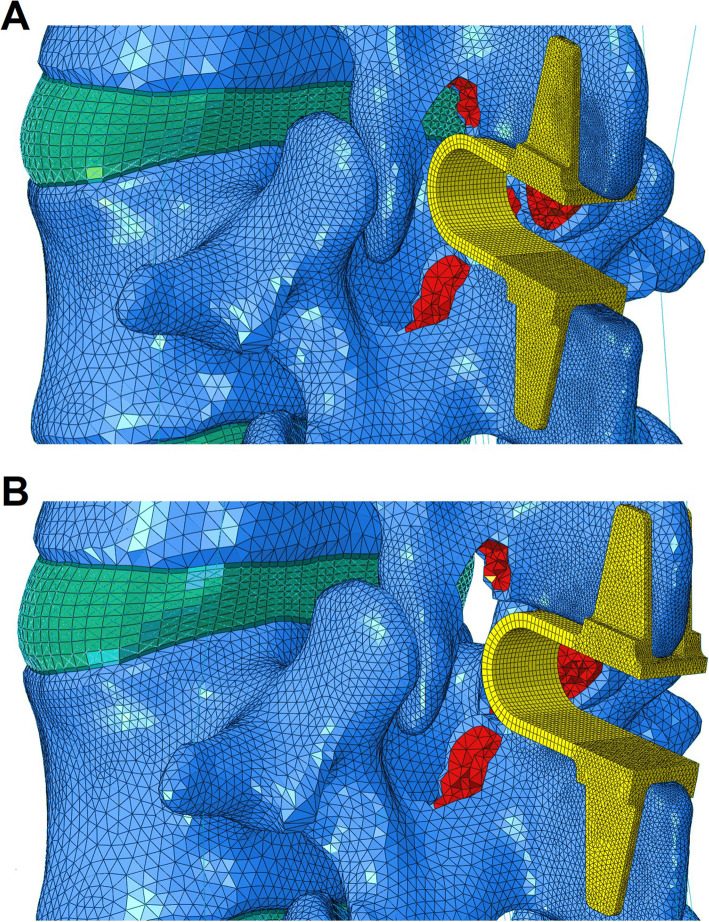
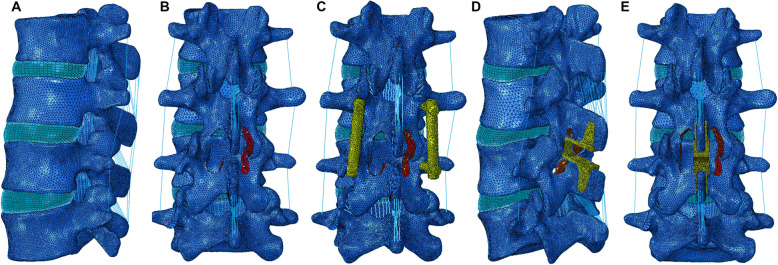
Four finite element models were constructed, i.e., DA, DF, ISS, and ILS. To minimize device influence and focus on the biomechanical properties of different methods, Coflex device as a model system was placed at different position for the comparison of ISS and ILS. The range of motion (ROM) and disc stress peak at the surgical and adjacent levels were compared among the four surgical constructs. The stress peak of the spinous process, whole device, and device wing was compared between ISS and ILS.

RESULTS

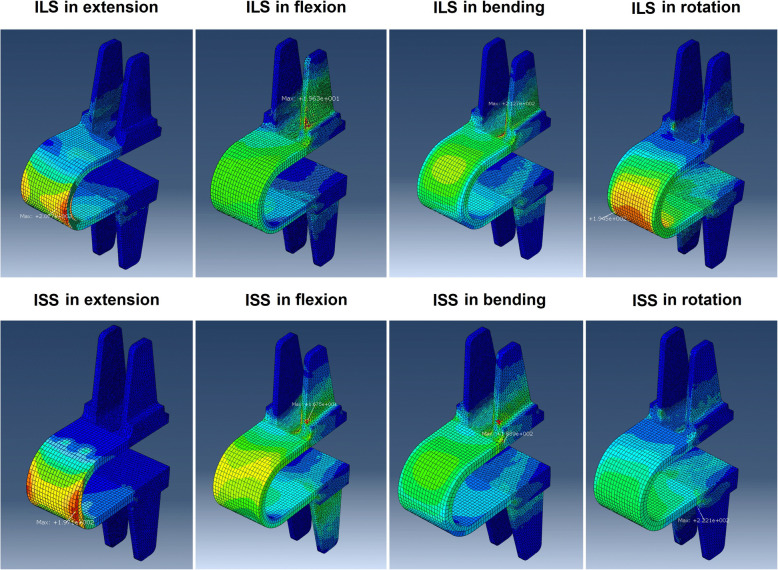
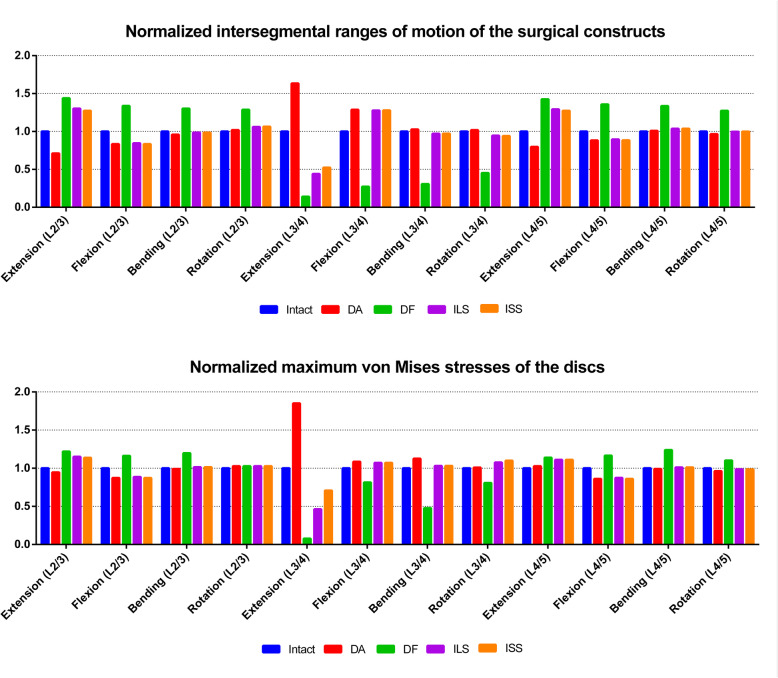
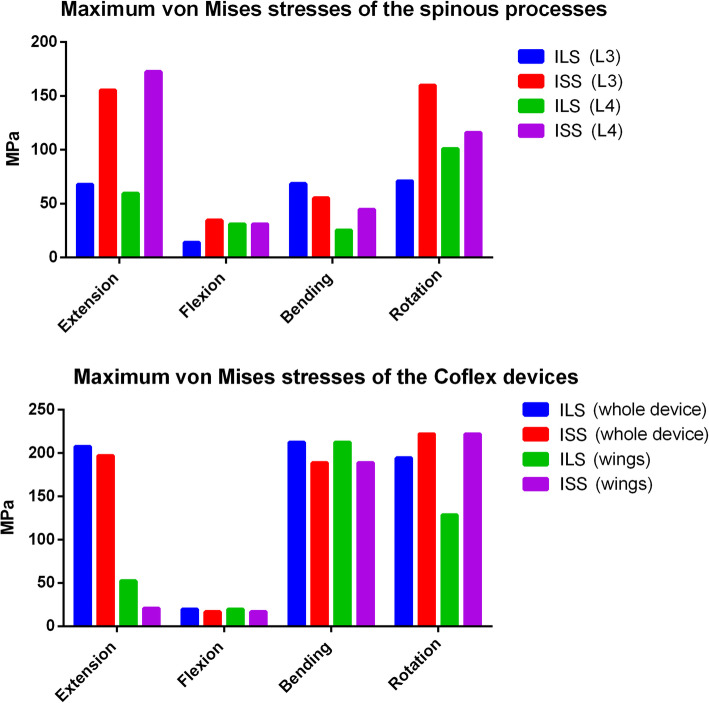
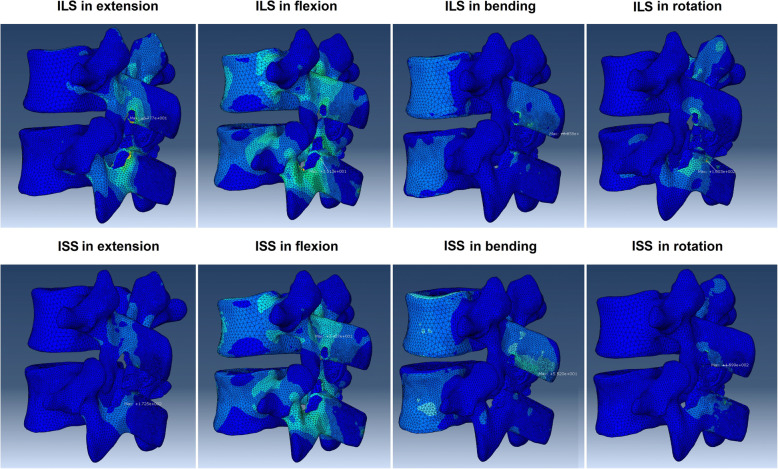
Compared with DA, the ROM and disc stress at the surgical level in ILS or ISS were much lower in extension. The ROM and disc stress at the surgical level in ILS were 1.27° and 0.36 MPa, respectively, and in ISS 1.51°and 0.55 MPa, respectively in extension. This is compared with 4.71° and 1.44 MPa, respectively in DA. ILS (2.06-4.85° and 0.37-0.98 MPa, respectively) or ISS (2.07-4.78° and 0.37-0.98 MPa, respectively) also induced much lower ROM and disc stress at the adjacent levels compared with DF (2.50-7.20° and 0.37-1.20 MPa, respectively). ILS further reduced the ROM and disc stress at the surgical level by 8% and 25%, respectively, compared to ISS. The stress peak of the spinous process in ILS was significantly lower than that in ISS (13.93-101 MPa vs. 31.08-172.5 MPa). In rotation, ILS yielded a much lower stress peak in the instrumentation wing than ISS (128.7 MPa vs. 222.1 MPa).

CONCLUSION

ILS and ISS partly address the issues of segmental instability in DA and hypermobility and overload at the adjacent levels in DF. ILS achieves greater segmental stability and results in a lower disc stress, compared to ISS. In addition, ILS reduces the risk of spinous process fracture and device failure.

摘要

背景

层间稳定和棘突间稳定是两种用于腰椎稳定的新型微创方法,常用于与腰椎减压联合治疗腰椎狭窄症。这两种方法有一定的相似之处,因此经常被归为一类。然而,这两种方法提供了不同的生物力学特性,这影响了它们各自的有效性和手术成功率。

目的

比较腰椎减压后层间稳定(ILS)和腰椎减压后棘突间稳定(ISS)的生物力学特性。为了进行比较,腰椎减压单纯(DA)和减压融合(DF)也被包括在生物力学分析中。

方法

构建了四个有限元模型,即 DA、DF、ISS 和 ILS。为了最小化器械的影响并关注不同方法的生物力学特性,将 Coflex 器械作为模型系统放置在不同的位置,以比较 ISS 和 ILS。比较了四种手术结构在手术和相邻节段的活动范围(ROM)和椎间盘应力峰值。比较了 ISS 和 ILS 棘突、整个器械和器械翼的应力峰值。

结果

与 DA 相比,ILS 或 ISS 在伸展时的 ROM 和手术节段的椎间盘应力要低得多。ILS 的 ROM 和手术节段的椎间盘应力分别为 1.27°和 0.36 MPa,ISS 分别为 1.51°和 0.55 MPa。与 DA 的 4.71°和 1.44 MPa 相比。ILS(分别为 2.06-4.85°和 0.37-0.98 MPa)或 ISS(分别为 2.07-4.78°和 0.37-0.98 MPa)在相邻节段也引起了比 DF(分别为 2.50-7.20°和 0.37-1.20 MPa)更低的 ROM 和椎间盘应力。与 ISS 相比,ILS 进一步降低了手术节段的 ROM 和椎间盘应力分别为 8%和 25%。与 ISS 相比,ILS 的棘突应力峰值明显较低(13.93-101 MPa 与 31.08-172.5 MPa)。在旋转中,ILS 在器械翼上产生的应力峰值明显低于 ISS(128.7 MPa 与 222.1 MPa)。

结论

ILS 和 ISS 部分解决了 DA 中节段不稳定和 DF 中相邻节段过度活动和过载的问题。与 ISS 相比,ILS 实现了更大的节段稳定性,并导致椎间盘应力更低。此外,ILS 降低了棘突骨折和器械失效的风险。
https://cdn.ncbi.nlm.nih.gov/pmc/blobs/b985/7392677/df28208ec71b/13018_2020_1812_Fig7_HTML.jpg
https://cdn.ncbi.nlm.nih.gov/pmc/blobs/b985/7392677/58c6b519bcd2/13018_2020_1812_Fig1_HTML.jpg
https://cdn.ncbi.nlm.nih.gov/pmc/blobs/b985/7392677/eb8e4dc7799e/13018_2020_1812_Fig2_HTML.jpg
https://cdn.ncbi.nlm.nih.gov/pmc/blobs/b985/7392677/d7b29856099b/13018_2020_1812_Fig3_HTML.jpg
https://cdn.ncbi.nlm.nih.gov/pmc/blobs/b985/7392677/071bdd6c35d6/13018_2020_1812_Fig4_HTML.jpg
https://cdn.ncbi.nlm.nih.gov/pmc/blobs/b985/7392677/cfde0c1a9c47/13018_2020_1812_Fig5_HTML.jpg
https://cdn.ncbi.nlm.nih.gov/pmc/blobs/b985/7392677/041e03e47246/13018_2020_1812_Fig6_HTML.jpg
https://cdn.ncbi.nlm.nih.gov/pmc/blobs/b985/7392677/df28208ec71b/13018_2020_1812_Fig7_HTML.jpg
https://cdn.ncbi.nlm.nih.gov/pmc/blobs/b985/7392677/58c6b519bcd2/13018_2020_1812_Fig1_HTML.jpg
https://cdn.ncbi.nlm.nih.gov/pmc/blobs/b985/7392677/eb8e4dc7799e/13018_2020_1812_Fig2_HTML.jpg
https://cdn.ncbi.nlm.nih.gov/pmc/blobs/b985/7392677/d7b29856099b/13018_2020_1812_Fig3_HTML.jpg
https://cdn.ncbi.nlm.nih.gov/pmc/blobs/b985/7392677/071bdd6c35d6/13018_2020_1812_Fig4_HTML.jpg
https://cdn.ncbi.nlm.nih.gov/pmc/blobs/b985/7392677/cfde0c1a9c47/13018_2020_1812_Fig5_HTML.jpg
https://cdn.ncbi.nlm.nih.gov/pmc/blobs/b985/7392677/041e03e47246/13018_2020_1812_Fig6_HTML.jpg
https://cdn.ncbi.nlm.nih.gov/pmc/blobs/b985/7392677/df28208ec71b/13018_2020_1812_Fig7_HTML.jpg

相似文献

1
Interlaminar stabilization offers greater biomechanical advantage compared to interspinous stabilization after lumbar decompression: a finite element analysis.与腰椎减压术后棘突间固定相比,板间稳定提供了更大的生物力学优势:有限元分析。
J Orthop Surg Res. 2020 Jul 29;15(1):291. doi: 10.1186/s13018-020-01812-5.
2
Biomechanical comparison of an interspinous device and a rigid stabilization on lumbar adjacent segment range of motion.棘突间装置与刚性固定对腰椎相邻节段活动度影响的生物力学比较
Acta Chir Orthop Traumatol Cech. 2011;78(5):404-9.
3
Prospective, randomized, multicenter study with 2-year follow-up to compare the performance of decompression with and without interlaminar stabilization.一项前瞻性、随机、多中心研究,随访2年,比较有无椎板间稳定化减压的效果。
J Neurosurg Spine. 2018 Apr;28(4):406-415. doi: 10.3171/2017.11.SPINE17643. Epub 2018 Jan 26.
4
Biomechanical comparison of different interspinous process devices in the treatment of lumbar spinal stenosis: a finite element analysis.不同棘突间装置治疗腰椎管狭窄症的生物力学比较:有限元分析。
BMC Musculoskelet Disord. 2022 Jun 17;23(1):585. doi: 10.1186/s12891-022-05543-y.
5
Effect of different designs of interspinous process devices on the instrumented and adjacent levels after double-level lumbar decompression surgery: A finite element analysis.双节段腰椎减压术后不同棘突间装置设计对节段内和相邻节段的影响:有限元分析。
PLoS One. 2020 Dec 30;15(12):e0244571. doi: 10.1371/journal.pone.0244571. eCollection 2020.
6
Biomechanical characteristics of a novel interspinous distraction fusion device in the treatment of lumbar degenerative diseases: a finite element analysis.新型棘突间撑开融合装置治疗腰椎退变性疾病的生物力学特性:有限元分析。
BMC Musculoskelet Disord. 2023 Dec 6;24(1):944. doi: 10.1186/s12891-023-07066-6.
7
Biomechanical investigation of a customized interspinous spacer system in the treatment of degenerative disc diseases: A finite element analysis.生物力学研究定制型棘突间撑开装置治疗退行性椎间盘疾病:有限元分析。
Clin Biomech (Bristol). 2024 Jun;116:106270. doi: 10.1016/j.clinbiomech.2024.106270. Epub 2024 May 18.
8
Three-Year Follow-up of the Prospective, Randomized, Controlled Trial of Coflex Interlaminar Stabilization vs Instrumented Fusion in Patients With Lumbar Stenosis.腰椎管狭窄症患者中Coflex椎间稳定术与器械辅助融合术的前瞻性、随机、对照试验的三年随访
Neurosurgery. 2016 Aug;79(2):169-81. doi: 10.1227/NEU.0000000000001237.
9
Biomechanical effect of bone resorption of the spinous process after single-segment interspinous dynamic stabilization device implantation: A finite element analysis.单节段棘突间动态稳定装置植入后棘突骨吸收的生物力学效应:有限元分析
Medicine (Baltimore). 2018 Jul;97(27):e11140. doi: 10.1097/MD.0000000000011140.
10
Biomechanical feasibility of semi-rigid stabilization and semi-rigid lumbar interbody fusion: a finite element study.半刚性稳定与半刚性腰椎体间融合的生物力学可行性:有限元研究。
BMC Musculoskelet Disord. 2022 Jan 3;23(1):10. doi: 10.1186/s12891-021-04958-3.

引用本文的文献

1
Quantitative relationships between elastic modulus of rod and biomechanical properties of transforaminal lumbar interbody fusion: a finite element analysis.椎间融合器弹性模量与经椎间孔腰椎椎间融合生物力学特性的定量关系:有限元分析
Front Bioeng Biotechnol. 2025 Jan 7;12:1510597. doi: 10.3389/fbioe.2024.1510597. eCollection 2024.
2
Five-year radiological outcomes between decompression alone and decompression with an interlaminar device for lumbar spinal stenosis.单纯减压与使用椎间融合器减压治疗腰椎管狭窄症的五年影像学结果。
J Spine Surg. 2024 Sep 23;10(3):488-500. doi: 10.21037/jss-24-33. Epub 2024 Sep 9.
3

本文引用的文献

1
Biomechanical Analysis of Different Lumbar Interspinous Process Devices: A Finite Element Study.不同腰椎棘突间装置的生物力学分析:一项有限元研究。
World Neurosurg. 2019 Jul;127:e1112-e1119. doi: 10.1016/j.wneu.2019.04.051. Epub 2019 Apr 10.
2
A 3-Dimensional Finite Element Analysis of Adjacent Segment Disk Degeneration Induced by Transforaminal Lumbar Interbody Fusion After Pedicle Screw Fixation.椎弓根螺钉固定后经椎间孔腰椎椎间融合术致相邻节段椎间盘退变的三维有限元分析
World Neurosurg. 2019 Apr;124:e51-e57. doi: 10.1016/j.wneu.2018.11.195. Epub 2018 Nov 29.
3
Wallis Interspinous Spacer for Treatment of Primary Lumbar Disc Herniation: Three-Year Results of a Randomized Controlled Trial.
Biomechanical comparison of polyetheretherketone rods and titanium alloy rods in transforaminal lumbar interbody fusion: a finite element analysis.
聚醚醚酮棒与钛合金棒在经椎间孔腰椎体间融合中的生物力学比较:有限元分析。
BMC Surg. 2024 May 29;24(1):169. doi: 10.1186/s12893-024-02462-8.
4
Determining a relative total lumbar range of motion to alleviate adjacent segment degeneration after transforaminal lumbar interbody fusion: a finite element analysis.确定相对总腰椎活动度以减轻经椎间孔腰椎体间融合术后相邻节段退变:有限元分析。
BMC Musculoskelet Disord. 2024 Mar 5;25(1):197. doi: 10.1186/s12891-024-07322-3.
5
Biomechanical characteristics of a novel interspinous distraction fusion device in the treatment of lumbar degenerative diseases: a finite element analysis.新型棘突间撑开融合装置治疗腰椎退变性疾病的生物力学特性:有限元分析。
BMC Musculoskelet Disord. 2023 Dec 6;24(1):944. doi: 10.1186/s12891-023-07066-6.
6
Evaluating 5-year outcomes of interlaminar devices as an adjunct to decompression for symptomatic lumbar spinal stenosis.评估作为减压辅助手段的层间装置治疗有症状腰椎椎管狭窄症的 5 年结果。
Eur Spine J. 2023 Apr;32(4):1367-1374. doi: 10.1007/s00586-023-07610-x. Epub 2023 Feb 25.
7
The effect of interlaminar Coflex stabilization in the topping-off procedure on local and global spinal sagittal alignment.Coflex 层间稳定在封顶手术中对局部和整体脊柱矢状位平衡的影响。
BMC Musculoskelet Disord. 2023 Feb 11;24(1):116. doi: 10.1186/s12891-023-06231-1.
8
Biomechanical Analysis of the Reasonable Cervical Range of Motion to Prevent Non-Fusion Segmental Degeneration After Single-Level ACDF.单节段ACDF术后预防非融合节段退变的合理颈椎活动范围的生物力学分析
Front Bioeng Biotechnol. 2022 Jun 16;10:918032. doi: 10.3389/fbioe.2022.918032. eCollection 2022.
9
Disc measurement and nucleus calibration in a smoothened lumbar model increases the accuracy and efficiency of in-silico study.在平滑的腰椎模型中进行椎间盘测量和核校准可提高计算机研究的准确性和效率。
J Orthop Surg Res. 2021 Aug 13;16(1):498. doi: 10.1186/s13018-021-02655-4.
10
Biomechanical finite element analysis of vertebral column resection and posterior unilateral vertebral resection and reconstruction osteotomy.脊柱切除术及后路单侧椎体切除与重建截骨术的生物力学有限元分析
J Orthop Surg Res. 2021 Jan 28;16(1):88. doi: 10.1186/s13018-021-02237-4.
用于治疗原发性腰椎间盘突出症的Wallis棘突间撑开器:一项随机对照试验的三年结果
World Neurosurg. 2018 Dec;120:e1331-e1336. doi: 10.1016/j.wneu.2018.09.086. Epub 2018 Sep 24.
4
Comparative effectiveness and safety of posterior lumbar interbody fusion, Coflex, Wallis, and X-stop for lumbar degenerative diseases: A systematic review and network meta-analysis.后路腰椎椎间融合术、Coflex、Wallis和X-stop治疗腰椎退行性疾病的比较有效性和安全性:一项系统评价和网状Meta分析
Clin Neurol Neurosurg. 2018 Sep;172:74-81. doi: 10.1016/j.clineuro.2018.06.030. Epub 2018 Jun 30.
5
Interspinous process devices for treatment of degenerative lumbar spine stenosis: A systematic review and meta-analysis.棘突间装置治疗退行性腰椎管狭窄症:系统评价和荟萃分析。
PLoS One. 2018 Jul 6;13(7):e0199623. doi: 10.1371/journal.pone.0199623. eCollection 2018.
6
Biomechanical Analysis of Lateral Lumbar Interbody Fusion Constructs with Various Fixation Options: Based on a Validated Finite Element Model.基于验证有限元模型的不同固定方式下腰椎外侧椎间融合结构的生物力学分析
World Neurosurg. 2018 Jun;114:e1120-e1129. doi: 10.1016/j.wneu.2018.03.158. Epub 2018 Mar 31.
7
Effect of Lumbar Lordosis on the Adjacent Segment in Transforaminal Lumbar Interbody Fusion: A Finite Element Analysis.腰椎前凸对经椎间孔腰椎椎间融合术相邻节段的影响:有限元分析
World Neurosurg. 2018 Jun;114:e114-e120. doi: 10.1016/j.wneu.2018.02.073. Epub 2018 Feb 21.
8
Prospective, randomized, multicenter study with 2-year follow-up to compare the performance of decompression with and without interlaminar stabilization.一项前瞻性、随机、多中心研究,随访2年,比较有无椎板间稳定化减压的效果。
J Neurosurg Spine. 2018 Apr;28(4):406-415. doi: 10.3171/2017.11.SPINE17643. Epub 2018 Jan 26.
9
Biomechanical evaluation of a novel pedicle screw-based interspinous spacer: A finite element analysis.一种新型椎弓根螺钉式棘突间撑开器的生物力学评估:有限元分析
Med Eng Phys. 2017 Aug;46:27-32. doi: 10.1016/j.medengphy.2017.05.004. Epub 2017 Jun 15.
10
Interspinous implants: are the new implants better than the last generation? A review.棘突间植入物:新一代植入物是否优于上一代?一篇综述。
Curr Rev Musculoskelet Med. 2017 Jun;10(2):189-198. doi: 10.1007/s12178-017-9401-z.