Cooke María Victoria, Chans Guillermo M, Argüello Gustavo A, Peláez Walter José
INFIQC-CONICET-Dpto. de Fisicoquímica, Facultad de Ciencias Químicas, Universidad Nacional de Córdoba, Ciudad Universitaria, Córdoba, X5000HUA, Argentina.
Tecnologico de Monterrey, Escuela de Ingeniería y Ciencias, Av. Carlos Lazo 100, Mexico City, 01389, México.
Heliyon. 2020 Jul 22;6(7):e04457. doi: 10.1016/j.heliyon.2020.e04457. eCollection 2020 Jul.
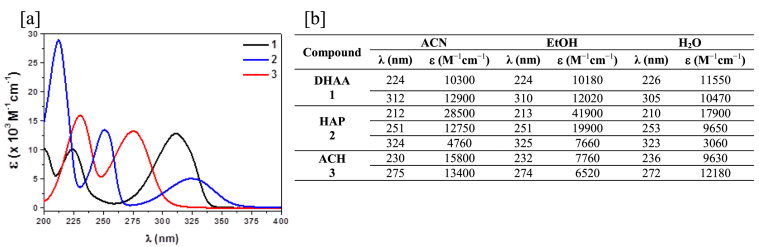
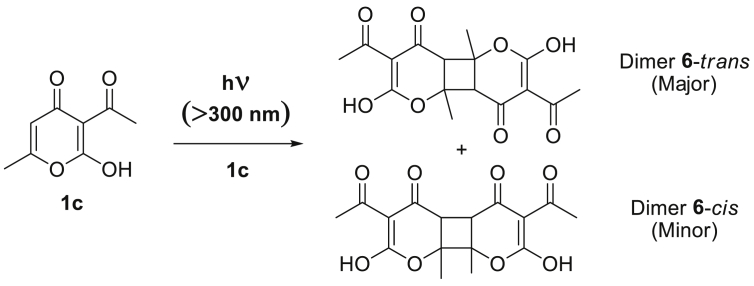
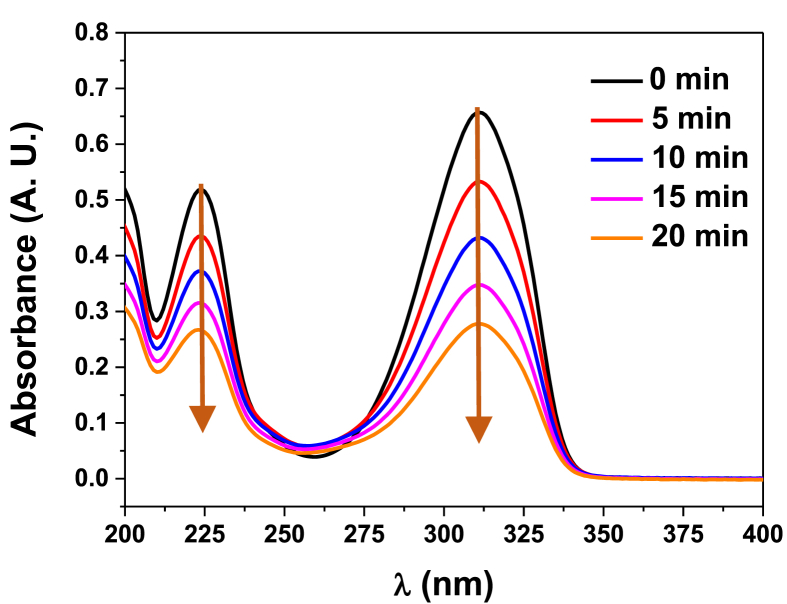
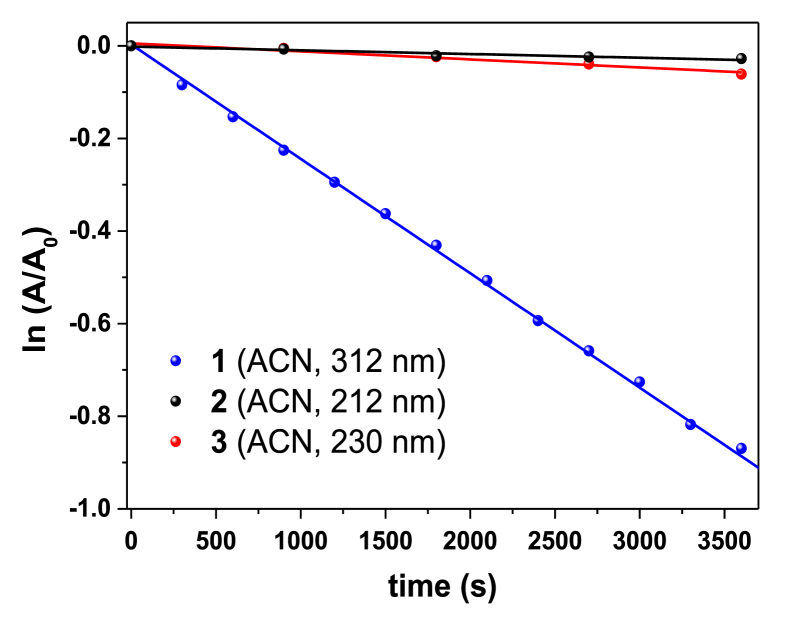
The purpose of this work was to determine the tautomerism, the conformational analysis and photoreactivity of dehydroacetic acid (DHAA, ). For that reason, the photolysis of DHAA () was performed at 254 nm and compared with two structurally similar compounds: 2-hydroxyacetophenone (HAP, ) and 2-acetyl-1,3-cyclohexanodione (ACH, ). We confirmed the degradation of to acetic acid and we propose a mechanism on the assumption that a [2+2] cyclodimerization occurs (after UV light absorption) followed by some consecutive Norrish Type I cleavages, affording ketenes that end-up in acetic acid. The UV absorption study was conducted for all three compounds to gain insight about their electronic transitions, both experimentally and with computational simulations using TDDFT (B3LYP/6-31+G(d,p)) methods. A detailed analysis of the different tautomers and isomers that can be present in solution and the MOs involved in the electronic transitions was also achieved. The HOMO→LUMO transition was the least energetic optically active transition for and , whereas was recognized to have a HOMO-1→LUMO transition. These transitions were all of n→π character.
这项工作的目的是确定脱氢乙酸(DHAA)的互变异构、构象分析和光反应活性。因此,在254nm波长下对DHAA进行了光解,并与两种结构相似的化合物进行了比较:2-羟基苯乙酮(HAP)和2-乙酰基-1,3-环己二酮(ACH)。我们证实了其降解为乙酸,并提出了一种机制,假定(在吸收紫外光后)发生[2+2]环二聚反应,随后进行一些连续的Norrish I型裂解,生成最终转化为乙酸的烯酮。对所有三种化合物进行了紫外吸收研究,通过实验以及使用TDDFT(B3LYP/6-31+G(d,p))方法的计算模拟,以深入了解它们的电子跃迁。还对溶液中可能存在的不同互变异构体和异构体以及电子跃迁中涉及的分子轨道进行了详细分析。对于DHAA和ACH,HOMO→LUMO跃迁是能量最低的光学活性跃迁,而HAP被认为具有HOMO-1→LUMO跃迁。这些跃迁均为n→π性质。