Bristol Medical School, Translational Health Sciences, University of Bristol, Upper Maudlin Street, Bristol, BS2 8HW, UK.
School of Biochemistry, University of Bristol, University Walk, Bristol, BS8 1TD, UK.
Diabetologia. 2020 Oct;63(10):2205-2217. doi: 10.1007/s00125-020-05230-4. Epub 2020 Jul 30.
AIMS/HYPOTHESIS: Treatment of vascular complications of diabetes remains inadequate. We reported that muscle pericytes (MPs) from limb muscles of vascular patients with diabetes mellitus display elevated levels of oxidative stress causing a dysfunctional phenotype. Here, we investigated whether treatment with dimethyl-2-oxoglutarate (DM-2OG), a tricarboxylic acid cycle metabolite with antioxidant properties, can restore a healthy metabolic and functional phenotype.
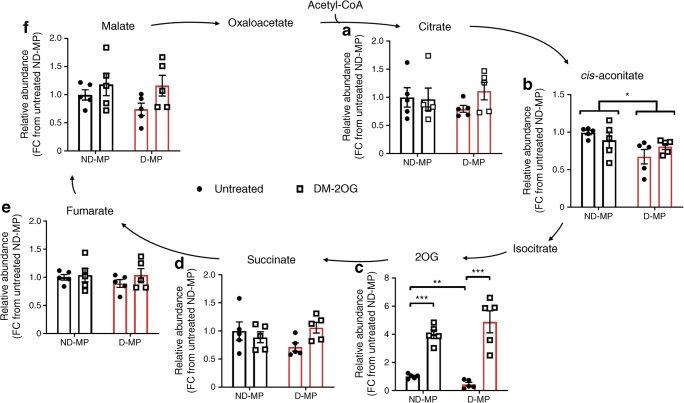
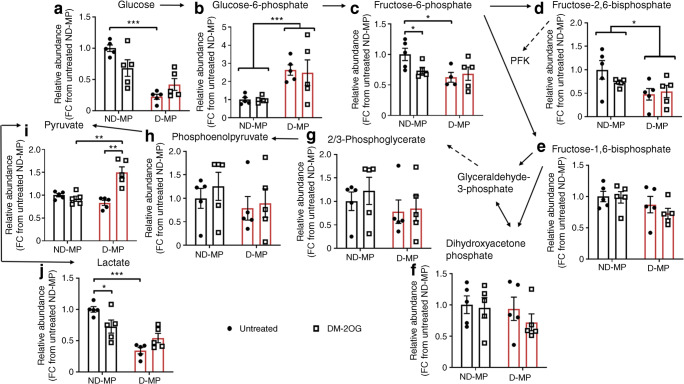
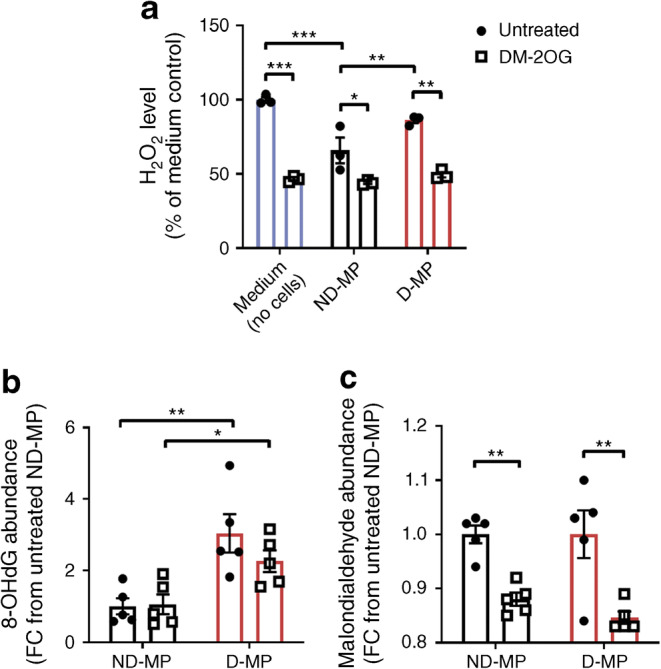
MPs were isolated from limb muscles of diabetes patients with vascular disease (D-MPs) and from non-diabetic control participants (ND-MPs). Metabolic status was assessed in untreated and DM-2OG-treated (1 mmol/l) cells using an extracellular flux analyser and anion-exchange chromatography-mass spectrometry (IC-MS/MS). Redox status was measured using commercial kits and IC-MS/MS, with antioxidant and metabolic enzyme expression assessed by quantitative RT-PCR and western blotting. Myogenic differentiation and proliferation and pericyte-endothelial interaction were assessed as functional readouts.
D-MPs showed mitochondrial dysfunction, suppressed glycolytic activity and reduced reactive oxygen species-buffering capacity, but no suppression of antioxidant systems when compared with ND-MP controls. DM-2OG supplementation improved redox balance and mitochondrial function, without affecting glycolysis or antioxidant systems. Nonetheless, this was not enough for treated D-MPs to regain the level of proliferation and myogenic differentiation of ND-MPs. Interestingly, DM-2OG exerted a positive effect on pericyte-endothelial cell interaction in the co-culture angiogenesis assay, independent of the diabetic status.
CONCLUSIONS/INTERPRETATION: These novel findings support the concept of using DM-2OG supplementation to improve pericyte redox balance and mitochondrial function, while concurrently allowing for enhanced pericyte-endothelial crosstalk. Such effects may help to prevent or slow down vasculopathy in skeletal muscles of people with diabetes. Graphical abstract.
目的/假设:糖尿病的血管并发症的治疗仍然不足。我们报道过,来自糖尿病血管病患者四肢肌肉的肌周细胞(MPs)表现出高水平的氧化应激,导致功能失调表型。在这里,我们研究了二甲-2-氧代戊二酸(DM-2OG),一种具有抗氧化特性的三羧酸循环代谢物,是否可以恢复健康的代谢和功能表型。
从糖尿病血管病患者(D-MPs)和非糖尿病对照参与者(ND-MPs)的四肢肌肉中分离 MPs。使用细胞外通量分析仪和阴离子交换色谱-质谱联用(IC-MS/MS),在未经处理和 DM-2OG 处理(1mmol/l)的细胞中评估代谢状态。使用商业试剂盒和 IC-MS/MS 测量氧化还原状态,通过定量 RT-PCR 和 Western 印迹评估抗氧化和代谢酶的表达。肌生成分化和增殖以及周细胞-内皮细胞相互作用被评估为功能读数。
与 ND-MP 对照相比,D-MPs 表现出线粒体功能障碍、抑制糖酵解活性和降低活性氧物质缓冲能力,但抗氧化系统没有受到抑制。DM-2OG 补充改善了氧化还原平衡和线粒体功能,而不影响糖酵解或抗氧化系统。尽管如此,这还不足以使治疗后的 D-MPs 恢复到 ND-MPs 的增殖和肌生成分化水平。有趣的是,DM-2OG 在共培养血管生成实验中对周细胞-内皮细胞相互作用产生了积极影响,而与糖尿病状态无关。
结论/解释:这些新发现支持使用 DM-2OG 补充来改善周细胞的氧化还原平衡和线粒体功能,同时允许增强周细胞-内皮细胞的串扰的概念。这些影响可能有助于预防或减缓糖尿病患者骨骼肌的血管病变。