Department of Malignant Hematology, H. Lee Moffitt Cancer Center and Research Institute, Tampa, FL.
Health Informatics Institute, University of South Florida, Tampa, FL.
Blood. 2020 Dec 10;136(24):2812-2823. doi: 10.1182/blood.2020006158.
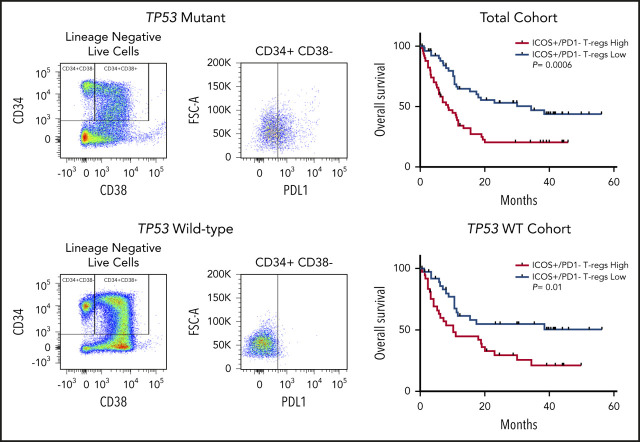
Somatic gene mutations are key determinants of outcome in patients with myelodysplastic syndromes (MDS) and secondary AML (sAML). In particular, patients with TP53 mutations represent a distinct molecular cohort with uniformly poor prognosis. The precise pathogenetic mechanisms underlying these inferior outcomes have not been delineated. In this study, we characterized the immunological features of the malignant clone and alterations in the immune microenvironment in patients with TP53-mutant and wild-type MDS or sAML. Notably, PDL1 expression is significantly increased in hematopoietic stem cells of patients with TP53 mutations, which is associated with MYC upregulation and marked downregulation of MYC's negative regulator miR-34a, a p53 transcription target. Notably, patients with TP53 mutations display significantly reduced numbers of bone marrow-infiltrating OX40+ cytotoxic T cells and helper T cells, as well as decreased ICOS+ and 4-1BB+ natural killer cells. Further, highly immunosuppressive regulatory T cells (Tregs) (ie, ICOShigh/PD-1-) and myeloid-derived suppressor cells (PD-1low) are expanded in cases with TP53 mutations. Finally, a higher proportion of bone marrow-infiltrating ICOShigh/PD-1- Treg cells is a highly significant independent predictor of overall survival. We conclude that the microenvironment of TP53 mutant MDS and sAML has an immune-privileged, evasive phenotype that may be a primary driver of poor outcomes and submit that immunomodulatory therapeutic strategies may offer a benefit for this molecularly defined subpopulation.
体细胞基因突变是骨髓增生异常综合征(MDS)和继发性急性髓系白血病(sAML)患者预后的关键决定因素。特别是,TP53 突变的患者代表了一个具有一致不良预后的独特分子亚群。这些不良结果的确切发病机制尚未阐明。在这项研究中,我们对 TP53 突变和野生型 MDS 或 sAML 患者恶性克隆的免疫学特征和免疫微环境改变进行了特征描述。值得注意的是,TP53 突变患者造血干细胞中 PDL1 的表达显著增加,这与 MYC 的上调和 MYC 的负调节剂 miR-34a 的显著下调相关,miR-34a 是 p53 转录靶标。值得注意的是,TP53 突变患者骨髓浸润的 OX40+细胞毒性 T 细胞和辅助 T 细胞数量明显减少,ICOS+和 4-1BB+自然杀伤细胞也减少。此外,TP53 突变病例中高度免疫抑制性调节性 T 细胞(Treg)(即 ICOShigh/PD-1-)和髓源性抑制细胞(PD-1low)扩增。最后,骨髓浸润的 ICOShigh/PD-1-Treg 细胞比例较高是总生存期的一个高度显著的独立预测因子。我们得出结论,TP53 突变 MDS 和 sAML 的微环境具有免疫特权、逃避表型,这可能是不良结果的主要驱动因素,并提出免疫调节治疗策略可能对这个分子定义的亚群有益。