Devillier Raynier, Mansat-De Mas Véronique, Gelsi-Boyer Veronique, Demur Cecile, Murati Anne, Corre Jill, Prebet Thomas, Bertoli Sarah, Brecqueville Mandy, Arnoulet Christine, Recher Christian, Vey Norbert, Mozziconacci Marie-Joelle, Delabesse Eric, Birnbaum Daniel
Hematology Department, Institut Paoli Calmettes, Marseille, France.
Aix-Marseille University, Marseille, France.
Oncotarget. 2015 Apr 10;6(10):8388-96. doi: 10.18632/oncotarget.3460.
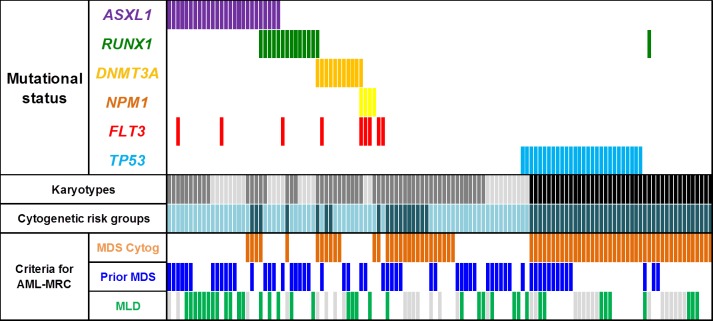
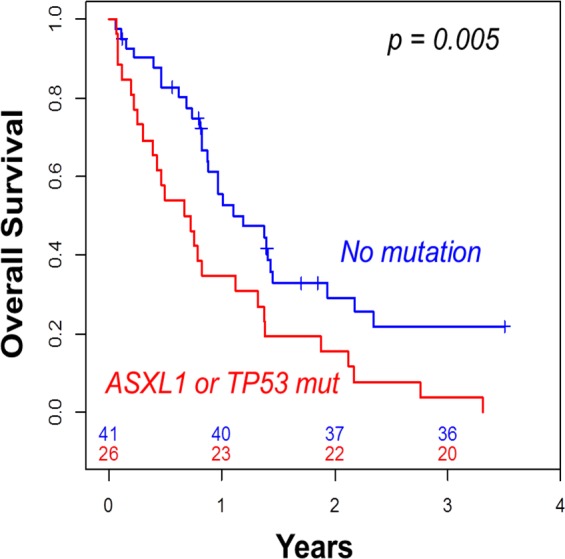
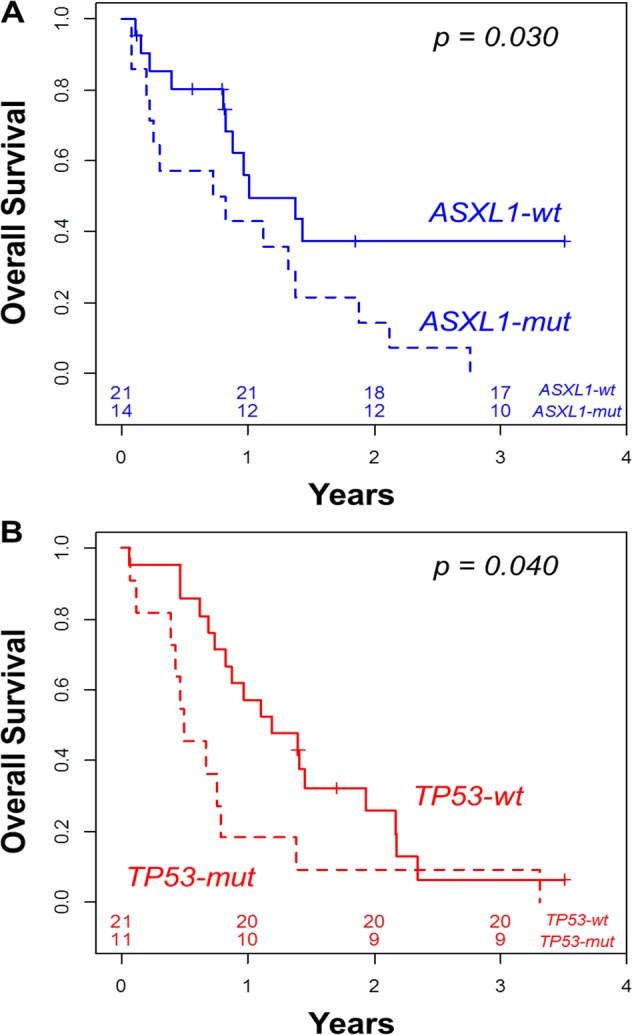
Acute myeloid leukemias (AML) with myelodysplasia-related changes (AML-MRC) are defined by the presence of multilineage dysplasia (MLD), and/or myelodysplastic syndrome (MDS)-related cytogenetics, and/or previous MDS. The goal of this study was to identify distinct biological and prognostic subgroups based on mutations of ASXL1, RUNX1, DNMT3A, NPM1, FLT3 and TP53 in 125 AML-MRC patients according to the presence of MLD, cytogenetics and outcome. ASXL1 mutations (n=26, 21%) were associated with a higher proportion of marrow dysgranulopoiesis (mutant vs. wild-type: 75% vs. 55%, p=0.030) and were mostly found in intermediate cytogenetic AML (23/26) in which they predicted inferior 2-year overall survival (OS, mutant vs. wild-type: 14% vs. 37%, p=0.030). TP53 mutations (n=28, 22%) were mostly found in complex karyotype AML (26/28) and predicted poor outcome within unfavorable cytogenetic risk AML (mutant vs. wild-type: 9% vs. 40%, p=0.040). In multivariate analysis, the presence of either ASXL1 or TP53 mutation was the only independent factor associated with shorter OS (HR, 95%CI: 2.53, 1.40-4.60, p=0.002) while MLD, MDS-related cytogenetics and previous MDS history did not influence OS. We conclude that ASXL1 and TP53 mutations identify two molecular subgroups among AML-MRCs, with specific poor prognosis. This could be useful for future diagnostic and prognostic classifications.
伴有骨髓发育异常相关改变的急性髓系白血病(AML-MRC)是由多系发育异常(MLD)、和/或与骨髓发育异常综合征(MDS)相关的细胞遗传学改变、和/或既往MDS来定义的。本研究的目的是根据125例AML-MRC患者中MLD的存在情况、细胞遗传学改变和预后,基于ASXL1、RUNX1、DNMT3A、NPM1、FLT3和TP53的突变来识别不同的生物学和预后亚组。ASXL1突变(n = 26,21%)与更高比例的骨髓粒系发育异常相关(突变型与野生型:75% 对55%,p = 0.030),且大多见于中等细胞遗传学风险的AML(23/26)中,在这类患者中,ASXL1突变预示2年总生存期较差(OS,突变型与野生型:14% 对37%,p = 0.030)。TP53突变(n = 28,22%)大多见于复杂核型AML(26/28)中,并预示在不良细胞遗传学风险的AML中预后较差(突变型与野生型:9% 对40%,p = 0.040)。在多变量分析中,ASXL1或TP53突变的存在是与较短总生存期相关的唯一独立因素(HR,95%CI:2.53,1.40 - 4.60,p = 0.002),而MLD、与MDS相关的细胞遗传学改变和既往MDS病史并不影响总生存期。我们得出结论,ASXL1和TP53突变在AML-MRC中识别出两个分子亚组,具有特定的不良预后。这可能对未来的诊断和预后分类有用。