
基于糖化血红蛋白水平比较急性心肌梗死合并糖尿病前期患者应用第一代和第二代药物洗脱支架的效果。
Comparison of First- and Second-Generation Drug-Eluting Stents in Patients with Acute Myocardial Infarction and Prediabetes Based on the Hemoglobin A1c Level.
机构信息
Division of Cardiology, Department of Internal Medicine, Kangwon National University School of Medicine, Chuncheon, Republic of Korea.
Department of Cardiology, Chonnam National University Hospital, Gwangju, Republic of Korea.
出版信息
J Interv Cardiol. 2020 Jul 18;2020:1710439. doi: 10.1155/2020/1710439. eCollection 2020.
OBJECTIVE
To compare major clinical outcomes after successful percutaneous coronary intervention (PCI) with first-generation (1G) drug-eluting stents (DES) and second-generation (2G) DES in patients with acute myocardial infarction (AMI) and prediabetes.
BACKGROUND
Patients with prediabetes are associated with an increased incidence of coronary artery disease. The relative superiority of 1G- and 2G-DES in these patients is not well established.
METHODS
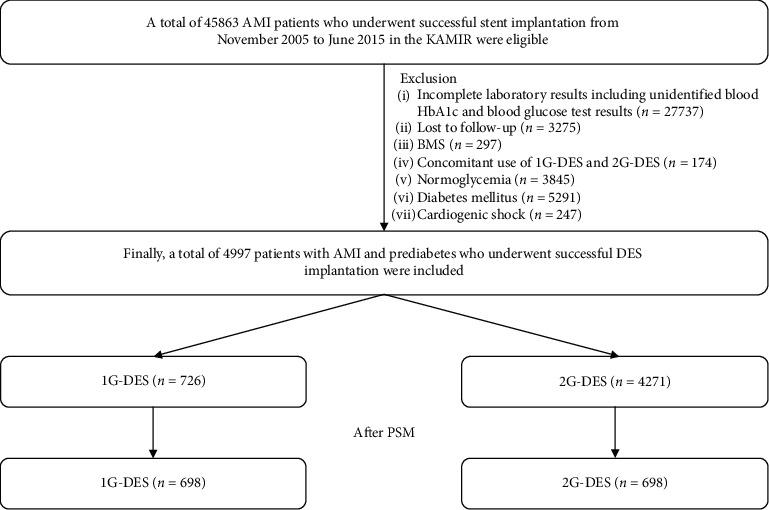
A total of 4997 patients with AMI and prediabetes were divided into two groups: the 1D-DES group ( = 726) and the 2G-DES group ( = 4271). The primary outcomes were the patient-oriented composite outcomes (POCOs) defined as all-cause death, recurrent myocardial infarction (Re-MI), and any disease revascularization at 2-year follow-up. The secondary outcome was probable or definite stent thrombosis (ST).
RESULTS
After propensity score-matching (PSM) analysis, two PSM groups (698 pairs, = 1396, C-statistics = 0.725) were generated. The cumulative incidence rates of POCOs (hazard ratio (HR): 1.467; 95% confidence interval (CI): 1.068-2.015; = 0.018), any disease revascularization (HR: 2.259; 95% CI: 1.397-3.654; = 0.001), and ST (HR: 4.361; 95% CI: 1.243-15.30; = 0.021) in the 1G-DES group were significantly higher than those in the 2G-DES group. However, the cumulative incidence rates of all-cause death, cardiac death, and Re-MI were similar between the two groups.
CONCLUSIONS
In patients with AMI and prediabetes, 2G-DES implantation was more efficacious than 1G-DES implantation over a 2-year follow-up period. However, further studies are needed to confirm these results.
目的
比较急性心肌梗死(AMI)合并糖尿病前期患者经皮冠状动脉介入治疗(PCI)后使用第一代(1G)药物洗脱支架(DES)和第二代(2G)DES 的主要临床结局。
背景
糖尿病前期患者的冠状动脉疾病发病率增加。这些患者中 1G-DES 和 2G-DES 的相对优势尚未得到很好的确定。
方法
共纳入 4997 例 AMI 合并糖尿病前期患者,分为 1D-DES 组(n=726)和 2G-DES 组(n=4271)。主要终点为患者导向的复合结局(POCOs),定义为 2 年随访时的全因死亡、复发性心肌梗死(Re-MI)和任何疾病血运重建。次要终点为可能或确定的支架血栓形成(ST)。
结果
经倾向评分匹配(PSM)分析后,生成了两组 PSM(698 对,n=1396,C 统计量=0.725)。POCOs 的累积发生率(风险比(HR):1.467;95%置信区间(CI):1.068-2.015;P=0.018)、任何疾病血运重建(HR:2.259;95%CI:1.397-3.654;P=0.001)和 ST(HR:4.361;95%CI:1.243-15.30;P=0.021)在 1G-DES 组的发生率明显高于 2G-DES 组。然而,两组间的全因死亡、心脏死亡和 Re-MI 的累积发生率相似。
结论
在 AMI 合并糖尿病前期患者中,与 1G-DES 植入相比,2G-DES 植入在 2 年随访期间更有效。然而,需要进一步的研究来证实这些结果。

 Zotero 插件