Department of Cardiology, Thoraxcentrum Twente, Medisch Spectrum Twente, Koningsplein 1, 7512 KZ, Enschede, The Netherlands.
Department of Health Technology and Services Research, Faculty of Behavioural, Management and Social Sciences, Technical Medical Centre, University of Twente, Enschede, Netherlands.
Cardiovasc Diabetol. 2021 Oct 30;20(1):217. doi: 10.1186/s12933-021-01405-4.
Diabetes is associated with adverse outcomes after percutaneous coronary intervention with drug-eluting stents (DES), but for prediabetes this association has not been definitely established. Furthermore, in patients with prediabetes treated with contemporary stents, bleeding data are lacking. We assessed 3-year ischemic and bleeding outcomes following treatment with new-generation DES in patients with prediabetes and diabetes as compared to normoglycemia.
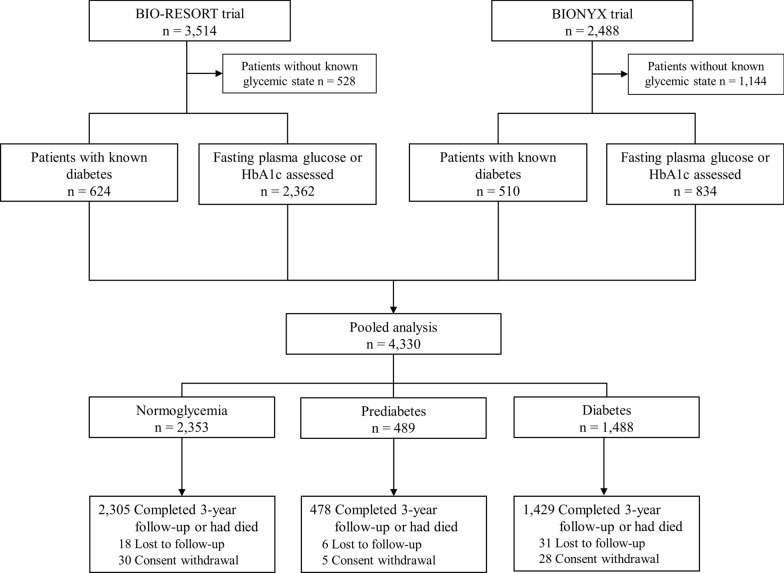
For this post-hoc analysis, we pooled patient-level data of the BIO-RESORT and BIONYX stent trials which both stratified for diabetes at randomization. Both trials were multicenter studies performed in tertiary cardiac centers. Study participants were patients of whom glycemic state was known based on hemoglobin A1c, fasting plasma glucose, or medically treated diabetes. Three-year follow-up was available in 4212/4330 (97.3 %) patients. The main endpoint was target vessel failure, a composite of cardiac death, target vessel myocardial infarction, or target vessel revascularization.
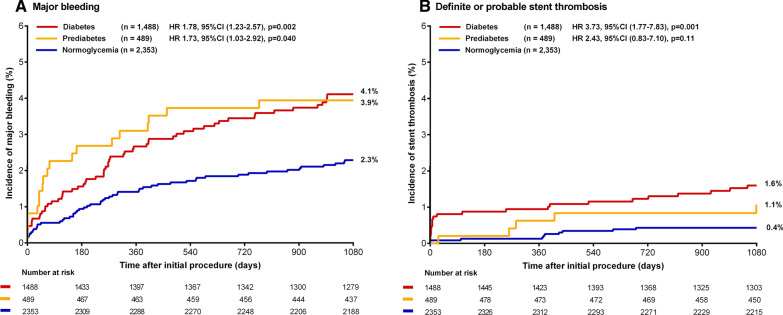
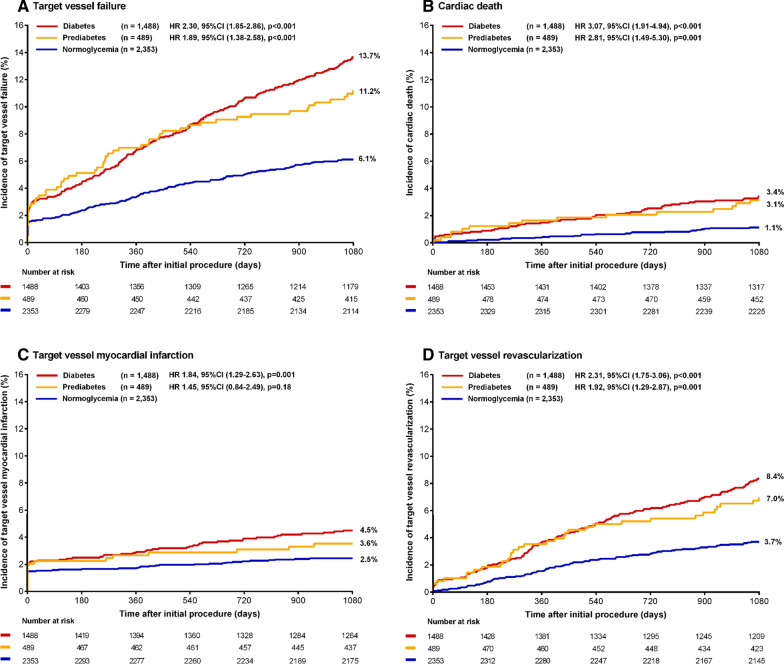
Baseline cardiovascular risk profiles were progressively abnormal in patients with normoglycemia, prediabetes, and diabetes. The main endpoint occurred in 54/489 patients with prediabetes (11.2 %) and 197/1488 with diabetes (13.7 %), as compared to 142/2,353 with normoglycemia (6.1 %) (HR: 1.89, 95 %-CI 1.38-2.58, p < 0.001, and HR: 2.30, 95 %-CI 1.85-2.86, p < 0.001, respectively). In patients with prediabetes, cardiac death and target vessel revascularization rates were significantly higher (HR: 2.81, 95 %-CI 1.49-5.30, p = 0.001, and HR: 1.92, 95 %-CI 1.29-2.87, p = 0.001), and in patients with diabetes all individual components of the main endpoint were significantly higher than in patients with normoglycemia (all p ≤ 0.001). Results were consistent after adjustment for confounders. Major bleeding rates were significantly higher in patients with prediabetes and diabetes, as compared to normoglycemia (3.9 % and 4.1 % vs. 2.3 %; HR:1.73, 95 %-CI 1.03-2.92, p = 0.040, and HR:1.78, 95 %-CI 1.23-2.57, p = 0.002). However, after adjustment for confounders, differences were no longer significant.
Not only patients with diabetes but also patients with prediabetes represent a high-risk population. After treatment with new-generation DES, both patient groups had higher risks of ischemic and bleeding events. Differences in major bleeding were mainly attributable to dissimilarities in baseline characteristics. Routine assessment of glycemic state may help to identify patients with prediabetes for intensified management of cardiovascular risk factors.
BIO-RESORT ClinicalTrials.gov: NCT01674803, registered 29-08-2012; BIONYX ClinicalTrials.gov: NCT02508714, registered 27-7-2015.
糖尿病与药物洗脱支架经皮冠状动脉介入治疗后的不良结果相关,但对于糖尿病前期,这种关联尚未得到明确证实。此外,在接受当代支架治疗的糖尿病前期患者中,缺乏出血数据。我们评估了新代药物洗脱支架治疗糖尿病前期和糖尿病患者与血糖正常患者相比,3 年的缺血和出血结果。
本事后分析汇集了 BIO-RESORT 和 BIONYX 支架试验的患者水平数据,这两项试验均在随机分组时分层了糖尿病。这两项试验都是在三级心脏中心进行的多中心研究。研究参与者是根据糖化血红蛋白、空腹血浆葡萄糖或医学治疗的糖尿病已知血糖状态的患者。4212/4330(97.3%)患者可获得 3 年随访。主要终点是靶血管失败,包括心脏死亡、靶血管心肌梗死或靶血管血运重建的复合终点。
血糖正常、糖尿病前期和糖尿病患者的基线心血管风险状况逐渐异常。54/489 例糖尿病前期患者(11.2%)和 197/1488 例糖尿病患者(13.7%)发生主要终点,而 142/2353 例血糖正常患者(6.1%)(HR:1.89,95%CI 1.38-2.58,p<0.001,和 HR:2.30,95%CI 1.85-2.86,p<0.001)。在糖尿病前期患者中,心脏死亡和靶血管血运重建的发生率明显更高(HR:2.81,95%CI 1.49-5.30,p=0.001,和 HR:1.92,95%CI 1.29-2.87,p=0.001),而在糖尿病患者中,主要终点的所有单个组成部分均明显高于血糖正常患者(均 p≤0.001)。在调整混杂因素后,结果仍然一致。糖尿病前期和糖尿病患者的大出血发生率明显高于血糖正常患者(分别为 3.9%和 4.1%和 2.3%;HR:1.73,95%CI 1.03-2.92,p=0.040,和 HR:1.78,95%CI 1.23-2.57,p=0.002)。然而,在调整混杂因素后,差异不再显著。
不仅是糖尿病患者,而且是糖尿病前期患者,都是高危人群。在接受新一代药物洗脱支架治疗后,两组患者的缺血和出血事件风险均较高。大出血差异主要归因于基线特征的不同。常规评估血糖状态可能有助于识别糖尿病前期患者,从而加强心血管危险因素的管理。
BIO-RESORT ClinicalTrials.gov:NCT01674803,注册于 2012 年 8 月 29 日;BIONYX ClinicalTrials.gov:NCT02508714,注册于 2015 年 7 月 27 日。