Division of Cardiology, Department of Internal Medicine, Kangwon National University School of Medicine, Chuncheon, Republic of Korea.
Chonnam National University Hospital, Gwangju, Republic of Korea.
Sci Rep. 2021 Apr 30;11(1):9364. doi: 10.1038/s41598-021-88593-x.
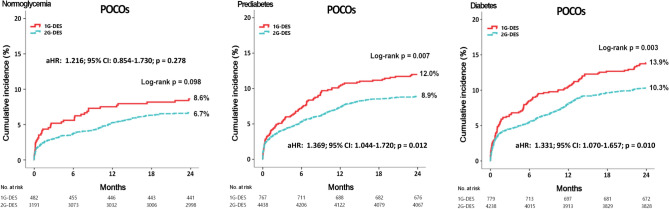
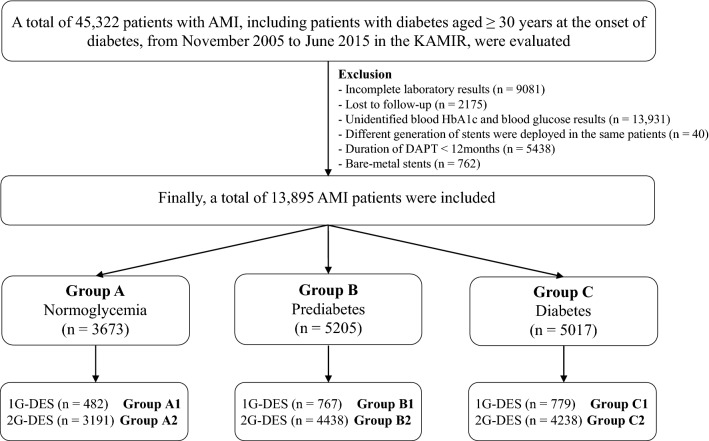
We investigated the effects of stent generation on 2-year clinical outcomes between prediabetes and diabetes patients after acute myocardial infarction (AMI). A total of 13,895 AMI patients were classified into normoglycemia (group A: 3673), prediabetes (group B: 5205), and diabetes (group C: 5017). Thereafter, all three groups were further divided into first-generation (1G)-drug-eluting stent (DES) and second-generation (2G)-DES groups. Patient-oriented composite outcomes (POCOs) defined as all-cause death, recurrent myocardial infarction (Re-MI), and any repeat revascularization were the primary outcome. Stent thrombosis (ST) was the secondary outcome. In both prediabetes and diabetes groups, the cumulative incidences of POCOs, any repeat revascularization, and ST were higher in the 1G-DES than that in the 2G-DES. In the diabetes group, all-cause death and cardiac death rates were higher in the 1G-DES than that in the 2G-DES. In both stent generations, the cumulative incidence of POCOs was similar between the prediabetes and diabetes groups. However, in the 2G-DES group, the cumulative incidences of Re-MI and all-cause death or MI were significantly higher in the diabetes group than that in the prediabetes group. To conclude, 2G-DES was more effective than 1G-DES in reducing the primary and secondary outcomes for both prediabetes and diabetes groups.
我们研究了支架代际对急性心肌梗死(AMI)后合并糖尿病和糖尿病前期患者 2 年临床结局的影响。共纳入 13895 例 AMI 患者,分为血糖正常(A 组:3673 例)、糖尿病前期(B 组:5205 例)和糖尿病(C 组:5017 例)。此后,三组患者进一步分为第一代(1G)药物洗脱支架(DES)和第二代(2G)DES 组。以全因死亡、再发心肌梗死(Re-MI)和任何再次血运重建为患者导向的复合终点(POCOs)作为主要终点。支架血栓形成(ST)为次要终点。在糖尿病前期和糖尿病组中,1G-DES 的 POCOs、任何再次血运重建和 ST 的累积发生率均高于 2G-DES。在糖尿病组中,1G-DES 的全因死亡和心脏性死亡发生率高于 2G-DES。在两种支架中,POCOs 的累积发生率在糖尿病前期和糖尿病组之间相似。然而,在 2G-DES 组中,糖尿病组的 Re-MI 和全因死亡或 MI 的累积发生率明显高于糖尿病前期组。总之,与 1G-DES 相比,2G-DES 更能有效降低糖尿病前期和糖尿病组的主要和次要结局。