Molecular Rheumatology, School of Medicine, Trinity Biomedical Sciences Institute, Trinity College Dublin, Dublin, Ireland.
Rheumatology EULAR Centre of Excellence, Centre for Arthritis & Rheumatic Diseases, St Vincent's University Hospital, University College Dublin, Dublin, Ireland.
Front Immunol. 2020 Jul 7;11:1406. doi: 10.3389/fimmu.2020.01406. eCollection 2020.
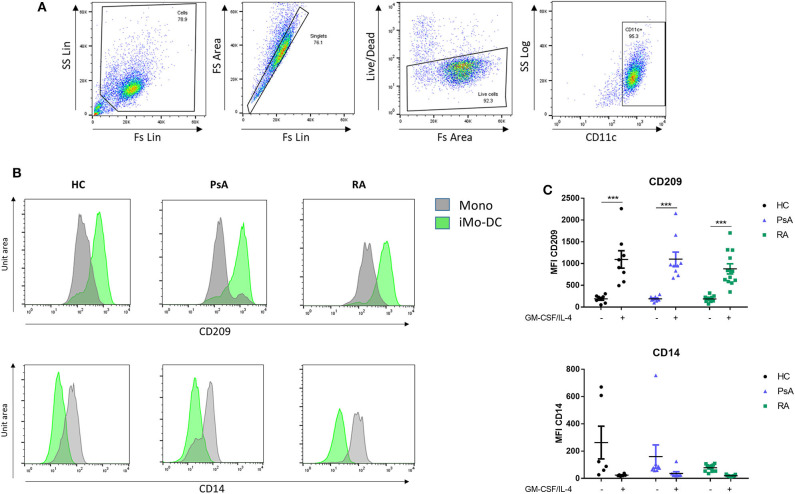
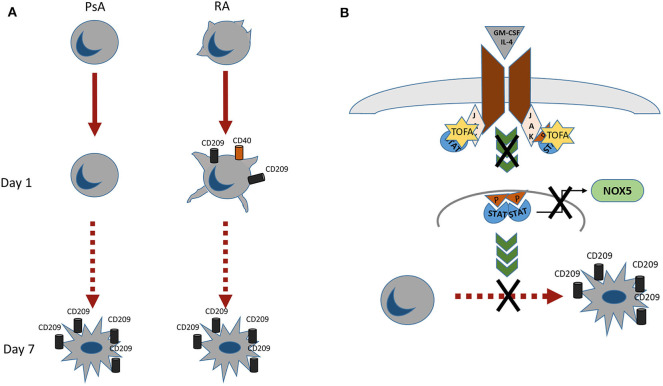
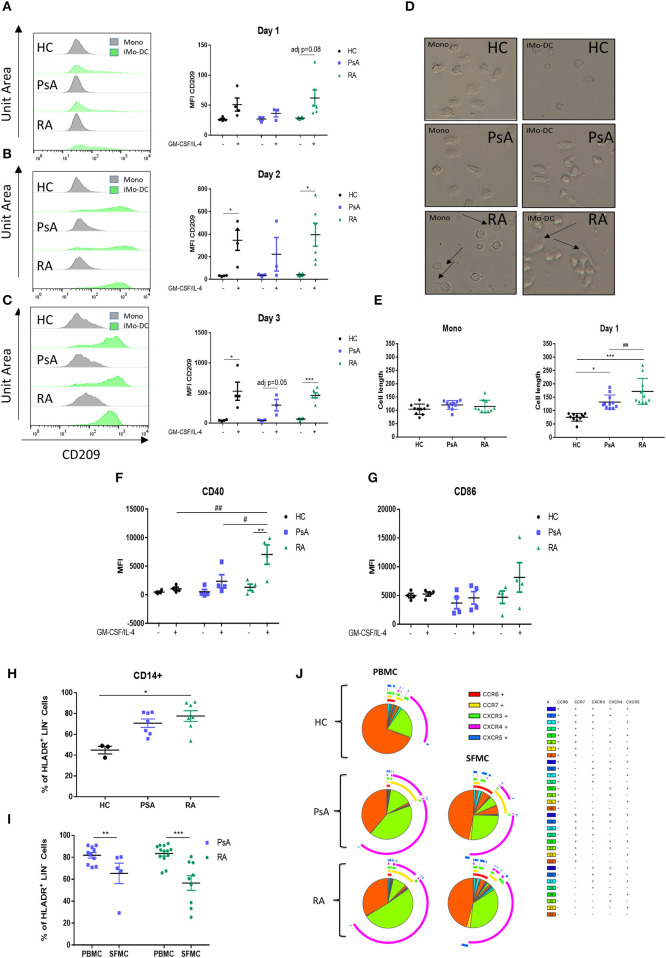
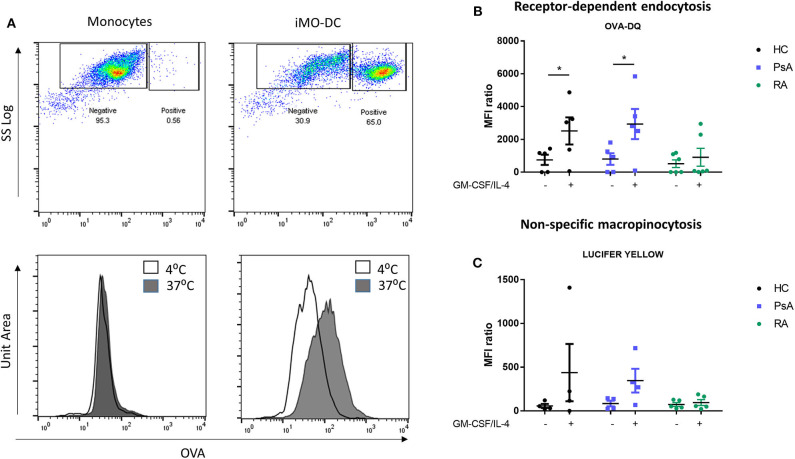
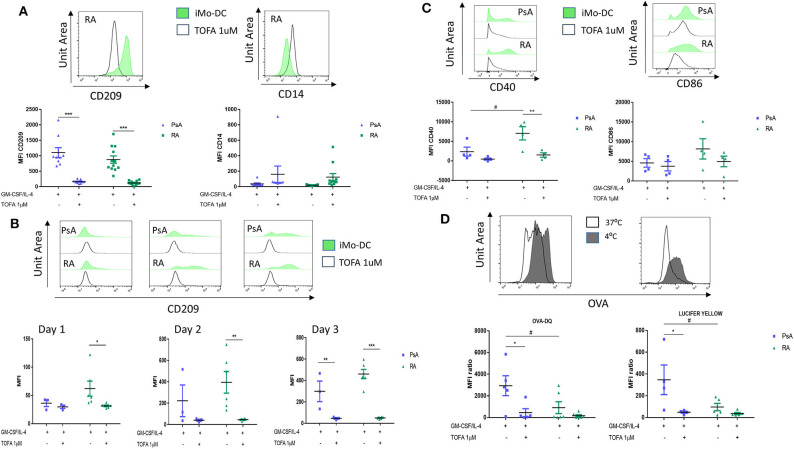
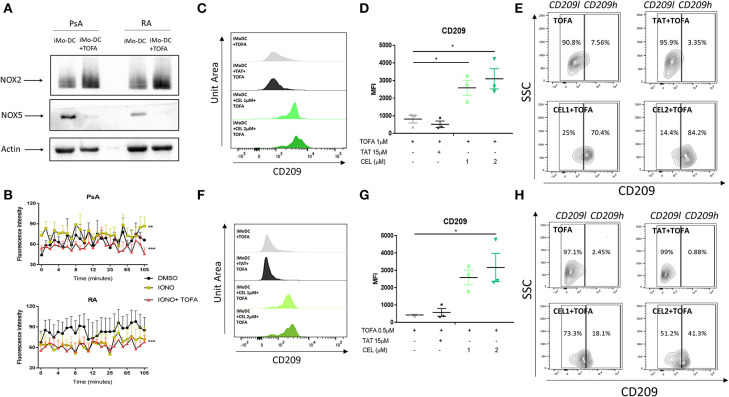
Monocyte-derived Dendritic cells (Mo-DC) are a distinct DC subset, involved in inflammation and infection, they originate from monocytes upon stimulation in the circulation and their activation and function may vary in autoimmune diseases. In this study we investigate the differences in Mo-DC differentiation and function in patients with Rheumatoid (RA) compared to Psoriatic arthritis (PsA). A significant increase in the Mo-DC differentiation marker CD209, paralleled by a corresponding decrease in the monocytic marker CD14, was demonstrated in RA compared to PsA, as early as 1 day post Mo-DC differentiation. RA monocytes were phenotypically different to PsA, displaying a more mature phenotype associated with altered cellular-morphology, early dendrite formation, and a significant increase in the CD40 marker. In addition, SPICE algorithm flow cytometric analysis showed distinct differences in chemokine receptors distribution in HC compared to PsA and RA CD14 cells in the blood, with increased expression of the chemokine receptors CCR7 and CXCR4 observed in PsA and RA. In addition CD14 cells at the site of inflammation showed a different chemokine receptor pattern between PsA and RA patients, with higher expression of CXCR3 and CXCR5 in RA when compared to PsA. The early priming observed in RA resulted in monocyte-endocytosis and antigen-uptake mechanisms to be impaired, effects that were not observed in PsA where phagocytosis capacity remained highly functional. Tofacitinib inhibited early Mo-DC differentiation, decreasing both CD209 and CD40 activation markers in RA. Inhibition of Mo-DC differentiation in response to Tofacitinib was mediated an imbalance in the activation of NADPH-oxidases NOX5 and NOX2. This effect was reversed by NOX5 inhibition, but not NOX2, resulting in suppression of NOX5-dependent ROS production. In conclusion, RA monocytes are already primed to become DC, evident by increased expression of activation markers, morphological appearance and impaired endocytosis capacity. Furthermore, we demonstrated for the first time that NOX5 mediates Mo-DC differentiation and function in response to Tofacitinib, which may alter DC functions.
单核细胞衍生的树突状细胞 (Mo-DC) 是一种独特的树突状细胞亚群,参与炎症和感染,它们起源于刺激循环中的单核细胞,其激活和功能在自身免疫性疾病中可能有所不同。在这项研究中,我们研究了类风湿性关节炎 (RA) 患者与银屑病关节炎 (PsA) 患者之间 Mo-DC 分化和功能的差异。早在 Mo-DC 分化后 1 天,就证明 RA 中 Mo-DC 分化标志物 CD209 的显著增加,同时相应的单核细胞标志物 CD14 减少。RA 单核细胞的表型与 PsA 不同,表现出与细胞形态改变、早期树突形成和 CD40 标志物显著增加相关的更成熟表型。此外,SPICE 算法流式细胞术分析显示,HC 与 PsA 和 RA CD14 细胞之间血液中趋化因子受体分布存在明显差异,PsA 和 RA 中观察到趋化因子受体 CCR7 和 CXCR4 的表达增加。此外,炎症部位的 CD14 细胞在 PsA 和 RA 患者之间表现出不同的趋化因子受体模式,与 PsA 相比,RA 中 CXCR3 和 CXCR5 的表达更高。RA 中观察到的早期启动导致单核细胞内吞和抗原摄取机制受损,而在 PsA 中未观察到这种现象,其中吞噬能力仍然高度功能性。托法替尼抑制 RA 中早期 Mo-DC 分化,降低 RA 中 CD209 和 CD40 激活标志物。托法替尼对 Mo-DC 分化的抑制作用是通过 NADPH 氧化酶 NOX5 和 NOX2 的激活失衡介导的。这种作用可以通过抑制 NOX5 逆转,但不能通过抑制 NOX2 逆转,导致抑制 NOX5 依赖性 ROS 产生。总之,RA 单核细胞已经被预先激活成为 DC,这一点可以通过激活标志物、形态外观和受损的内吞能力的增加来证明。此外,我们首次证明 NOX5 介导托法替尼对 Mo-DC 分化和功能的反应,这可能改变 DC 功能。