Arteaga Maria Clara, Bello-Bedoy Rafael, Gasca-Pineda Jaime
Departamento de Biología de la Conservación, Centro de Investigación Científica y de Educación Superior de Ensenada (CICESE), Ensenada, Mexico.
Facultad de Ciencias, Universidad Autónoma de Baja California, Ensenada, Mexico.
Front Plant Sci. 2020 May 28;11:685. doi: 10.3389/fpls.2020.00685. eCollection 2020.
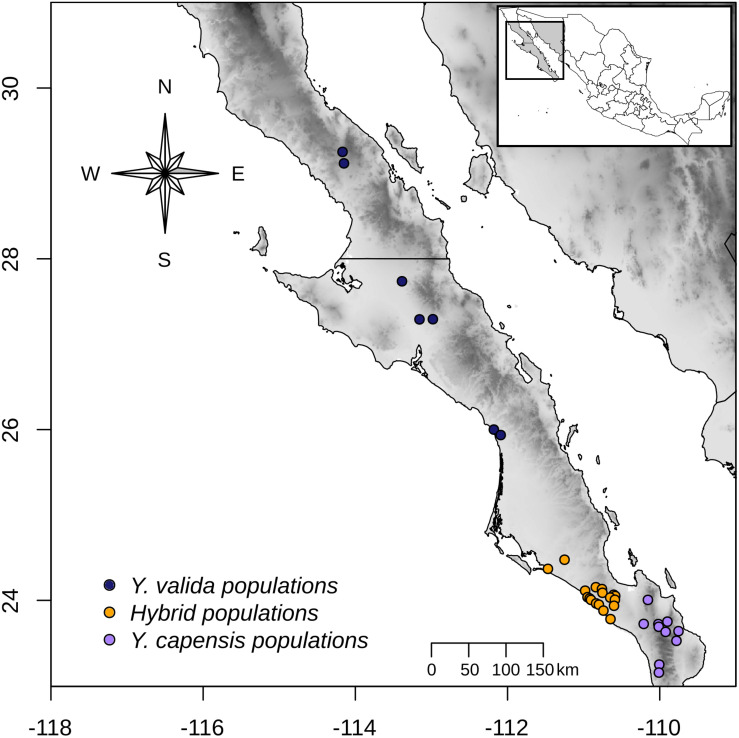
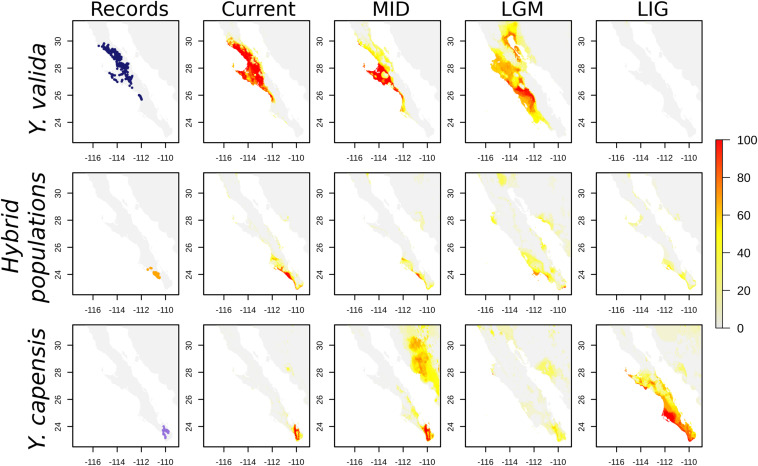
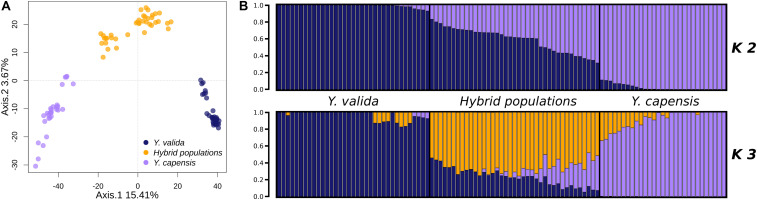
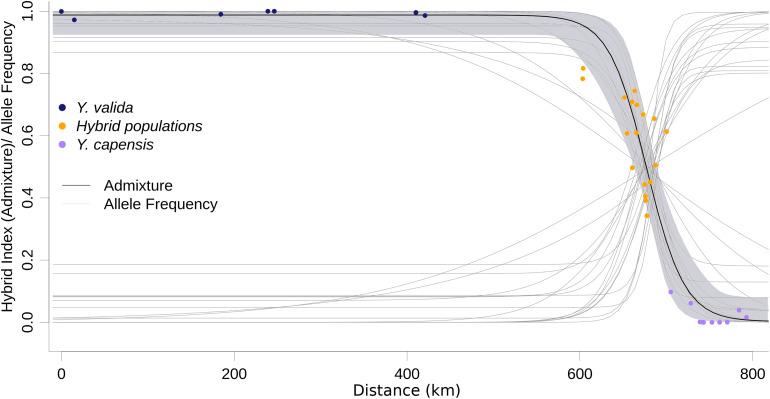
Hybridization can occur when two geographically isolated species are reproductively compatible and have come into sympatry due to range shifts. Yucca and yucca moths exhibit obligate pollination mutualism; yucca moths are responsible for the gene flow mediated by pollen among yucca populations. In the Baja California Peninsula, there are two yucca sister species, and , that have coevolved with the same pollinator, . Both yucca species are endemic to the peninsula, and their current distributions are allopatric. Based on their morphological characteristics, it has been suggested that some plants growing in the southern part of the Magdalena flatland, a spatially disjunct part of 's range, have hybrid origins. We conducted genomic and climatic analyses of the two yucca species as well as the putative hybrid populations. We genotyped 3,423 single nucleotide polymorphisms in 120 individuals sampled from 35 localities. We applied Bayesian tests and geographic cline analyses to the genomic data. Using climatic information from the occurrence sites, we projected species distribution models in different periods to assess changes in the distributional range, and we performed a statistical test to define the niche divergence between the paternal species and the putative hybrid populations. Structure analysis revealed mixed ancestry in the genome of hybrid populations, and the Bayesian models supported a scenario of post-divergence gene flow between the yucca species. Our species distribution models reveal that the geographical ranges of the parental species overlapped mainly during the Last Glacial Maximum, which could facilitate genetic admixture between those species. Finally, we found that most of the assessed environmental axes between the parents and hybrid populations are divergent, indicating that the climatic niche of the hybrid populations is shifting from that of the populations' progenitors. Our results show that the populations in the southern part of the Magdalena flatland are the result of combination of the genetic components of two species. Hybrid individuals with this novel genomic combination arose in a different habitat than their parental species, and they exhibit ecological divergence, which contributes to reproductive isolation through spatial and temporal barriers.
当两个地理隔离的物种在生殖上具有兼容性,并且由于分布范围的变化而进入同域分布时,就可能发生杂交。丝兰和丝兰蛾表现出专性传粉互利共生关系;丝兰蛾负责花粉介导的丝兰种群间的基因流动。在加利福尼亚半岛,有两种丝兰姊妹种, 和 ,它们与同一种传粉者 共同进化。这两种丝兰都 endemic 于该半岛,它们目前的分布是异域的。基于它们的形态特征,有人提出,生长在 Magdalena 平原南部( 的分布范围中一个空间上不连续的部分)的一些植物具有杂交起源。我们对这两种丝兰以及假定的杂交种群进行了基因组和气候分析。我们对从35个地点采集的120个个体中的3423个单核苷酸多态性进行了基因分型。我们对基因组数据应用了贝叶斯检验和地理渐变分析。利用来自出现地点的气候信息,我们在不同时期预测了物种分布模型,以评估分布范围的变化,并进行了统计检验以确定父本物种与假定的杂交种群之间的生态位差异。结构分析揭示了杂交种群基因组中的混合血统,贝叶斯模型支持丝兰物种之间分化后基因流动的情况。我们的物种分布模型表明,亲本物种的地理范围主要在末次盛冰期重叠,这可能促进了这些物种之间的基因混合。最后,我们发现亲本和杂交种群之间评估的大多数环境轴是不同的,这表明杂交种群的气候生态位正在从其种群祖先的生态位发生转变。我们的结果表明,Magdalena 平原南部的种群是两个物种遗传成分组合的结果。具有这种新基因组组合的杂交个体出现在与其亲本物种不同的栖息地,并且它们表现出生态分化,这通过空间和时间障碍有助于生殖隔离。 (注:“endemic”此处译为“特有”,但原文中该词使用不太准确,可能影响整体译文的专业性和准确性,最好能结合更专业的植物学知识准确判断该词在文中的含义。)