Feng Guiyu, Han Mei, Li Xun, Geng Le, Miao Yingchun
Dongzhimen Hospital, Beijing University of Chinese Medicine, Beijng 100700, China.
School of Traditional Chinese Medicine, Beijing University of Chinese Medicine, Beijing 100029, China.
Evid Based Complement Alternat Med. 2020 Jul 15;2020:8071821. doi: 10.1155/2020/8071821. eCollection 2020.
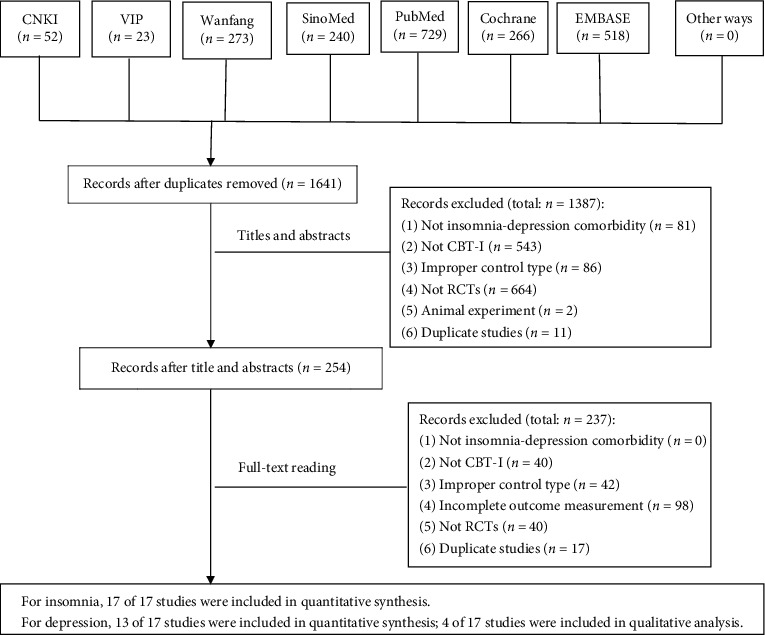
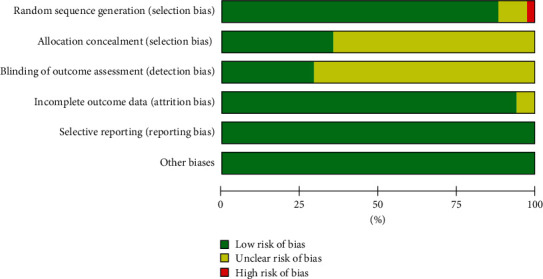
Insomnia and depression often co-occurr. However, there is lack of effective treatment for such comorbidity. CBT-I has been recommended as the first-line treatment for insomnia; whether it is also effective for comorbidity of insomnia and depression is still unknown. Therefore, we conducted this meta-analysis of randomized controlled trials to assess the clinical effectiveness and safety of CBT-I for insomnia comorbid with depression. Seven electronic databases, including China National Knowledge Infrastructure (CNKI), Wanfang Database, China Science Technology Journal Database, SinoMed Database, PubMed, the Cochrane Library, and EMBASE, as well as grey literature, were searched from the beginning of each database to July 1, 2019. Randomized controlled trials that compared CBT-I to no treatment or hypnotics (zopiclone, estazolam, and benzodiazepine agonist) for insomnia comorbid with depression and reported both insomnia scales and depression scales. Cochrane Reviewer's Handbook was used for evaluating the risk of bias of included studies. Review Manager 5.3 software was used for meta-analysis. Online GRADEpro was used to assess the quality of evidence.
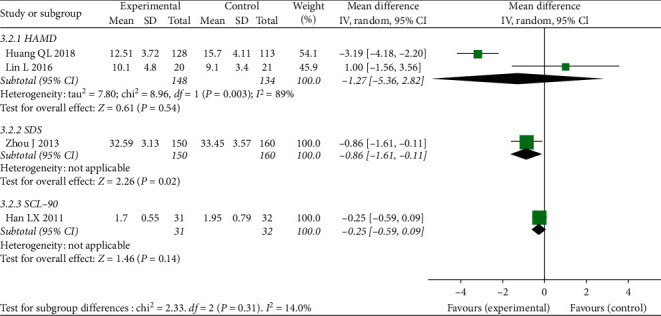
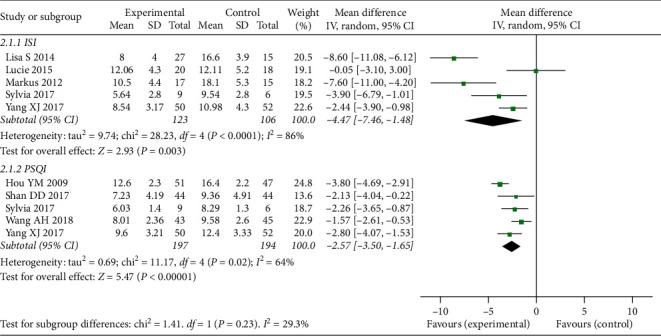
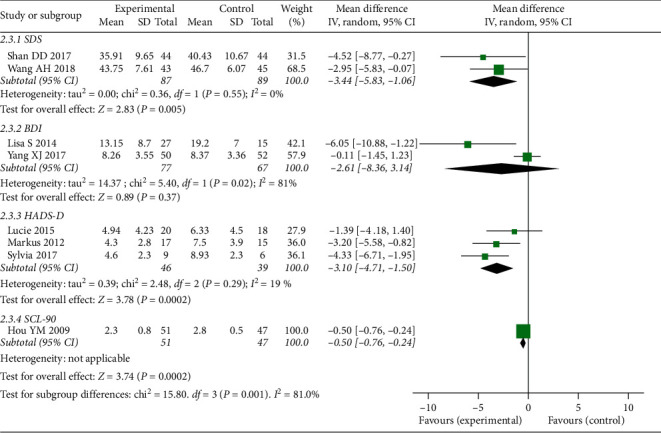
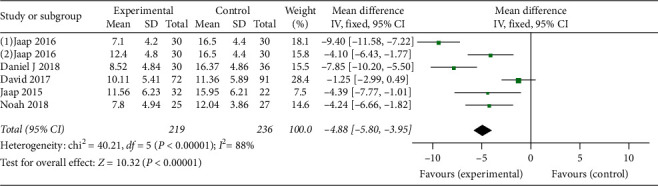
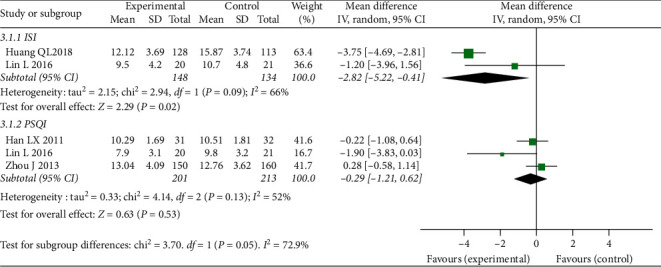
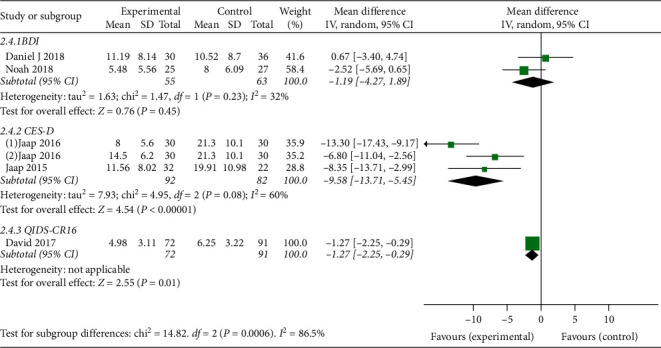
The pooled data showed that CBT-I was superior to no treatment for insomnia, while it was unsure whether CBT-I was better than no treatment for depression. And the effectiveness of CBT-I was comparable to hypnotics for both insomnia and depression. CBT-I was likely to be safe due to its noninvasive nature. The methodological quality varied across these trials. The evidence quality varied from moderate to very low, and the recommendation level was low.
Currently, findings support that CBT-I seems to be effective and safe for insomnia comorbid with depression to improve the insomnia condition, while it is unsure whether CBT-I could improve depression condition. More rigorous trials are needed to confirm our findings.
失眠与抑郁症常同时出现。然而,针对这种共病情况缺乏有效的治疗方法。认知行为疗法治疗失眠(CBT-I)已被推荐为失眠的一线治疗方法;其对失眠与抑郁症共病是否也有效仍不清楚。因此,我们进行了这项随机对照试验的荟萃分析,以评估CBT-I治疗失眠合并抑郁症的临床有效性和安全性。检索了七个电子数据库,包括中国知网(CNKI)、万方数据库、中国科技期刊数据库、中国生物医学文献数据库、PubMed、考克兰图书馆和EMBASE,以及灰色文献,检索时间从每个数据库建库起始至2019年7月1日。纳入比较CBT-I与不治疗或催眠药(佐匹克隆、艾司唑仑和苯二氮卓类激动剂)治疗失眠合并抑郁症且报告了失眠量表和抑郁量表的随机对照试验。采用考克兰系统评价员手册评估纳入研究的偏倚风险。使用Review Manager 5.3软件进行荟萃分析。使用在线GRADEpro评估证据质量。
汇总数据显示,CBT-I治疗失眠优于不治疗,而对于抑郁症,不确定CBT-I是否优于不治疗。CBT-I治疗失眠和抑郁症的有效性与催眠药相当。由于其非侵入性,CBT-I可能是安全的。这些试验的方法学质量各不相同。证据质量从中等至极低不等,推荐级别较低。
目前的研究结果支持,CBT-I治疗失眠合并抑郁症似乎有效且安全,可改善失眠状况,但不确定CBT-I是否能改善抑郁状况。需要更严格的试验来证实我们的研究结果。