Lalonde Emilie, Rentas Stefan, Lin Fumin, Dulik Matthew C, Skraban Cara M, Spinner Nancy B
Division of Genomic Diagnostics, Department of Pathology and Laboratory Medicine, School of Medicine, Children's Hospital of Philadelphia, University of Pennsylvania, Philadelphia, PA, United States.
Division of Human Genetics, Department of Pediatrics, School of Medicine, Children's Hospital of Philadelphia, University of Pennsylvania, Philadelphia, PA, United States.
Front Pediatr. 2020 Jul 8;8:373. doi: 10.3389/fped.2020.00373. eCollection 2020.
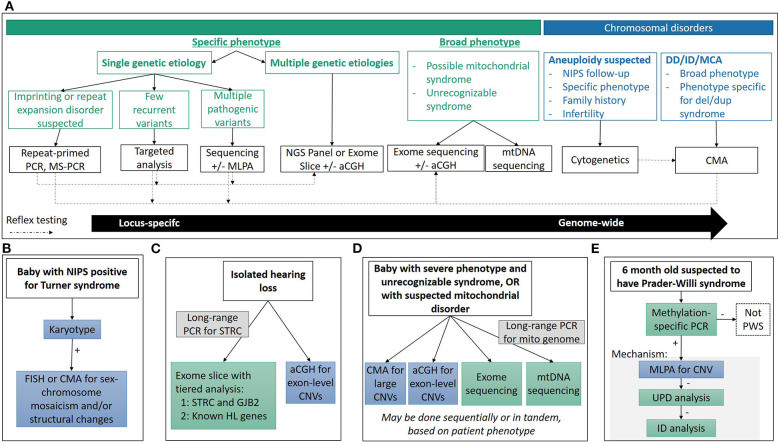
Powerful, recent advances in technologies to analyze the genome have had a profound impact on the practice of medical genetics, both in the laboratory and in the clinic. Increasing utilization of genome-wide testing such as chromosomal microarray analysis and exome sequencing have lead a shift toward a "genotype-first" approach. Numerous techniques are now available to diagnose a particular syndrome or phenotype, and while traditional techniques remain efficient tools in certain situations, higher-throughput technologies have become the laboratory tool for diagnosis of most conditions. However, selecting the right assay or technology is challenging, and the wrong choice may lead to prolonged time to diagnosis, or even a missed diagnosis. In this review, we will discuss current core technologies for the diagnosis of classic genetic disorders to shed light on the benefits and disadvantages of these strategies, including diagnostic efficiency, variant interpretation, and secondary findings. Finally, we review upcoming technologies posed to impart further changes in the field of genetic diagnostics as we move toward "genome-first" practice.
强大的基因组分析技术最近取得的进展,对医学遗传学实践在实验室和临床方面都产生了深远影响。全基因组检测如染色体微阵列分析和外显子组测序的使用日益增加,已导致向“基因型优先”方法的转变。现在有许多技术可用于诊断特定综合征或表型,虽然传统技术在某些情况下仍然是有效的工具,但高通量技术已成为诊断大多数病症的实验室工具。然而,选择正确的检测方法或技术具有挑战性,错误的选择可能导致诊断时间延长,甚至漏诊。在本综述中,我们将讨论诊断经典遗传疾病的当前核心技术,以阐明这些策略的优缺点,包括诊断效率、变异解读和次要发现。最后,我们回顾即将出现的技术,这些技术将在我们迈向“基因组优先”实践时给基因诊断领域带来进一步变化。