Chen Zhiqiang, Liu Xueqian, Liu Dengren, Li Fang, Wang Li, Liu Shufeng
Key Laboratory of Optic-Electric Sensing and Analytical Chemistry for Life Science, Ministry of Education, College of Chemistry and Molecular Engineering, Qingdao University of Science and Technology, Qingdao, China.
College of Marine Science and Biological Engineering, Qingdao University of Science and Technology, Qingdao, China.
Front Chem. 2020 Jul 9;8:521. doi: 10.3389/fchem.2020.00521. eCollection 2020.
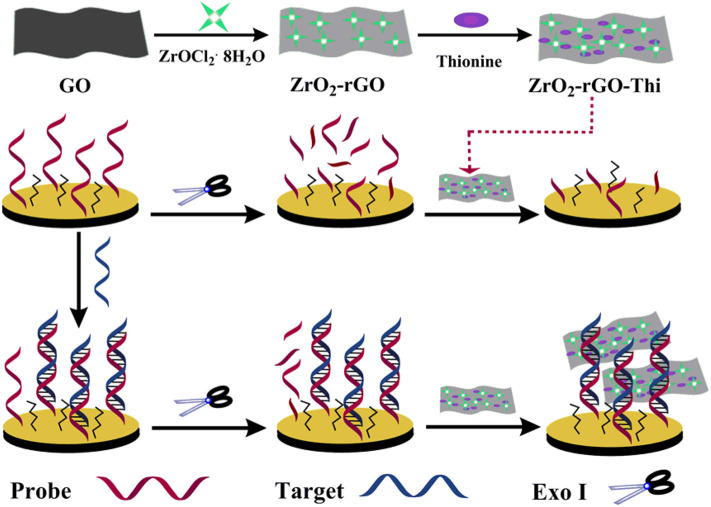
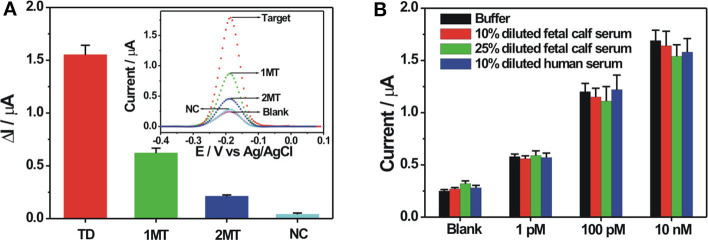
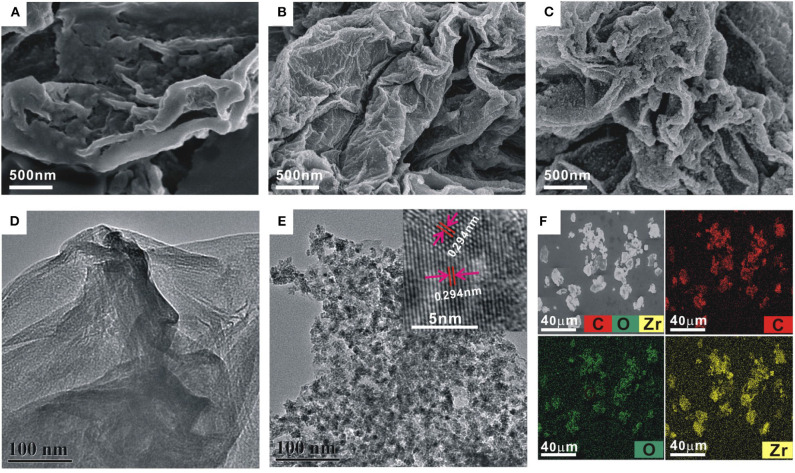
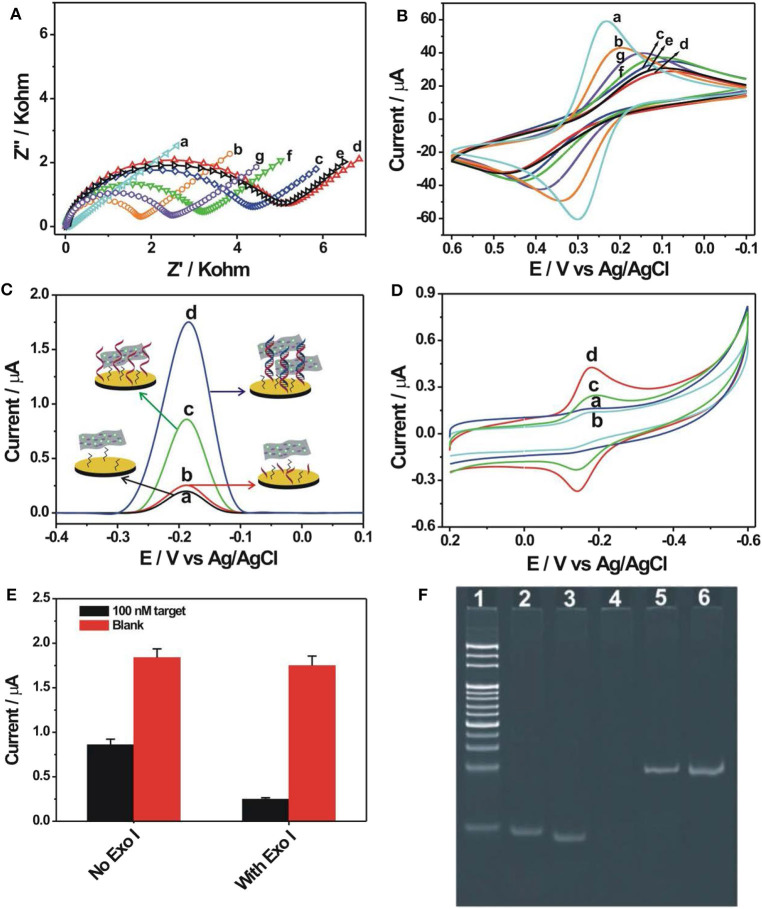
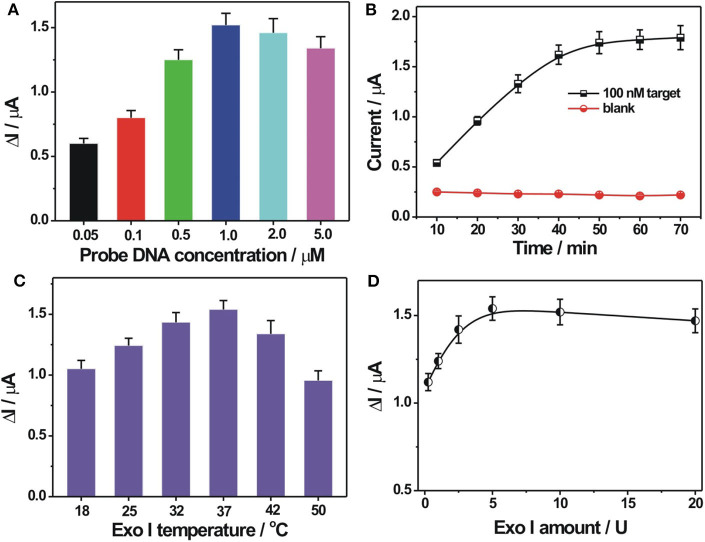
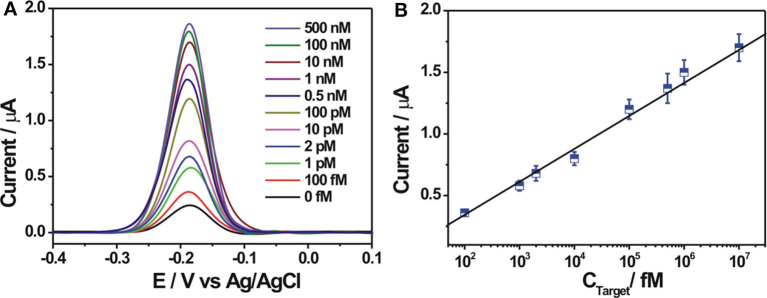
In this work, a simple but sensitive electrochemical DNA biosensor for nucleic acid detection was developed by taking advantage of exonuclease (Exo) I-assisted cleavage for background reduction and zirconia-reduced graphene oxide-thionine (ZrO-rGO-Thi) nanocomposite for integral DNA recognition, signal amplification, and reporting. The ZrO-rGO nanocomposite was obtained by a one-step hydrothermal synthesis method. Then, thionine was adsorbed onto the rGO surface, π-π stacking, as an excellent electrochemical probe. The biosensor fabrication is very simple, with probe DNA immobilization and hybridization recognition with the target nucleic acid. Then, the ZrO-rGO-Thi nanocomposite was captured onto an electrode the multicoordinative interaction of ZrO with the phosphate group on the DNA skeleton. The adsorbed abundant thionine molecules onto the ZrO-rGO nanocomposite facilitated an amplified electrochemical response related with the target DNA. Since upon the interaction of the ZrO-rGO-Thi nanocomposite with the probe DNA an immobilized electrode may also occur, an Exo I-assisted cleavage was combined to remove the unhybridized probe DNA for background reduction. With the current proposed strategy, the target DNA related with P53 gene could be sensitively assayed, with a wide linear detection range from 100 fM to 10 nM and an attractive low detection limit of 24 fM. Also, the developed DNA biosensor could differentiate the mismatched targets from complementary target DNA. Therefore, it offers a simple but effective biosensor fabrication strategy and is anticipated to show potential for applications in bioanalysis and medical diagnosis.
在本工作中,开发了一种简单而灵敏的用于核酸检测的电化学DNA生物传感器,该传感器利用核酸外切酶I辅助切割来降低背景,并利用氧化锆-还原氧化石墨烯-硫堇(ZrO-rGO-Thi)纳米复合材料进行完整的DNA识别、信号放大和报告。ZrO-rGO纳米复合材料通过一步水热合成法获得。然后,硫堇作为一种优异的电化学探针,通过π-π堆积吸附在rGO表面。生物传感器的制备非常简单,包括探针DNA的固定以及与靶核酸的杂交识别。然后,通过ZrO与DNA骨架上磷酸基团的多配位相互作用,将ZrO-rGO-Thi纳米复合材料捕获到电极上。吸附在ZrO-rGO纳米复合材料上的大量硫堇分子促进了与靶DNA相关的电化学响应放大。由于ZrO-rGO-Thi纳米复合材料与探针DNA相互作用时也可能发生电极固定,因此结合核酸外切酶I辅助切割以去除未杂交的探针DNA以降低背景。采用当前提出的策略,可以灵敏地检测与P53基因相关的靶DNA,线性检测范围宽,从100 fM到10 nM,检测限低至24 fM。此外,所开发的DNA生物传感器能够区分错配靶标与互补靶标DNA。因此,它提供了一种简单而有效的生物传感器制备策略,有望在生物分析和医学诊断中显示出应用潜力。