Department of Psychology, York University.
Rotman Research Institute, Baycrest Health Sciences University, 3560 Bathurst Street Toronto, Ontario M6A 2E1, Canada.
Soc Cogn Affect Neurosci. 2020 Oct 8;15(8):815-825. doi: 10.1093/scan/nsaa105.
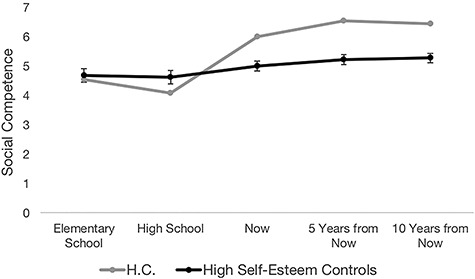
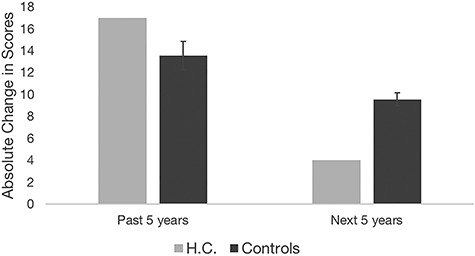
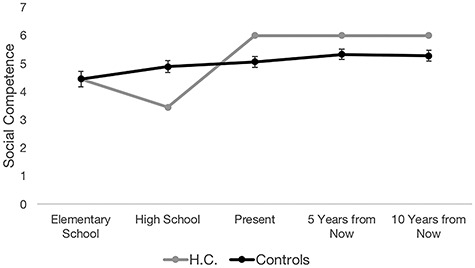
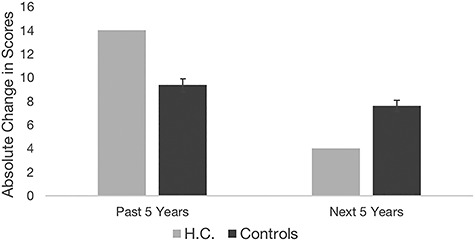
Does the tendency to adjust appraisals of ourselves in the past and future in order to maintain a favourable view of ourselves in the present require episodic memory? A developmental amnesic person with impaired episodic memory (HC) was compared with two groups of age-matched controls on tasks assessing the Big Five personality traits and social competence in relation to the past, present and future. Consistent with previous research, controls believed that their personality had changed more in the past 5 years than it will change in the next 5 years (i.e. the end-of-history illusion), and rated their present and future selves as more socially competent than their past selves (i.e. social improvement illusion), although this was moderated by self-esteem. Despite her lifelong episodic memory impairment, HC also showed these biases of temporal self-appraisal. Together, these findings do not support the theory that the temporal extension of the self-concept requires the ability to recollect richly detailed memories of the self in the past and future.
为了保持现在对自己的有利看法,人们是否倾向于调整过去和未来对自己的评价?一名患有情景记忆障碍的发展性遗忘症患者(HC)与两组年龄匹配的对照组进行了比较,这些对照组在评估与过去、现在和未来有关的五大人格特质和社会能力的任务上进行了比较。与先前的研究一致,对照组认为他们的个性在过去 5 年中变化比未来 5 年中变化更大(即历史终结错觉),并且他们对自己现在和未来的评价比过去更有社交能力(即社交改善错觉),尽管这受到自尊的调节。尽管她一生都患有情景记忆障碍,但 HC 也表现出了这种时间自我评价的偏差。总的来说,这些发现并不支持这样一种理论,即自我概念的时间延伸需要能够回忆起过去和未来自我的丰富详细记忆的能力。