Department of Medicine and Centre de Pédagogie des Sciences de la Santé, Université de Sherbrooke, Sherbrooke, Québec, Canada.
Institute of Medical Education Research Rotterdam, Erasmus Medical Center, Erasmus University, Rotterdam, The Netherlands.
Perspect Med Educ. 2021 Jun;10(3):171-179. doi: 10.1007/s40037-020-00603-2.
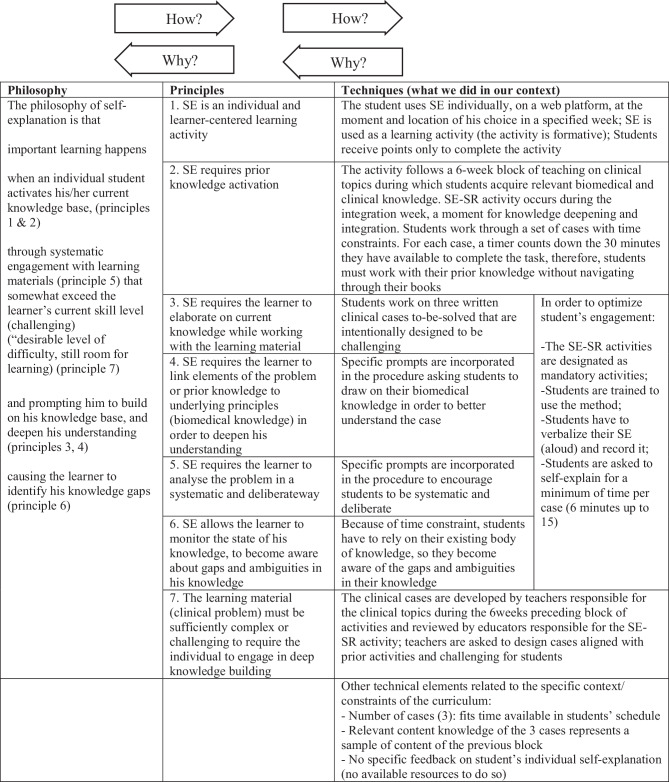
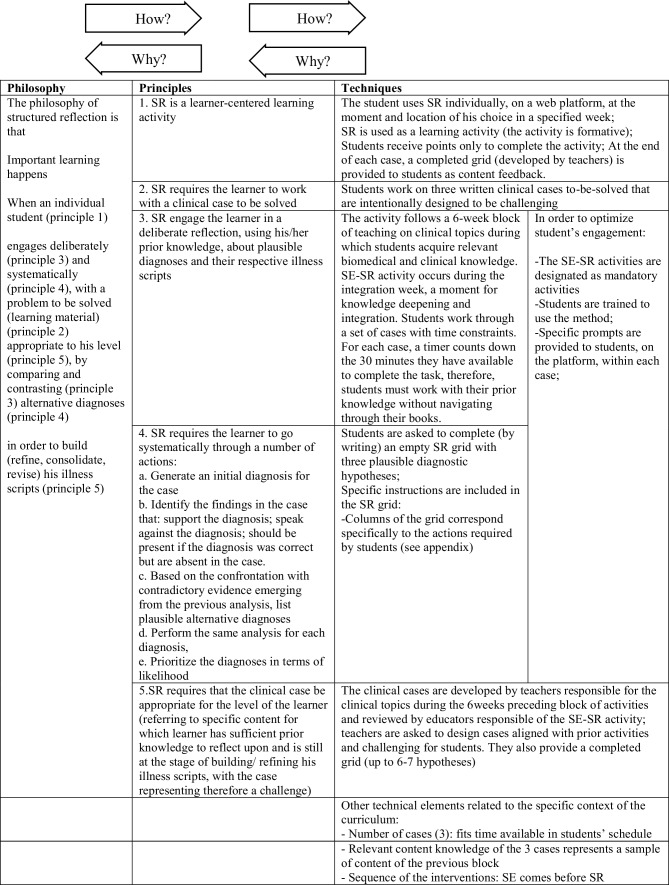
Self-explanation and structured reflection have been studied independently with results suggesting that both learning interventions can effectively support medical students' clinical reasoning development. Given this evidence, medical schools may want/begin to implement these interventions in their curricula. Implementing educational interventions requires educators to maintain the core philosophy and principles of the interventions intact while adjusting implementation techniques to the specificities of individual learning contexts. Educational scholars have yet to explicitly articulate the philosophy, principles and techniques of self-explanation and structured reflection. Without such descriptions, educators risk failing to realize self-explanation's and structured reflection's effect to support students' clinical reasoning skill development in their implementations. Relying on the layered analysis approach, we articulate the philosophy, principles and techniques of self-explanation and structured reflection. This description is framed within the context of an actual implementation to illustrate the philosophies underpinning self-explanation and structured reflection, the principles that realize those philosophies, and the techniques that can be used to enact those principles. Building on the similarities between self-explanation and structured reflection, while also harnessing their differences, we identify why and how these interventions can be combined in a single implementation, while preserving their philosophies and principles. The layered analysis of self-explanation and structured reflection offers essential insights into the underpinnings of these interventions. They are articulated in this manuscript in hopes that other scholars will continue to refine these descriptions thereby facilitating effective use of self-explanation and structured reflection for clinical reasoning development.
自我解释和结构化反思已被分别进行了研究,研究结果表明,这两种学习干预措施都可以有效地支持医学生临床推理能力的发展。鉴于这一证据,医学院校可能希望/开始在其课程中实施这些干预措施。实施教育干预措施需要教育工作者在调整实施技术以适应个别学习环境的特殊性的同时,保持干预措施的核心理念和原则不变。教育学者尚未明确阐述自我解释和结构化反思的理念、原则和技术。如果没有这些描述,教育者可能会在实施过程中无法实现自我解释和结构化反思的效果,从而无法支持学生临床推理技能的发展。我们采用分层分析方法阐述了自我解释和结构化反思的理念、原则和技术。该描述是在实际实施的背景下进行的,旨在说明自我解释和结构化反思的理念基础、实现这些理念的原则,以及可以用来实施这些原则的技术。我们利用自我解释和结构化反思之间的相似性,同时利用它们的差异,确定了为什么以及如何可以将这些干预措施结合在一个单一的实施中,同时保持它们的理念和原则。自我解释和结构化反思的分层分析为这些干预措施的基础提供了重要的见解。本文详细阐述了这些干预措施,希望其他学者能够进一步完善这些描述,从而促进自我解释和结构化反思在临床推理发展中的有效应用。