Department of Clinical Neuroscience, Karolinska Institutet, Stockholm, Sweden.
Department of Neurosurgery, Karolinska University Hospital, Stockholm, Sweden.
Oper Neurosurg (Hagerstown). 2020 Dec 15;20(1):8-17. doi: 10.1093/ons/opaa235.
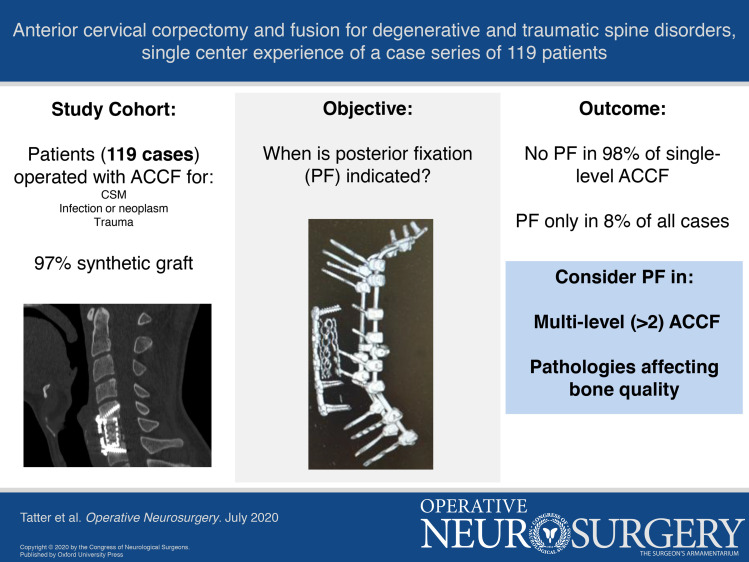
Anterior cervical corpectomy and fusion (ACCF) is a treatment option for several cervical pathologies. Various graft materials such as autografts, titanium mesh cages (TMC), or poly-ether-ether-ketone (PEEK) cages are used. Additional posterior fixation (PF) to provide extra support and improve stability is sometimes performed initially, or later as supplementary treatment.
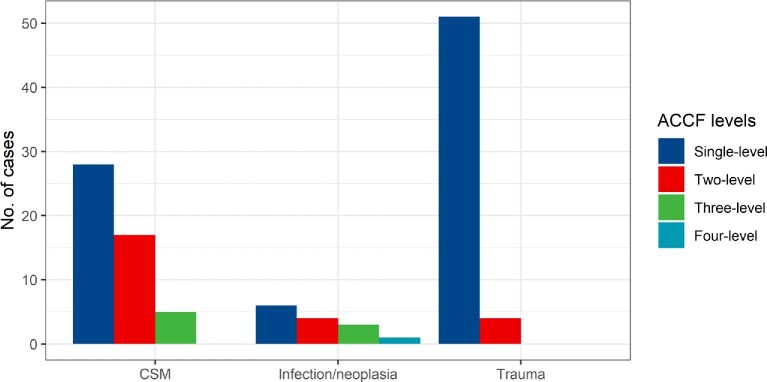
To describe our retrospective study of 119 consecutive cases of ACCF with synthetic grafts, in 3 cohorts of cervical spondylotic myelopathy (CSM), infectious and neoplastic processes, and trauma, with special focus on need for supplementary PF.
A total of 135 adult patients treated with ACCF between January 2005 and January 2018 were identified. Patients lost to follow-up were excluded, and 119 remaining patients were included for retrospective clinical and radiological assessment.
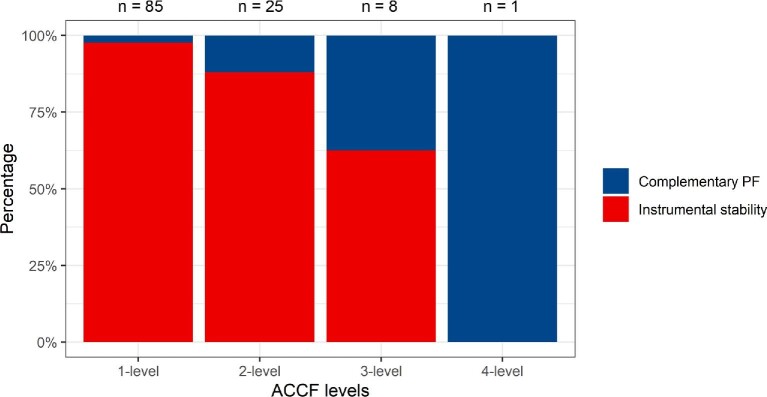
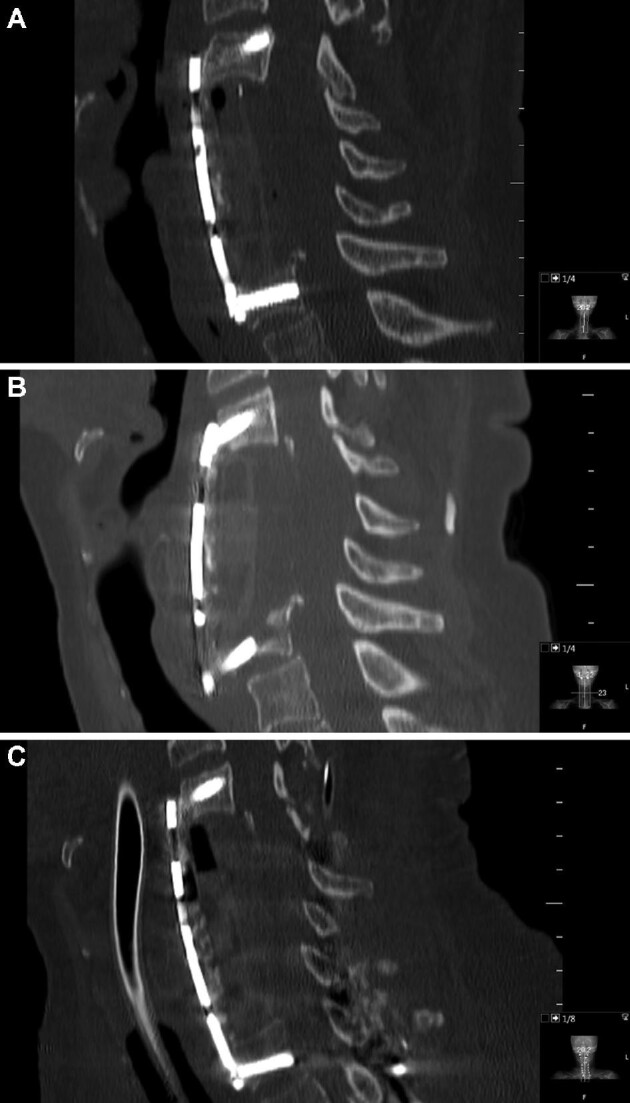
Synthetic grafts were used in 116 (97%) cases. Only 9 (8%) ACCF cases required later supplementary PF, where 7 (78%) cases were multilevel. There was a statistically significant difference in revision rate with PF for single-level compared to multilevel ACCFs (P = .001). Revision rates with PF were 2%, 29%, and 7% in CSM, infectious and neoplastic processes, and trauma cohorts, respectively.
The results indicate that ACCF is a safe and effective treatment for degenerative and traumatic cervical spine disorders, with low complication and revision rates. Single-level ACCF can be performed without additional PF. Multilevel ACCF (n > 2) and pathologies affecting bone quality seem to be risk factors for material subsidence and instability. In these cases, additional PF should be considered.
颈椎前路椎体次全切除融合术(ACCF)是治疗多种颈椎疾病的一种选择。各种移植物材料,如自体骨、钛网笼(TMC)或聚醚醚酮(PEEK)笼,被用于该手术。为了提供额外的支撑和改善稳定性,有时会在初始阶段或后期作为补充治疗进行额外的后路固定(PF)。
描述我们对使用合成移植物进行的 119 例连续颈椎前路椎体次全切除融合术(ACCF)的回顾性研究,这 119 例患者分 3 组,分别为颈椎病脊髓病(CSM)、感染和肿瘤病变以及创伤,特别关注需要补充后路固定的情况。
共确定了 2005 年 1 月至 2018 年 1 月期间接受 ACCF 治疗的 135 例成年患者。排除失访患者后,共纳入 119 例患者进行回顾性临床和影像学评估。
116 例(97%)病例使用了合成移植物。只有 9 例(8%)ACCF 病例需要进行后期的补充后路固定,其中 7 例(78%)为多节段。单节段与多节段 ACCF 相比,后路固定的翻修率有显著统计学差异(P=0.001)。在后路固定的病例中,CSM、感染和肿瘤病变以及创伤组的翻修率分别为 2%、29%和 7%。
结果表明,ACCF 是一种安全有效的治疗退行性和外伤性颈椎疾病的方法,并发症和翻修率较低。单节段 ACCF 可以不进行额外的后路固定。多节段 ACCF(n>2)和影响骨质量的病变似乎是移植物下沉和不稳定的危险因素。在这些情况下,应考虑进行额外的后路固定。