Sorbonne Université, INSERM, Nutrition and Obesities; Systemic approaches (NutriOmics), Paris, France; AP-HP, Pitié-Salpêtrière Hospital, Diabetology department, F-75013 Paris, France.
Université de Paris, BFA, UMR 8251, CNRS, F-75013 Paris, France.
EBioMedicine. 2020 Aug;58:102895. doi: 10.1016/j.ebiom.2020.102895. Epub 2020 Jul 30.
Bariatric surgery is an effective treatment for type 2 diabetes. Early post-surgical enhancement of insulin secretion is key for diabetes remission. The full complement of mechanisms responsible for improved pancreatic beta cell functionality after bariatric surgery is still unclear. Our aim was to identify pathways, evident in the islet transcriptome, that characterize the adaptive response to bariatric surgery independently of body weight changes.
We performed entero-gastro-anastomosis (EGA) with pyloric ligature in leptin-deficient ob/ob mice as a surrogate of Roux-en-Y gastric bypass (RYGB) in humans. Multiple approaches such as determination of glucose tolerance, GLP-1 and insulin secretion, whole body insulin sensitivity, ex vivo glucose-stimulated insulin secretion (GSIS) and functional multicellular Ca-imaging, profiling of mRNA and of miRNA expression were utilized to identify significant biological processes involved in pancreatic islet recovery.
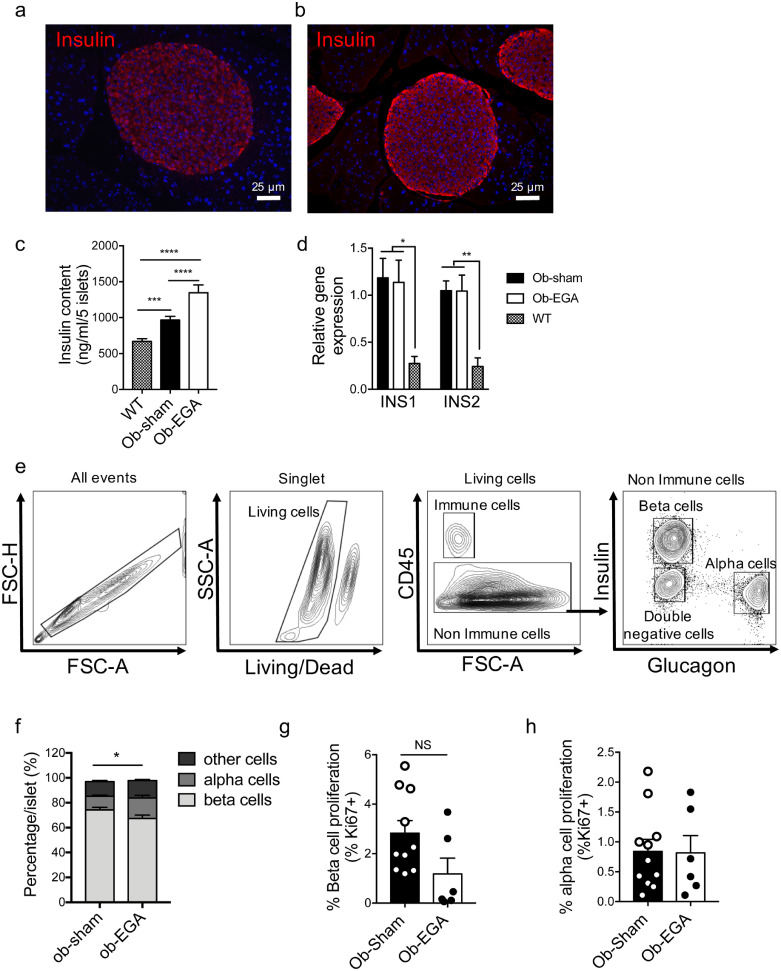
EGA resolved diabetes, increased pancreatic insulin content and GSIS despite a persistent increase in fat mass, systemic and intra-islet inflammation, and lipotoxicity. Surgery differentially regulated 193 genes in the islet, most of which were involved in the regulation of glucose metabolism, insulin secretion, calcium signaling or beta cell viability, and these were normalized alongside changes in glucose metabolism, intracellular Ca dynamics and the threshold for GSIS. Furthermore, 27 islet miRNAs were differentially regulated, four of them hubs in a miRNA-gene interaction network and four others part of a blood signature of diabetes resolution in ob/ob mice and in humans.
Taken together, our data highlight novel miRNA-gene interactions in the pancreatic islet during the resolution of diabetes after bariatric surgery that form part of a blood signature of diabetes reversal.
European Union's Horizon 2020 research and innovation programme via the Innovative Medicines Initiative 2 Joint Undertaking (RHAPSODY), INSERM, Société Francophone du Diabète, Institut Benjamin Delessert, Wellcome Trust Investigator Award (212625/Z/18/Z), MRC Programme grants (MR/R022259/1, MR/J0003042/1, MR/L020149/1), Diabetes UK (BDA/11/0004210, BDA/15/0005275, BDA 16/0005485) project grants, National Science Foundation (310030-188447), Fondation de l'Avenir.
减重手术是治疗 2 型糖尿病的有效方法。术后早期胰岛素分泌增强是糖尿病缓解的关键。导致减重手术后胰腺β细胞功能改善的完整机制仍不清楚。我们的目的是确定胰岛转录组中存在的途径,这些途径独立于体重变化而表征对减重手术的适应性反应。
我们在瘦素缺陷 ob/ob 小鼠中进行了肠胃吻合术(EGA)加幽门结扎,作为人类 Roux-en-Y 胃旁路术(RYGB)的替代方法。我们利用多种方法,如葡萄糖耐量、GLP-1 和胰岛素分泌、全身胰岛素敏感性、离体葡萄糖刺激胰岛素分泌(GSIS)和多功能细胞钙成像、mRNA 和 miRNA 表达谱分析,来确定与胰腺胰岛恢复相关的重要生物学过程。
尽管脂肪量持续增加、全身和胰岛内炎症以及脂肪毒性,EGA 仍能治愈糖尿病、增加胰腺胰岛素含量和 GSIS。手术在胰岛中差异调节了 193 个基因,其中大多数涉及葡萄糖代谢、胰岛素分泌、钙信号或β细胞活力的调节,这些基因与葡萄糖代谢、细胞内 Ca 动力学和 GSIS 阈值的变化一起得到了正常化。此外,27 个胰岛 miRNA 也受到差异调节,其中 4 个是 miRNA 基因相互作用网络中的枢纽,另外 4 个是肥胖小鼠和人类糖尿病缓解的血液特征中的一部分。
综上所述,我们的数据强调了减重手术后糖尿病缓解期间胰岛中新型 miRNA 基因相互作用,这些相互作用构成了糖尿病逆转血液特征的一部分。
欧盟地平线 2020 研究和创新计划通过创新药物倡议 2 联合承诺(RHAPSODY)、法国国家健康与医学研究院、法国糖尿病学会、本杰明·德莱塞特研究所、惠康信托基金会研究员奖(212625/Z/18/Z)、医学研究理事会项目资助(MR/R022259/1、MR/J0003042/1、MR/L020149/1)、英国糖尿病协会(BDA/11/0004210、BDA/15/0005275、BDA 16/0005485)项目资助、美国国家科学基金会(310030-188447)、未来基金会。