Wang Fangzheng, Jiang Chuner, Wang Lei, Yan Fengqin, Piao Yongfeng, Ye Zhimin, Xu Min, Liu Jiping, Fu Zhenfu, Jiang Yangming
Department of Radiation Oncology, Cancer Hospital of the University of Chinese Academy of Sciences, Zhejiang Hangzhou 310022, People's Republic of China.
Institute of Cancer and Basic Medicine (ICBM), Chinese Academy of Sciences, Zhejiang Hangzhou 310022, People's Republic of China.
J Cancer. 2020 Jul 6;11(17):5210-5222. doi: 10.7150/jca.45767. eCollection 2020.
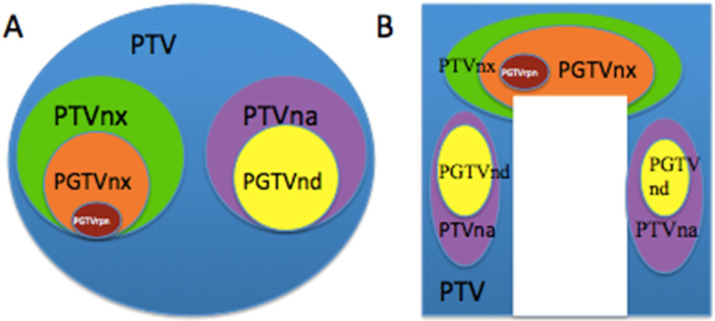
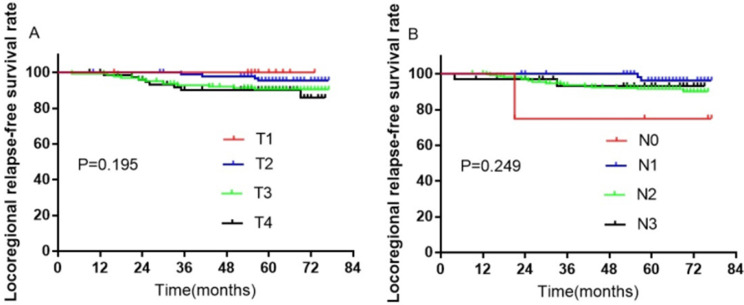
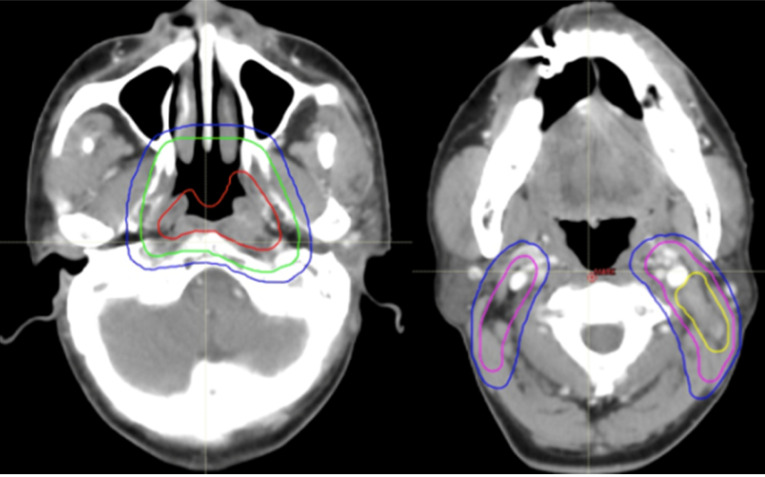
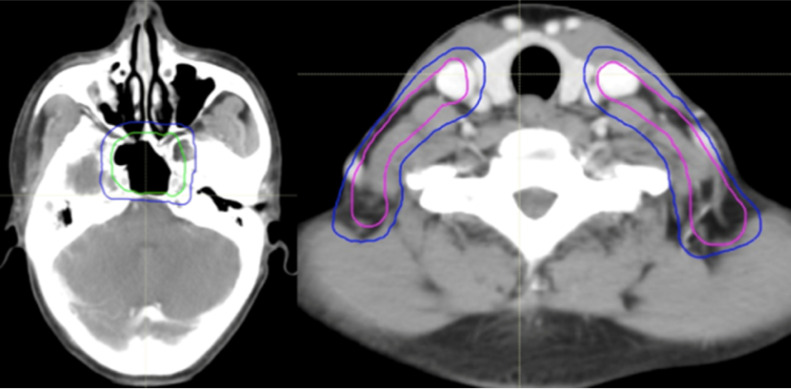
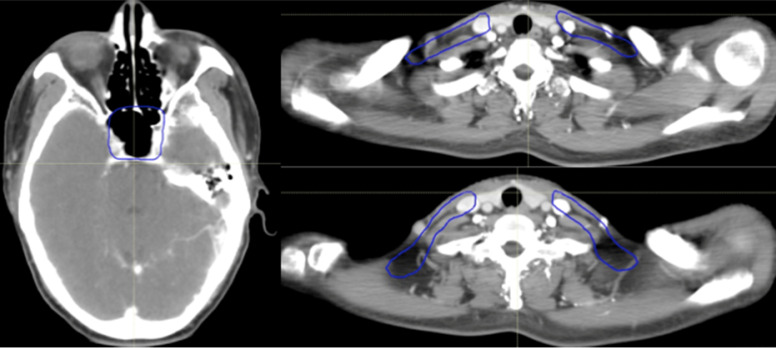
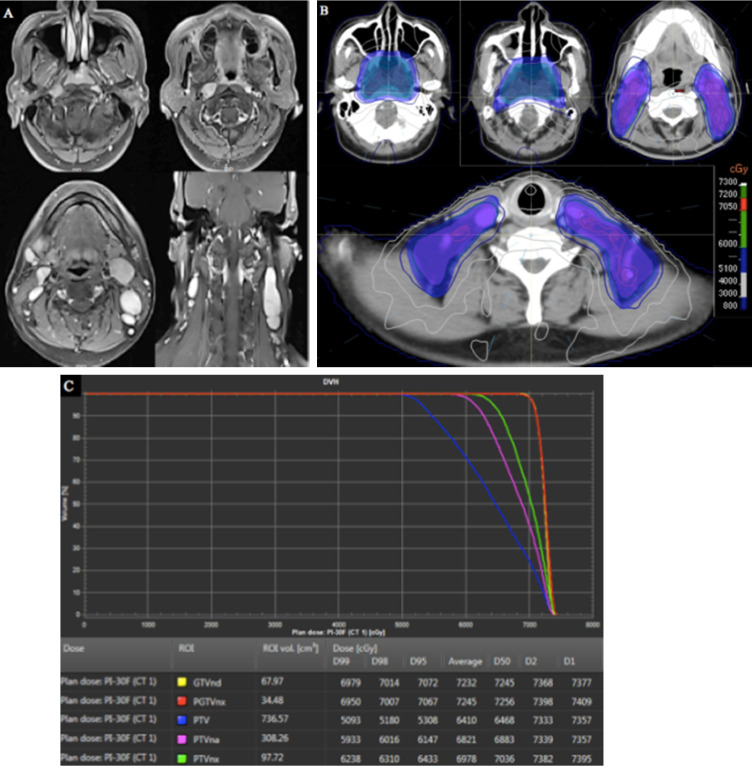
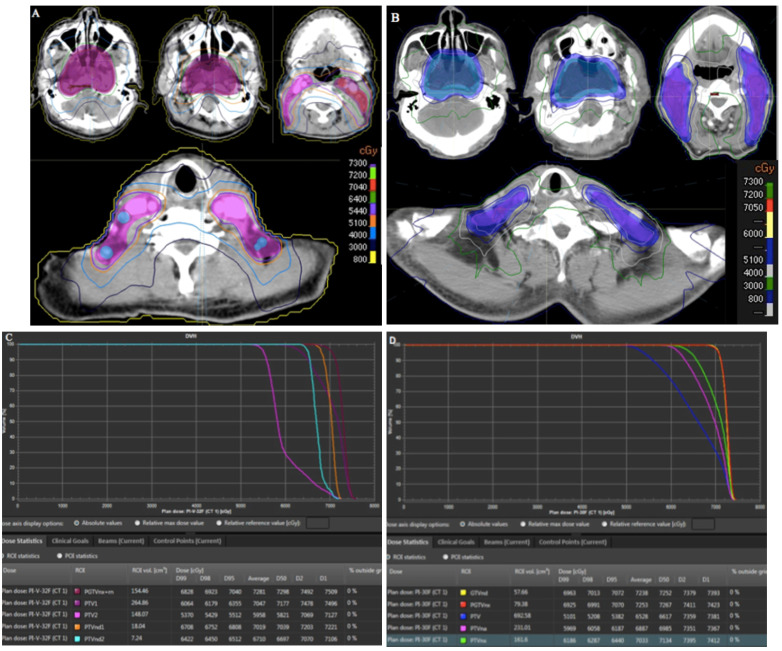
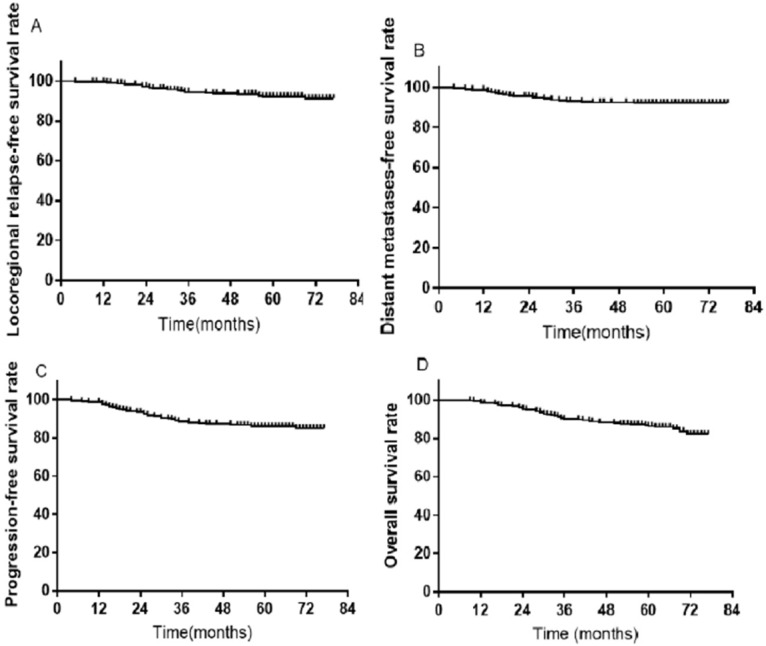
: Although intensity-modulated radiotherapy (IMRT) provides promising survival advantages and fewer late complications in patients with nasopharyngeal cancer (NPC), appropriated target volumes and prescribed doses are still being explored. This study aimed to propose different risk target volumes and corresponding prescribed doses in our center and to evaluate the physical basis and efficacy of this protocol based on the long-term survival of NPC patients. We retrospectively assessed patients with histology-proven non-metastatic NPC treated with definitive IMRT using our protocol of different risk target volumes and corresponding prescribed doses based on the orderly stepwise pattern of tumor spread. We described the delineation for different risk target volumes and the design of IMRT planning for an NPC case. Additionally, we compared the dosimetric distributions between the China protocol and our protocol through two NPC cases. The patterns of failure and locoregional control were the primary endpoints. All survival outcomes were calculated using the Kaplan-Meier method. From January 2013 to December 2014, a total of 335 patients were treated; the median follow-up for patients who survived was 70 months. All patients completed IMRT using our protocol. Twenty-five patients developed locoregional recurrence, and all recurrences occurred within the high-dose target volumes. The rates of locoregional recurrence-free survival, distant metastasis-free survival, progression-free survival, and overall survival at 5 years were 92.2%, 92.1%, 85.9%, and 86.3%, respectively. The biological effective doses of the prescribed doses in our protocol were similar to those of the China and 0615 protocols. Moreover, our protocol offered a reduction in D1 and D2 in the primary gross tumor volume (GTV), while V30 and V40 in normal tissues were lower. Our protocol of different risk target volume delineations and corresponding prescribed doses based on the stepwise pattern of tumor spread resulted in favorable locoregional control with no relapse outside the GTV.
尽管调强放疗(IMRT)在鼻咽癌(NPC)患者中具有显著的生存优势且晚期并发症较少,但合适的靶区体积和处方剂量仍在探索之中。本研究旨在提出本中心不同风险靶区体积及相应的处方剂量,并基于NPC患者的长期生存情况评估该方案的物理基础和疗效。我们回顾性评估了经组织学证实的非转移性NPC患者,这些患者采用我们基于肿瘤扩散有序逐步模式的不同风险靶区体积及相应处方剂量的方案接受了根治性IMRT治疗。我们描述了不同风险靶区体积的勾画以及一例NPC病例的IMRT计划设计。此外,我们通过两例NPC病例比较了中国方案和我们方案之间的剂量分布。失败模式和局部区域控制是主要终点。所有生存结局均采用Kaplan-Meier方法计算。2013年1月至2014年12月,共治疗335例患者;存活患者的中位随访时间为70个月。所有患者均按照我们的方案完成了IMRT。25例患者出现局部区域复发,所有复发均发生在高剂量靶区内。5年时局部区域无复发生存率、远处转移无复发生存率、无进展生存率和总生存率分别为92.2%、92.1%、85.9%和86.3%。我们方案中处方剂量的生物等效剂量与中国方案和0615方案相似。此外,我们的方案使原发大体肿瘤体积(GTV)中的D1和D2降低,而正常组织中的V30和V40更低。我们基于肿瘤扩散逐步模式的不同风险靶区体积勾画及相应处方剂量方案导致了良好的局部区域控制,且GTV外无复发。