Yang Yongqiang, Li Xiaole, Zhou Pengcheng, Deng Xiaoyu, Wang Yingyi, Dang Qianqian, Zheng Yingjuan, Yang Daoke
Department of Radiotherapy, The First Affiliated Hospital of Zhengzhou University, Zhengzhou, Henan, People's Republic of China.
Cancer Manag Res. 2021 Nov 2;13:8169-8178. doi: 10.2147/CMAR.S334958. eCollection 2021.
To analyze the effects of radiotherapy and its timing on the survival and safety of patients with newly diagnosed distant metastatic NPC in non-high-incidence areas.
We retrospectively analyzed 94 newly diagnosed NPC patients with distant metastatic admitted to our hospital from January 2011 to June 2018. They were divided into three groups: no radiotherapy group received chemotherapy alone, early radiotherapy group was combined with radiotherapy during 1 to 3 cycles of chemotherapy, and late radiotherapy group was combined with radiotherapy after 4-6 cycles of chemotherapy were effective. The efficacy and side effects of the three groups were compared, and the prognostic factors were analyzed.
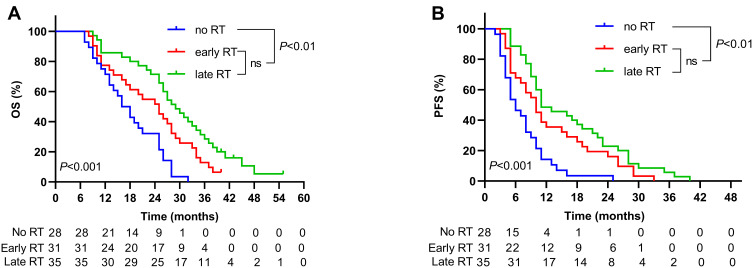
The 6-month, 1-year and 2-year PFS were 53.6%, 14.3% and 3.6% in no radiotherapy group, 71.0%, 38.7% and 19.4% in early radiotherapy group, 88.6%, 48.6% and 22.9% in late radiotherapy group; the radiotherapy groups were better than the no radiotherapy group, and the difference was statistically significant ( < 0.017). The 1-year, 2-year and 3-year OS were 75.0%, 32.1% and 0 in no radiotherapy group, 77.4%, 54.8% and 12.9% in early radiotherapy group, 85.7%, 71.4% and 31.4% in late radiotherapy group; the radiotherapy groups were better than the no radiotherapy group, and the differences were statistically significant ( < 0.017). There was no significant difference in OS and PFS between the two radiotherapy groups. Univariate and multivariate analysis showed that HBV ( = 0.031), number of metastases ( = 0.002), liver metastases ( = 0.038), radiotherapy ( < 0.001) and treatment response ( = 0.011) were related to OS. There was no significant difference in the incidence of adverse events ( > 0.017).
Early and late combined radiotherapy had similar clinical efficacy and both prolonged PFS and OS for patients with newly diagnosed distant metastatic NPC in non-high-risk areas. If chemotherapy response is expected to be poor, radiotherapy can be received early.
分析放疗及其时机对非高发地区新诊断的远处转移鼻咽癌患者生存及安全性的影响。
回顾性分析2011年1月至2018年6月我院收治的94例新诊断的远处转移鼻咽癌患者。将其分为三组:未放疗组单纯接受化疗,早期放疗组在化疗1至3周期时联合放疗,晚期放疗组在化疗4 - 6周期有效后联合放疗。比较三组的疗效及副作用,并分析预后因素。
未放疗组6个月、1年和2年的无进展生存期(PFS)分别为53.6%、14.3%和3.6%,早期放疗组分别为71.0%、38.7%和19.4%,晚期放疗组分别为88.6%、48.6%和22.9%;放疗组优于未放疗组,差异有统计学意义(<0.017)。未放疗组1年、2年和3年的总生存期(OS)分别为75.0%、32.1%和0,早期放疗组分别为77.4%、54.8%和12.9%,晚期放疗组分别为85.7%、71.4%和31.4%;放疗组优于未放疗组,差异有统计学意义(<0.017)。两个放疗组之间的OS和PFS无显著差异。单因素和多因素分析显示,乙肝病毒(HBV)(=0.031)、转移灶数量(=0.002)、肝转移(=