Chen Liuxi, Huang Xingxing, Zhang Wenzheng, Liu Ying, Chen Bi, Xiang Yu, Zhang Ruonan, Zhang Mingming, Feng Jiao, Liu Shuiping, Duan Ting, Chen Xiaying, Wang Wengang, Pan Ting, Yan Lili, Jin Ting, Li Guohua, Li Yongqiang, Xie Tian, Sui Xinbing
Department of Medical Oncology, the Affiliated Hospital of Hangzhou Normal University, College of Medicine, Hangzhou Normal University, Hangzhou, Zhejiang, China.
Key Laboratory of Elemene Class Anti-cancer Chinese Medicine of Zhejiang Province, Hangzhou Normal University, Hangzhou, Zhejiang, China.
J Cancer. 2020 Jul 11;11(18):5440-5448. doi: 10.7150/jca.46158. eCollection 2020.
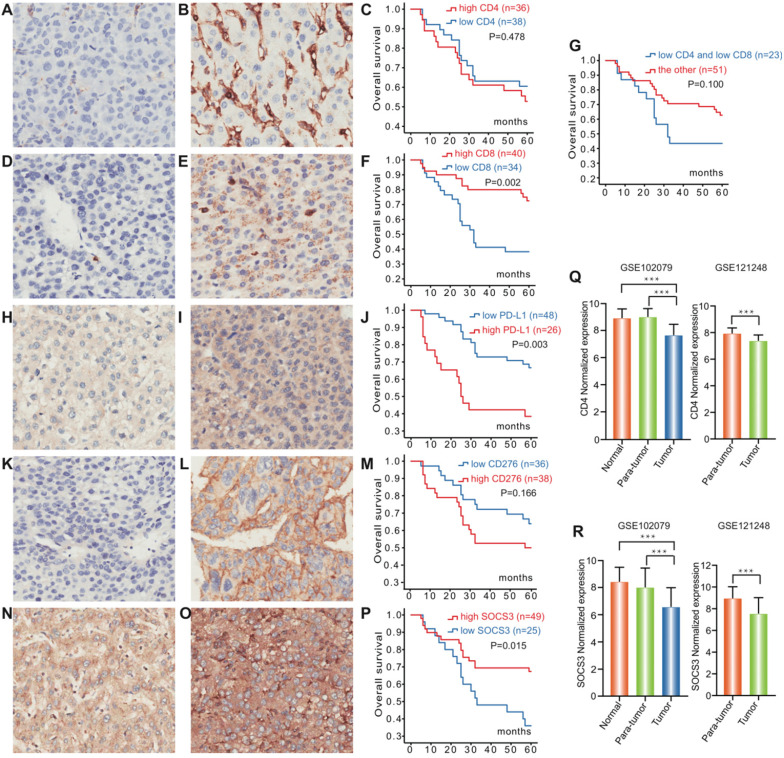
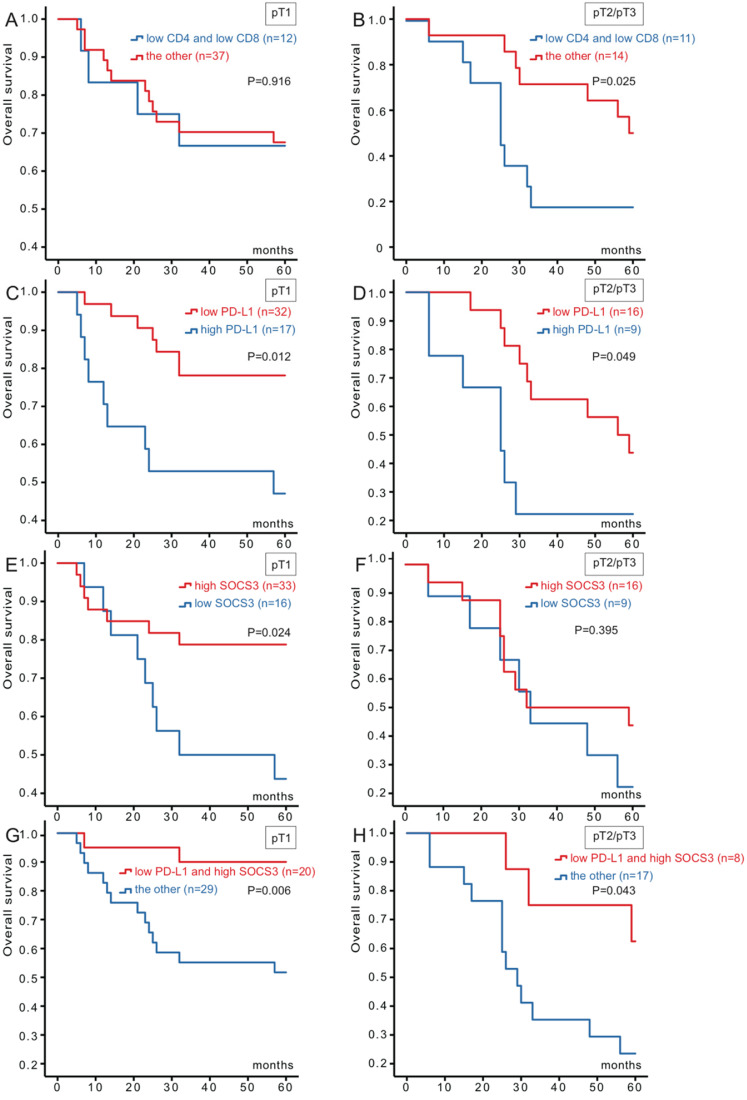
To investigate the correlation between the expression of PD-L1, SOCS3 and immune-related biomarkers CD276, CD4, CD8 in hepatocellular carcinoma (HCC) and further determine the relationship with clinicopathologic characteristics and the prognostic value of their co-expression in HCC patients. We assessed the expression of PD-L1, CD276, SOCS3, CD4 and CD8 by immunohistochemistry in tumor tissue from 74 HCC patients who underwent curative hepatectomy. High expression of PD-L1 was significantly associated with high Edmondson grade (p<0.01) and elevated enzyme (p=0.037); high expression of CD276 was significantly correlated with high Edmondson grade (p=0.021); high expression of SOCS3 was significantly associated with age (p=0.026) and tumor size (p=0.041), while PD-L1 showed no significant correlation. The expression of PD-L1, CD276, SOCS3 protein and other clinicopathological factors (sex, vascular invasion, tumor number, tumor capsule, pT stage, liver cirrhosis, HBsAg, TBiL, AFP) showed no significant correlation (p>0.05). High expression of CD8 was respectively significantly associated with worse overall survival (OS) (p=0.002). There was no significantly difference between CD4 and CD8 high-expression and overall survival (OS) (p=0.100). Both high expression of PD-L1 (p=0.003) and low expression of SOCS3 (p=0.015) was significantly associated with worse overall survival (OS). But CD276 only had a trendency (p=0.166). Additionally, multivariate Cox regression models implied that PD-L1, SOCS3, as well as both CD4 and CD8 was an independent prognostic factor for OS (p<0.05). Furthermore, HCC patients with PD-L1 low-expression and SOCS3 high-expression had a better prognostic according to the different pT stages (p<0.05). We for the first time demonstrated that PD-L1 and SOCS3 were independent prognostic factor for HCC patients. Co-expression of low PD-L1 and high SOCS3 could be a better predictive marker for HCC patients.
为研究肝细胞癌(HCC)中程序性死亡受体配体1(PD-L1)、细胞因子信号转导抑制因子3(SOCS3)与免疫相关生物标志物CD276、CD4、CD8表达之间的相关性,并进一步确定其与临床病理特征的关系以及它们的共表达在HCC患者中的预后价值。我们采用免疫组织化学方法评估了74例行根治性肝切除术的HCC患者肿瘤组织中PD-L1、CD276、SOCS3、CD4和CD8的表达。PD-L1高表达与高Edmondson分级(p<0.01)和酶升高(p=0.037)显著相关;CD276高表达与高Edmondson分级显著相关(p=0.021);SOCS3高表达与年龄(p=0.026)和肿瘤大小(p=0.041)显著相关,而PD-L1与之无显著相关性。PD-L1、CD276、SOCS3蛋白的表达与其他临床病理因素(性别、血管侵犯、肿瘤数目、肿瘤包膜、pT分期、肝硬化、乙肝表面抗原、总胆红素、甲胎蛋白)均无显著相关性(p>0.05)。CD8高表达分别与较差的总生存期(OS)显著相关(p=0.002)。CD4和CD8高表达与总生存期(OS)之间无显著差异(p=0.100)。PD-L1高表达(p=0.003)和SOCS3低表达(p=0.015)均与较差的总生存期(OS)显著相关。但CD276仅有相关趋势(p=0.166)。此外,多因素Cox回归模型表明,PD-L1、SOCS3以及CD4和CD8均是OS的独立预后因素(p<0.05)。此外,根据不同的pT分期,PD-L1低表达且SOCS3高表达的HCC患者预后较好(p<0.05)。我们首次证明PD-L1和SOCS3是HCC患者的独立预后因素。低PD-L1与高SOCS3共表达可能是HCC患者更好的预测标志物。