Pegueroles Jordi, Pané Adriana, Vilaplana Eduard, Montal Víctor, Bejanin Alexandre, Videla Laura, Carmona-Iragui María, Barroeta Isabel, Ibarzabal Ainitze, Casajoana Anna, Alcolea Daniel, Valldeneu Silvia, Altuna Miren, de Hollanda Ana, Vidal Josep, Ortega Emilio, Osorio Ricardo, Convit Antonio, Blesa Rafael, Lleó Alberto, Fortea Juan, Jiménez Amanda
Memory Unit, Department of Neurology Hospital de la Santa Creu i Sant Pau, Biomedical Research Institute Sant Pau, Universitat Autònoma de Barcelona Barcelona Spain.
Centro de Investigación Biomédica en Red de Enfermedades Neurodegenerativas (CIBERNED) Madrid Spain.
Alzheimers Dement (Amst). 2020 Jul 28;12(1):e12052. doi: 10.1002/dad2.12052. eCollection 2020.
AIMS/HYPOTHESIS: Midlife obesity is a risk factor for dementia. We investigated the impact of obesity on brain structure, metabolism, and cerebrospinal fluid (CSF) core Alzheimer's disease (AD) biomarkers in healthy elderly.
We selected controls from ADNI2 with CSF AD biomarkers and/or fluorodeoxyglucose positron emission tomography (FDG-PET) and 3T-MRI. We measured cortical thickness, FDG uptake, and CSF amyloid beta (Aβ)1-42, p-tau, and t-tau levels. We performed regression analyses between these biomarkers and body mass index (BMI).
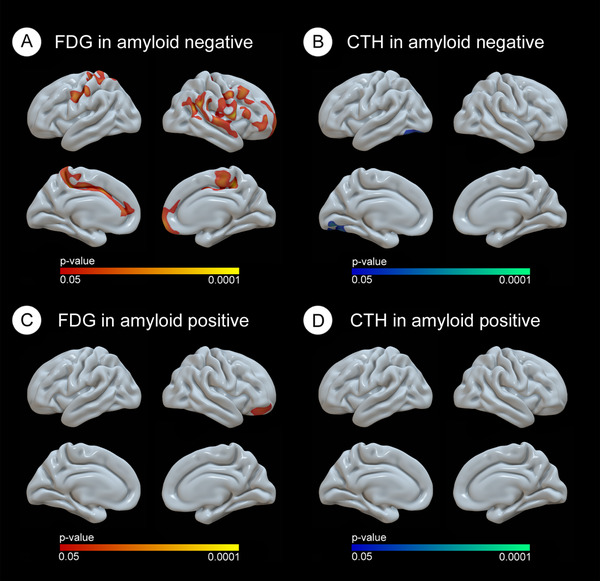
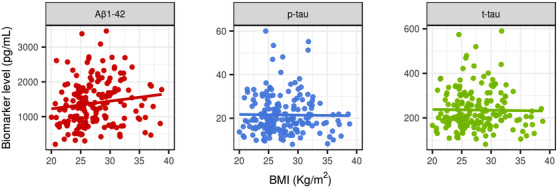
We included 201 individuals (mean age 73.5 years, mean BMI 27.4 kg/m). Higher BMI was related to less cortical thickness and higher metabolism in brain areas typically not involved in AD (family-wise error [FWE] <0.05), but not to AD CSF biomarkers. It is notable that the impact of obesity on brain metabolism and structure was also found in amyloid negative individuals.
CONCLUSIONS/INTERPRETATION: In the cognitively unimpaired elderly, obesity has differential effects on brain metabolism and structure independent of an underlying AD pathophysiology.
目的/假设:中年肥胖是痴呆症的一个风险因素。我们研究了肥胖对健康老年人脑结构、代谢以及脑脊液(CSF)中阿尔茨海默病(AD)核心生物标志物的影响。
我们从ADNI2中选取了具有CSF AD生物标志物和/或氟脱氧葡萄糖正电子发射断层扫描(FDG-PET)以及3T磁共振成像(MRI)的对照组。我们测量了皮质厚度、FDG摄取以及CSF淀粉样蛋白β(Aβ)1-42、磷酸化tau蛋白(p-tau)和总tau蛋白(t-tau)水平。我们对这些生物标志物与体重指数(BMI)之间进行了回归分析。
我们纳入了201名个体(平均年龄73.5岁,平均BMI为27.4 kg/m²)。较高的BMI与通常不涉及AD的脑区皮质厚度变薄和代谢增加有关(家族性错误率[FWE]<0.05),但与AD CSF生物标志物无关。值得注意的是,在淀粉样蛋白阴性个体中也发现了肥胖对脑代谢和结构的影响。
结论/解读:在认知未受损的老年人中,肥胖对脑代谢和结构有不同影响,且独立于潜在的AD病理生理学。