Poddar Jit, Singh Sukhpal, Kumar Pardeep, Bali Sharadendu, Gupta Sumeet, Chakrabarti Sasanka
Department of Biochemistry, Institute of Post-graduate Medical Education & Research, Kolkata, India.
Department of Biochemistry, M M Institute of Medical Sciences & Research, Maharishi Markandeshwar Deemed University, Mullana, Ambala, India.
Heliyon. 2020 Jul 23;6(7):e04490. doi: 10.1016/j.heliyon.2020.e04490. eCollection 2020 Jul.
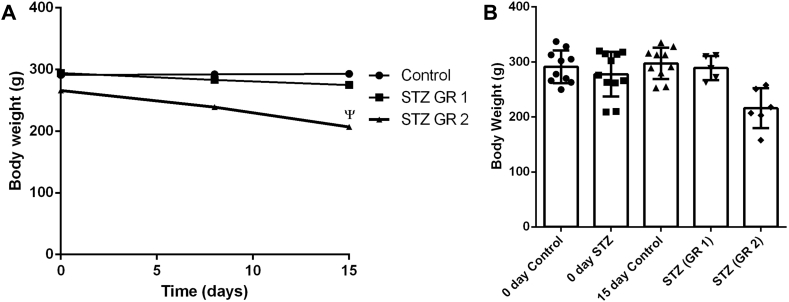
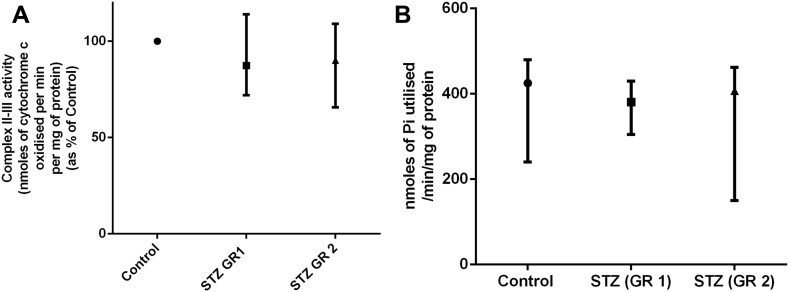
The effects of streptozotocin (STZ) on the brain after intracerebroventricular (ICV) administration in rodents have been suggested to mimic the pathogenesis of sporadic Alzheimer's disease (AD). Oxidative damage, decreased glucose utilization, mitochondrial bioenergetic changes, neuroinflammation and behavioral impairment have been reported in rodents after ICV-STZ administration. However, the molecular mechanisms of STZ effects on brain after ICV administration remain highly controversial. In this study we re-examined several bioenergetic parameters of rat brain mitochondria on day 15 following ICV-STZ treatment. We observed only a moderate but statistically significant decrease in complex I-III activity in brain mitochondria from streptozotocin-treated rats. There were no changes in complex II-III activity or phosphorylation capacity of brain mitochondria after streptozotocin treatment. More importantly, it was observed that ICV-STZ treatment caused variable degrees of body-weight loss in rats, and complex I-III activity was decreased only in those rats showing a significant (more than 10%-35%) loss in body-weights.
啮齿动物脑室内(ICV)注射链脲佐菌素(STZ)后对大脑的影响被认为可模拟散发性阿尔茨海默病(AD)的发病机制。在啮齿动物脑室内注射STZ后,已报道出现氧化损伤、葡萄糖利用减少、线粒体生物能量变化、神经炎症和行为障碍。然而,脑室内注射STZ后其对大脑影响的分子机制仍极具争议。在本研究中,我们在脑室内注射STZ治疗后第15天重新检测了大鼠脑线粒体的几个生物能量参数。我们观察到,链脲佐菌素处理的大鼠脑线粒体中复合体I - III活性仅出现中度但具有统计学意义的下降。链脲佐菌素处理后,脑线粒体的复合体II - III活性或磷酸化能力没有变化。更重要的是,观察到脑室内注射STZ处理导致大鼠体重出现不同程度的减轻,并且只有那些体重显著减轻(超过10% - 35%)的大鼠其复合体I - III活性才会降低。