Jung Hee-Won, Choi Jin-Hyuk, Jo Taehee, Shin Hyemi, Suh Jae Myoung
Graduate School of Medical Science and Engineering, Korea Advanced Institute for Science and Technology, Daejeon, Korea.
Biomedical Science and Engineering Interdisciplinary Program, Korea Advanced Institute for Science and Technology, Daejeon, Korea.
Ann Geriatr Med Res. 2019 Jun;23(2):83-89. doi: 10.4235/agmr.19.0012. Epub 2019 Jun 30.
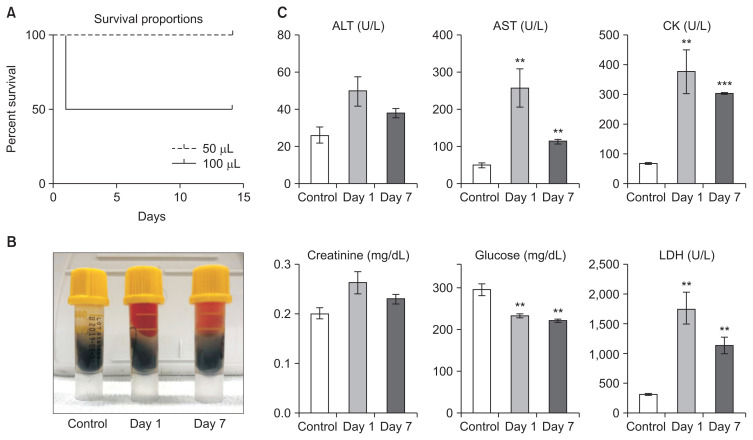
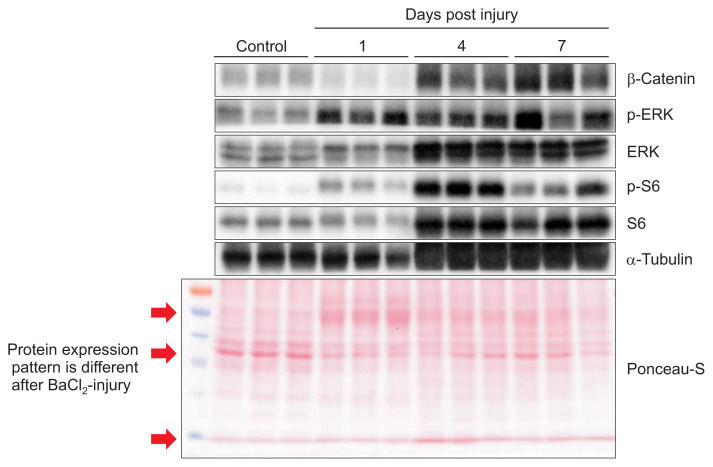
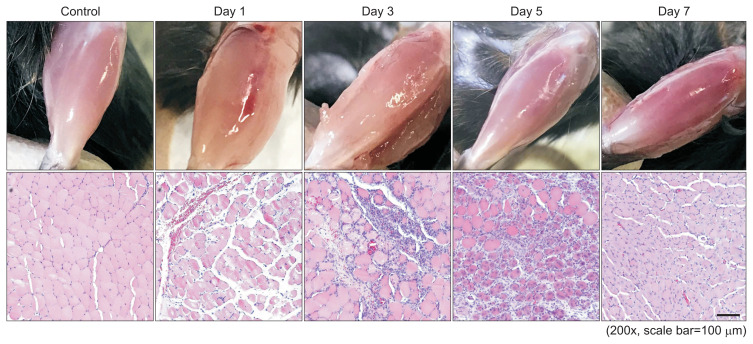
Skeletal muscle regeneration in mice has traditionally been studied using local freeze burn or snake venom injection models. More recently, a barium chloride (BaCl)-induced muscle injury model has been established and is gaining popularity due to the relatively simple procedure and accessibility to required reagents. Here we sought to characterize the local and systemic effects of BaCl-induced muscle injury. For this study, a 1.2% BaCl solution was locally administered to the tibialis anterior (TA) muscle and local and systemic phenotypes were analyzed at different timepoints. When 50 μL of the solution was injected unilaterally in the TA muscle, no mortality was observed. However, when 100 μL of the solution was injected, 50% of the mice died within 24 h. Serum analysis of the mice injected with 50 μL of BaCl solution at days 1 and 7 revealed changes resembling rhabdomyolysis. At day 1 post-injection of 50 μL of the BaCl solution, acute suppurative inflammation was observed in gross examination of the TA muscle, while extensive hemorrhagic necrosis was revealed on histological examination. At day 7, regenerated myofibers with centralized nuclei appeared with the resolution of acute inflammatory infiltration and the muscle tissue displayed molecular signatures consistent with myofiber differentiation. The overall muscle injury and regeneration phenotypes in the BaCl-induced muscle injury model were similar to those of the well-established freeze burn or snake venom injection models. Taken together, the BaCl-induced muscle injury model is comparable to conventional muscle injury and regeneration models, with considerations for possible systemic effects.
传统上,小鼠骨骼肌再生研究采用局部冻伤或蛇毒注射模型。最近,一种氯化钡(BaCl)诱导的肌肉损伤模型已被建立,由于其操作相对简单且所需试剂易于获取,该模型越来越受欢迎。在此,我们试图描述BaCl诱导的肌肉损伤的局部和全身影响。在本研究中,将1.2%的BaCl溶液局部注射到胫前(TA)肌,并在不同时间点分析局部和全身表型。当向TA肌单侧注射50μL该溶液时,未观察到死亡。然而,当注射100μL该溶液时,50%的小鼠在24小时内死亡。对在第1天和第7天注射50μL BaCl溶液的小鼠进行血清分析,结果显示出类似横纹肌溶解的变化。在注射50μL BaCl溶液后的第1天,对TA肌进行大体检查时观察到急性化脓性炎症,而组织学检查显示广泛的出血性坏死。在第7天,随着急性炎症浸润的消退,出现了核居中的再生肌纤维,并且肌肉组织显示出与肌纤维分化一致的分子特征。BaCl诱导的肌肉损伤模型中的整体肌肉损伤和再生表型与成熟的冻伤或蛇毒注射模型相似。综上所述,BaCl诱导的肌肉损伤模型与传统的肌肉损伤和再生模型相当,但需考虑可能的全身影响。