Jang Hak Chul
Department of Internal Medicine, Seoul National University Bundang Hospital, Seoul National University College of Medicine, Seongnam, Korea.
Ann Geriatr Med Res. 2018 Jun;22(2):73-79. doi: 10.4235/agmr.2018.22.2.73. Epub 2018 Jun 30.
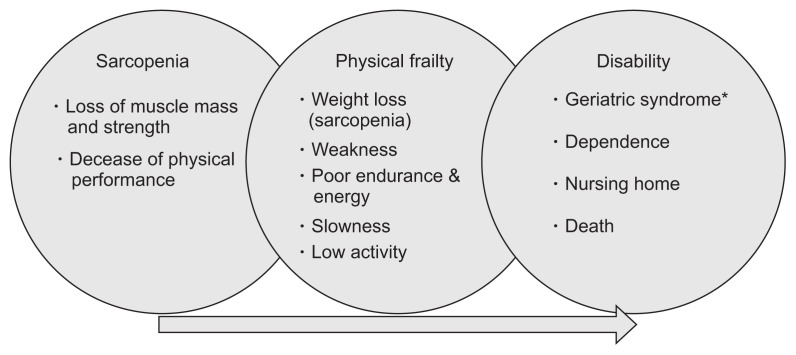
In 2017, Korea became an aged society, with the percentage of the population aged ≥65 years accounting for 14% of the total Korean population. The increasing number of older adults and the current health status of Korean older adults had led to increased medical expenditure and social problems. Sarcopenia, defined as the progressive decrease in skeletal muscle mass and strength, develops as a consequence of aging. Sarcopenia is also associated with a risk of adverse health outcomes such as frailty, physical disability, poor quality of life, and death. Thus, sarcopenia is a serious clinical problem among older adults. The International Classification of Diseases, Tenth Revision, Clinical Modification code for sarcopenia, M62.84, became available on October 1, 2016, in the United States. The diagnosis and treatment of sarcopenia urgently requires the establishment of an operational definition for sarcopenia in Korean older adults. In this article, I suggest a screening strategy and diagnostic criteria for sarcopenia in this population.
2017年,韩国步入老龄化社会,65岁及以上人口占韩国总人口的14%。老年人数量的增加以及韩国老年人目前的健康状况导致了医疗支出增加和社会问题。肌肉减少症的定义是骨骼肌质量和力量的逐渐下降,它是衰老的结果。肌肉减少症还与诸如虚弱、身体残疾、生活质量差和死亡等不良健康后果的风险相关。因此,肌肉减少症是老年人中的一个严重临床问题。2016年10月1日,美国开始使用国际疾病分类第十次修订本临床修订版中肌肉减少症的编码M62.84。肌肉减少症的诊断和治疗迫切需要为韩国老年人建立一个可操作的肌肉减少症定义。在本文中,我提出了针对该人群肌肉减少症的筛查策略和诊断标准。