Laboratory of Behavioural Gastronomy, Centre for Healthy Eating and Food Innovation, Maastricht University Campus Venlo, Venlo, Netherlands.
Princess Máxima Center for Pediatric Oncology, Utrecht, Netherlands.
Support Care Cancer. 2021 Mar;29(3):1619-1628. doi: 10.1007/s00520-020-05650-3. Epub 2020 Aug 2.
Chemotherapy can affect smell and taste function. This has never been investigated in childhood cancer patients during chemotherapy. The objective of this study was to determine whether psychophysical smell and taste tests are suitable for children with cancer. Taste and smell function, fungiform papillae density, and eating behavior were measured before (T1) and after (T2) a cycle of chemotherapy and compared with healthy controls.
Thirty-one childhood cancer patients treated for a hematological, solid, or brain malignancy (median age 12 years, 16 girls), and 24 healthy controls (median age: 11 years, 10 girls) participated. Smell function was measured using Sniffin' Sticks, including a threshold, discrimination, and identification test. Taste Strips were used to determine recognition thresholds for sweet, sour, salty, and bitter taste. Papillae density was investigated by counting the fungiform papillae of the anterior tongue. Eating behavior was assessed using the Behavioral Pediatrics Feeding Assessment Scale (BPFAS).
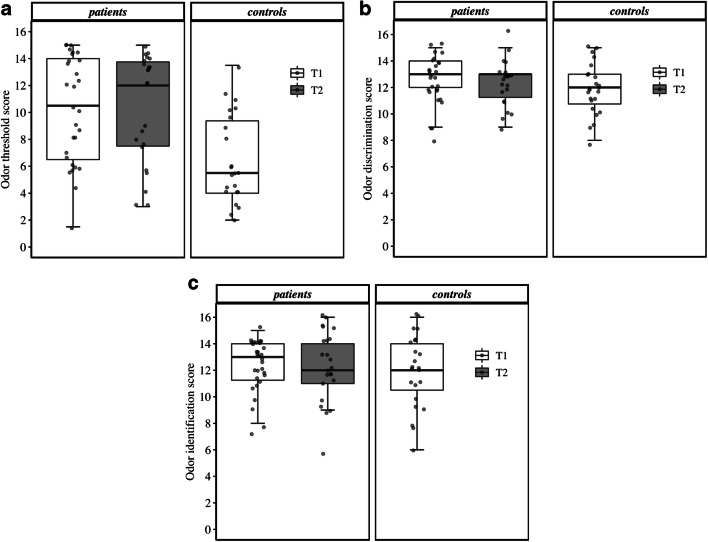
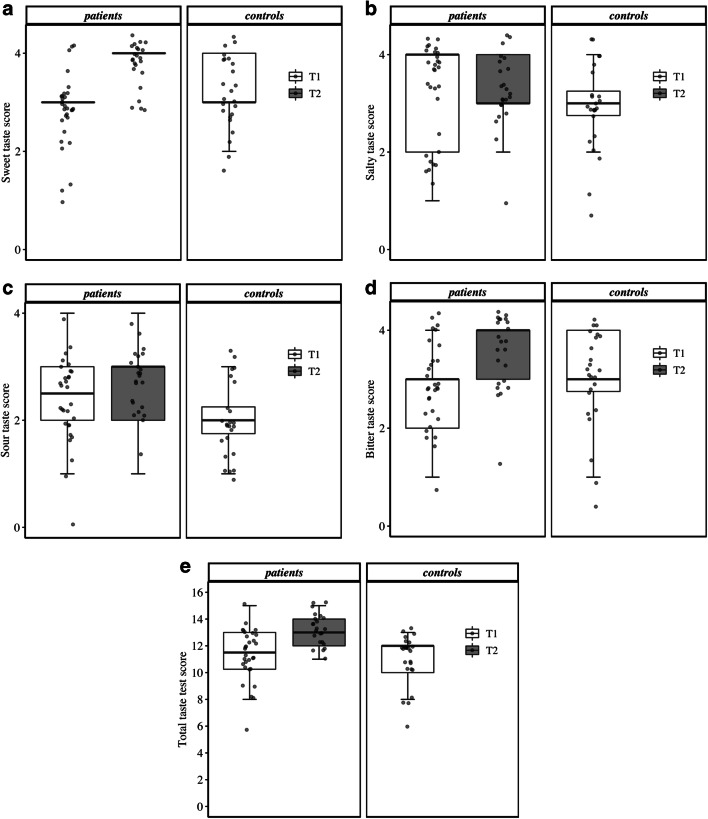
Smell and taste function could be investigated in more than 90% of the patients, while fungiform papillae density could be determined in 61% of the patients. A significant difference in smell threshold was found between patients and controls (p = 0.001), showing lower thresholds in patients. In patients, sweet taste (p < 0.001), bitter taste (p = 0.028), and total taste function (p = 0.004) were significantly different after a cycle of chemotherapy, with higher scores at T2.
The assessment of smell, taste, and fungiform papillae density is feasible in children with cancer. Results of the current study suggest that smell and taste sensitivity increased in children with cancer.
化疗会影响嗅觉和味觉功能。这在儿童癌症患者的化疗过程中从未被研究过。本研究的目的是确定心理物理学嗅觉和味觉测试是否适用于癌症儿童。在化疗周期前后(T1 和 T2)测量了味觉和嗅觉功能、菌状乳头密度和进食行为,并与健康对照组进行了比较。
31 名患有血液、实体或脑恶性肿瘤的儿童癌症患者(中位年龄 12 岁,16 名女孩)和 24 名健康对照组(中位年龄:11 岁,10 名女孩)参与了研究。使用 Sniffin' Sticks 测量嗅觉功能,包括阈值、辨别和识别测试。味觉条用于确定对甜、酸、咸和苦味觉的识别阈值。通过计数舌前部的菌状乳头来调查菌状乳头密度。使用行为儿科学喂养评估量表(BPFAS)评估进食行为。
超过 90%的患者可以进行嗅觉和味觉功能的研究,而 61%的患者可以确定菌状乳头密度。患者和对照组之间的嗅觉阈值存在显著差异(p=0.001),患者的阈值较低。在患者中,甜味(p<0.001)、苦味(p=0.028)和总味觉功能(p=0.004)在化疗周期后明显不同,T2 时得分更高。
评估癌症儿童的嗅觉、味觉和菌状乳头密度是可行的。本研究的结果表明,癌症儿童的嗅觉和味觉敏感性增加。