Department of Chemistry, Yale University, New Haven, CT 06520;
Green Center for Systems Biology, University of Texas Southwestern Medical Center, Dallas, TX 75390.
Proc Natl Acad Sci U S A. 2020 Aug 18;117(33):19879-19887. doi: 10.1073/pnas.1909634117. Epub 2020 Aug 3.
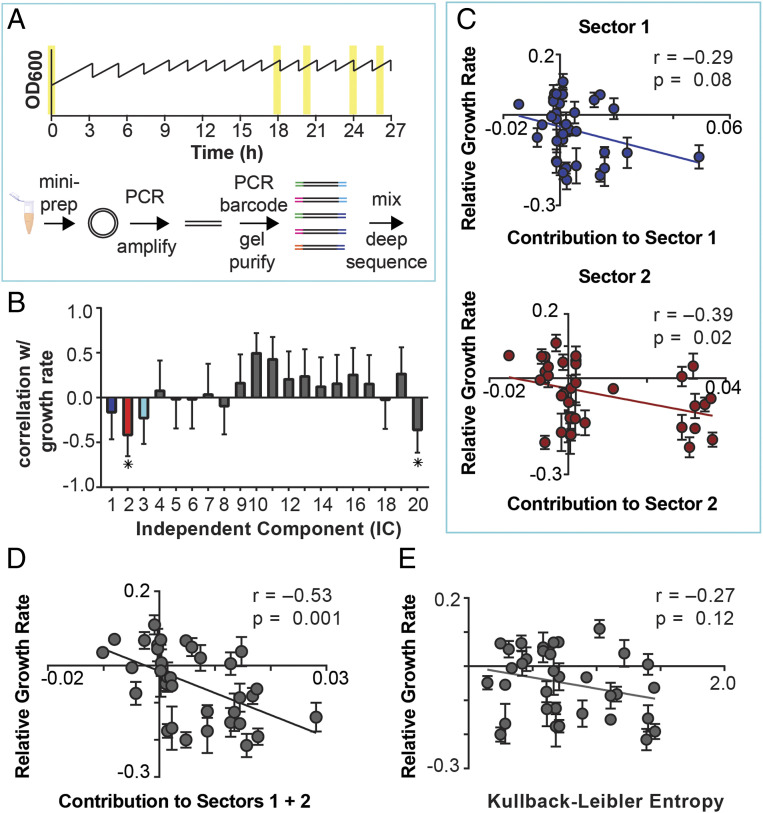
The ribosome translates the genetic code into proteins in all domains of life. Its size and complexity demand long-range interactions that regulate ribosome function. These interactions are largely unknown. Here, we apply a global coevolution method, statistical coupling analysis (SCA), to identify coevolving residue networks (sectors) within the 23S ribosomal RNA (rRNA) of the large ribosomal subunit. As in proteins, SCA reveals a hierarchical organization of evolutionary constraints with near-independent groups of nucleotides forming physically contiguous networks within the three-dimensional structure. Using a quantitative, continuous-culture-with-deep-sequencing assay, we confirm that the top two SCA-predicted sectors contribute to ribosome function. These sectors map to distinct ribosome activities, and their origins trace to phylogenetic divergences across all domains of life. These findings provide a foundation to map ribosome allostery, explore ribosome biogenesis, and engineer ribosomes for new functions. Despite differences in chemical structure, protein and RNA enzymes appear to share a common internal logic of interaction and assembly.
核糖体将遗传密码翻译成所有生命领域的蛋白质。其大小和复杂性需要远距离相互作用来调节核糖体的功能。这些相互作用在很大程度上是未知的。在这里,我们应用全局共进化方法,统计耦合分析(SCA),来识别大核糖体亚基的 23S 核糖体 RNA(rRNA)内共进化残基网络(扇区)。与蛋白质一样,SCA 揭示了进化约束的层次组织,具有近乎独立的核苷酸群在三维结构中形成物理上连续的网络。使用定量的、带有深度测序的连续培养测定法,我们证实了 SCA 预测的前两个扇区有助于核糖体功能。这些扇区映射到不同的核糖体活性,它们的起源可以追溯到所有生命领域的系统发育分歧。这些发现为映射核糖体变构、探索核糖体生物发生以及为新功能设计核糖体提供了基础。尽管在化学结构上存在差异,但蛋白质和 RNA 酶似乎共享相互作用和组装的共同内在逻辑。