Department of Gastroenterology and Hepatology, Musashino Red Cross Hospital, 1-26-1, Kyonan-cho, Musashino-shi, Tokyo, 180-8610, Japan.
Center for Liver-Biliary-Pancreatic Diseases, Matsuyama Red Cross Hospital, Ehime, Japan.
Sci Rep. 2020 Aug 3;10(1):13021. doi: 10.1038/s41598-020-69522-w.
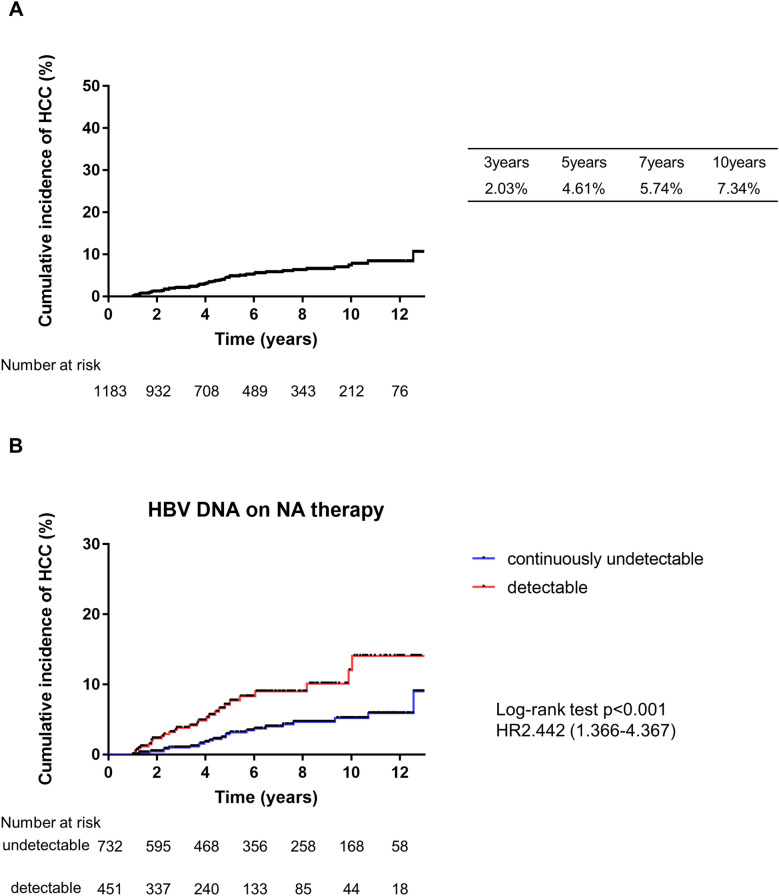
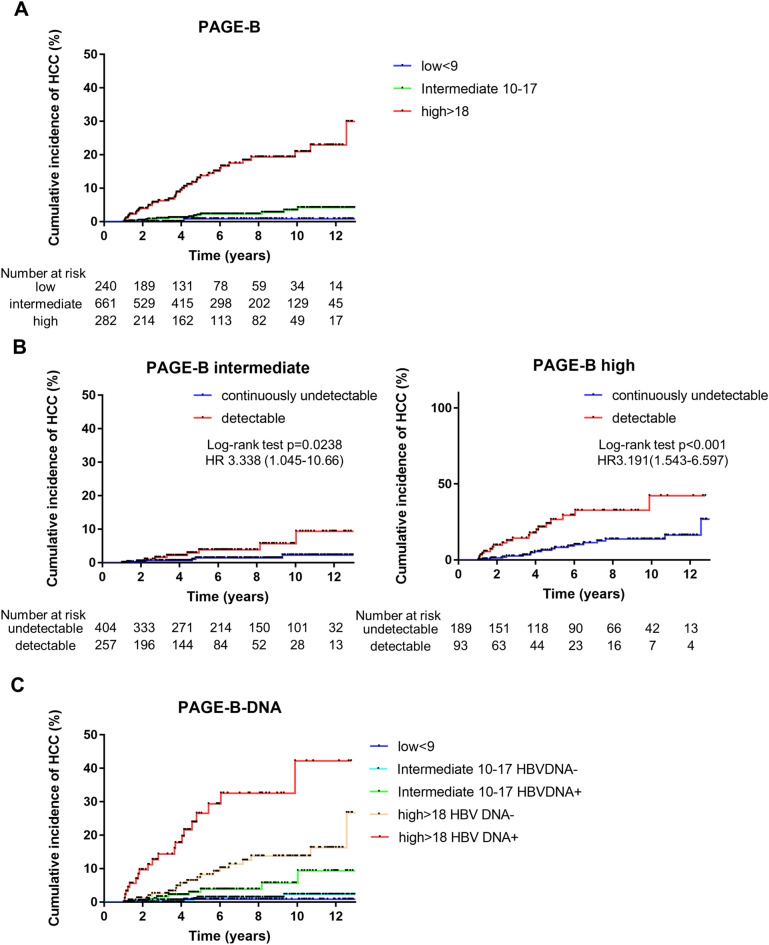
Nucleos(t)ide analogs (NA) suppress hepatitis B virus (HBV) replication and reduce the risk of hepatocellular carcinoma (HCC). However, NA cannot suppress carcinogenesis completely in patients with chronic hepatitis B. The aims of this study were to identify risk factors for HCC and develop a refined carcinogenesis prediction model. Patients receiving NA therapy (n = 1,183) were recruited retrospectively from the 16 hospitals. All patients had been receiving NA continuously for more than 1 year until the end of the follow-up. During a median follow-up of 4.9 (1.0-12.9) years, 52 (4.4%) patients developed HCC. A multivariate analysis revealed that male gender, older age, lower platelet counts at the baseline, and detectable HBV DNA during NA therapy were independent predictive factors of HCC development. The PAGE-B score was calculated by using these factors. 240 (20.3%), 661 (55.9%), and 282 (23.8%) patients were classified into low-, intermediate-, and high-risk groups, respectively. In the intermediate- and high-risk group, detectable HBV DNA was significantly associated with a higher risk of HCC development compared with continuously undetectable HBV DNA, respectively (HR 3.338; 95% CI 1.045-10.66/HR 3.191; 95% CI 1.543-6.597). PAGE-B-DNA, which is the combined PAGE-B and HBV DNA status, was valuable for a more refined stratification of PAGE-B.
核苷(酸)类似物 (NA) 抑制乙型肝炎病毒 (HBV) 复制,降低肝细胞癌 (HCC) 的风险。然而,NA 不能完全抑制慢性乙型肝炎患者的癌变。本研究旨在确定 HCC 的危险因素,并建立一个改良的癌变预测模型。回顾性招募了 16 家医院接受 NA 治疗的患者(n=1183)。所有患者均持续接受 NA 治疗超过 1 年,直至随访结束。在中位随访 4.9(1.0-12.9)年后,52(4.4%)例患者发生 HCC。多因素分析显示,男性、年龄较大、基线时血小板计数较低和 NA 治疗期间 HBV DNA 可检测是 HCC 发展的独立预测因素。使用这些因素计算 PAGE-B 评分。240(20.3%)、661(55.9%)和 282(23.8%)例患者分别归入低、中、高危组。在中危和高危组中,与持续不可检测的 HBV DNA 相比,可检测的 HBV DNA 与 HCC 发展的风险显著相关(HR 3.338;95%CI 1.045-10.66/HR 3.191;95%CI 1.543-6.597)。结合 PAGE-B 和 HBV DNA 状态的 PAGE-B-DNA 对 PAGE-B 进行更精细的分层具有重要价值。