Whitney Laboratory for Marine Bioscience and Departments of Neuroscience, University of Florida, St. Augustine and Gainesville, FL, 32080, USA.
Institute of Higher Nervous Activity and Neurophysiology, Russian Academy of Sciences, Moscow, 117485, Russia.
Sci Rep. 2020 Aug 3;10(1):13020. doi: 10.1038/s41598-020-69851-w.
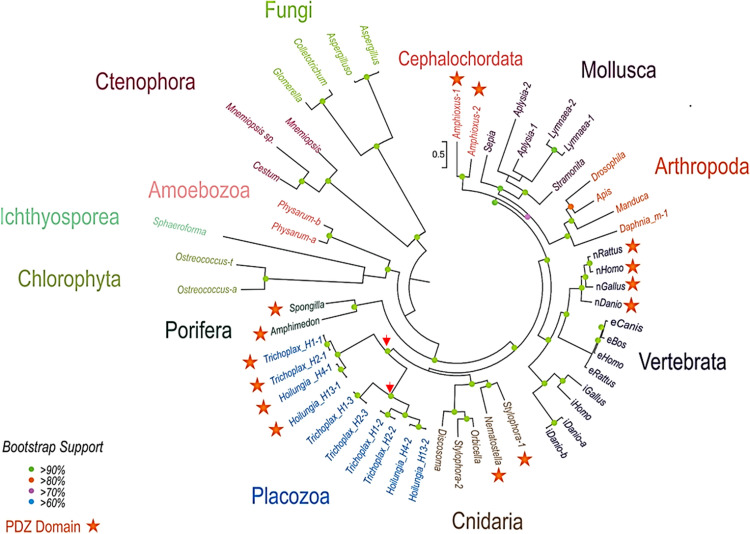
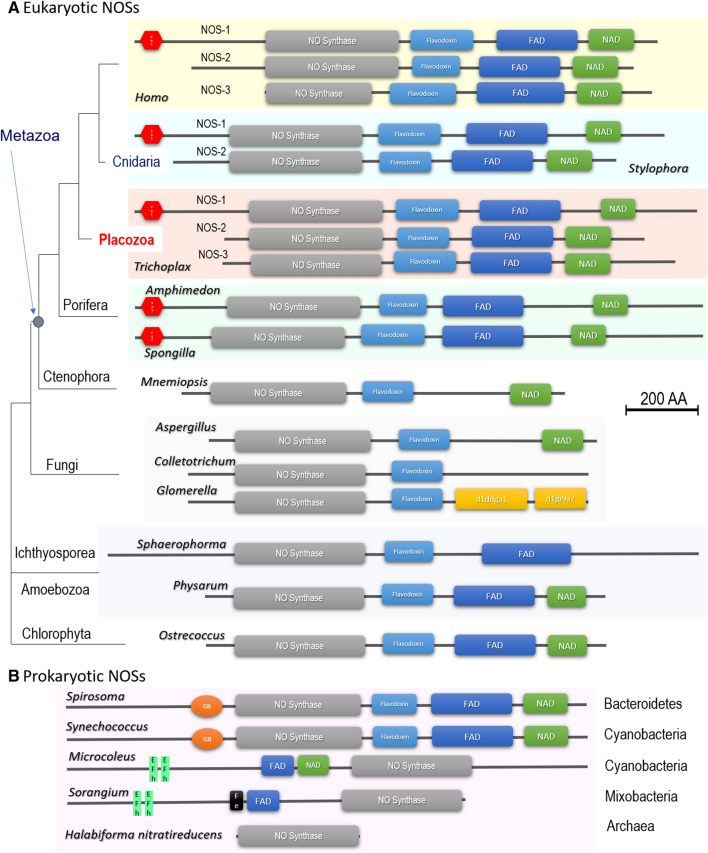
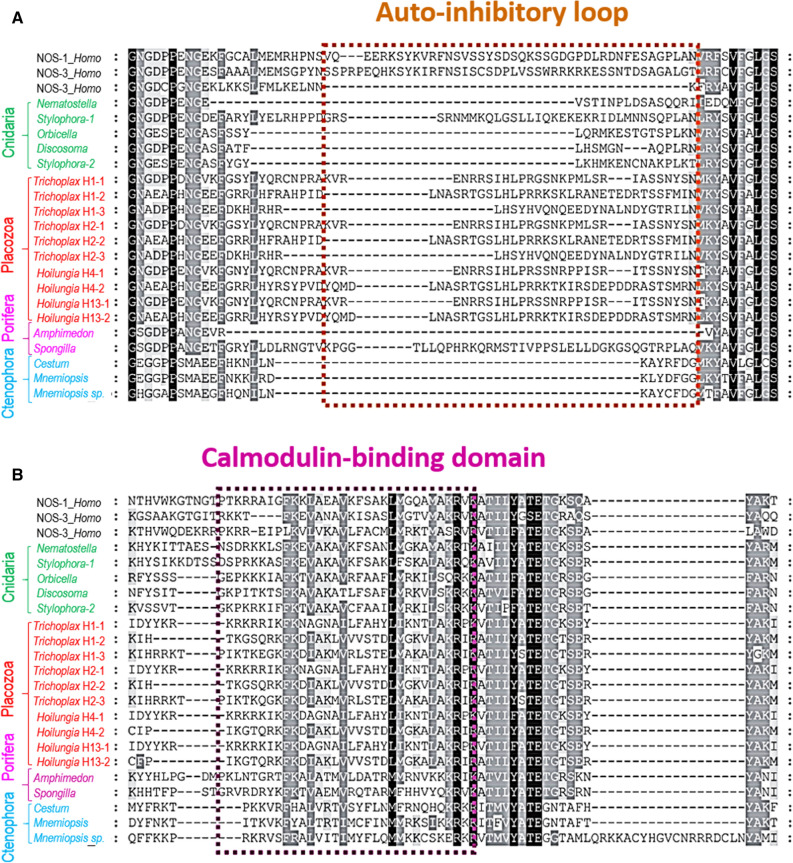
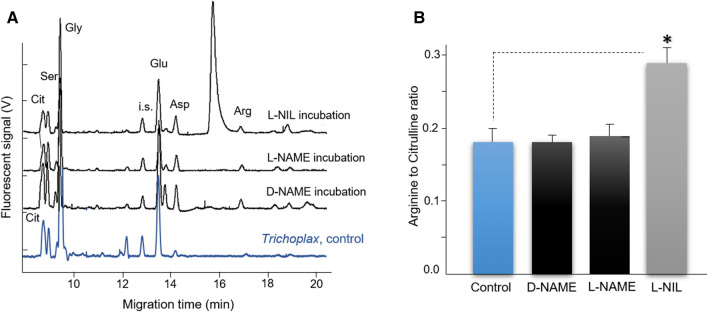
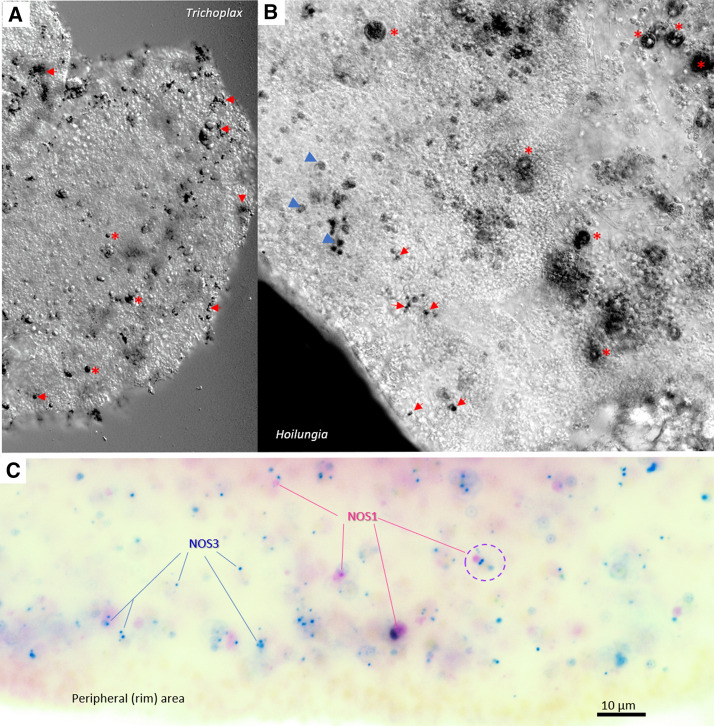
Nitric oxide (NO) is a ubiquitous gaseous messenger, but we know little about its early evolution. Here, we analyzed NO synthases (NOS) in four different species of placozoans-one of the early-branching animal lineages. In contrast to other invertebrates studied, Trichoplax and Hoilungia have three distinct NOS genes, including PDZ domain-containing NOS. Using ultra-sensitive capillary electrophoresis assays, we quantified nitrites (products of NO oxidation) and L-citrulline (co-product of NO synthesis from L-arginine), which were affected by NOS inhibitors confirming the presence of functional enzymes in Trichoplax. Using fluorescent single-molecule in situ hybridization, we showed that distinct NOSs are expressed in different subpopulations of cells, with a noticeable distribution close to the edge regions of Trichoplax. These data suggest both the compartmentalized release of NO and a greater diversity of cell types in placozoans than anticipated. NO receptor machinery includes both canonical and novel NIT-domain containing soluble guanylate cyclases as putative NO/nitrite/nitrate sensors. Thus, although Trichoplax and Hoilungia exemplify the morphologically simplest free-living animals, the complexity of NO-cGMP-mediated signaling in Placozoa is greater to those in vertebrates. This situation illuminates multiple lineage-specific diversifications of NOSs and NO/nitrite/nitrate sensors from the common ancestor of Metazoa and the preservation of conservative NOS architecture from prokaryotic ancestors.
一氧化氮(NO)是一种普遍存在的气态信使,但我们对其早期进化知之甚少。在这里,我们分析了 4 种不同扁盘动物物种中的一氧化氮合酶(NOS)——一种早期分支的动物谱系。与其他已研究的无脊椎动物不同,Trichoplax 和 Hoilungia 有三个不同的 NOS 基因,包括含有 PDZ 结构域的 NOS。我们使用超灵敏毛细管电泳分析,定量了亚硝酸盐(NO 氧化的产物)和 L-瓜氨酸(L-精氨酸合成 NO 的副产物),NOS 抑制剂对它们的影响证实了 Trichoplax 中存在功能性酶。使用荧光单分子原位杂交,我们表明不同的 NOS 在细胞的不同亚群中表达,在 Trichoplax 的边缘区域附近有明显的分布。这些数据表明,NO 的分隔释放和扁盘动物中比预期更多的细胞类型多样性。NO 受体机制包括经典和新型 NIT 结构域含有可溶性鸟苷酸环化酶,作为潜在的 NO/亚硝酸盐/硝酸盐传感器。因此,尽管 Trichoplax 和 Hoilungia 是形态最简单的自由生活动物的范例,但 Placozoa 中 NO-cGMP 介导的信号转导的复杂性比脊椎动物更高。这种情况阐明了 NOS 和 NO/亚硝酸盐/硝酸盐传感器从 Metazoa 的共同祖先以及从原核祖先保守的 NOS 结构的多个谱系特异性多样化。