Departamento de Tecnología Química y Ambiental, Universidad Rey Juan Carlos, 28933 Móstoles (Madrid), Spain.
Departamento de Ingenieria Química, Facultad de Ciencias, Universidad Autonoma de Madrid, Campus de Cantoblanco, 28049 Madrid, Spain.
Molecules. 2020 Aug 2;25(15):3534. doi: 10.3390/molecules25153534.
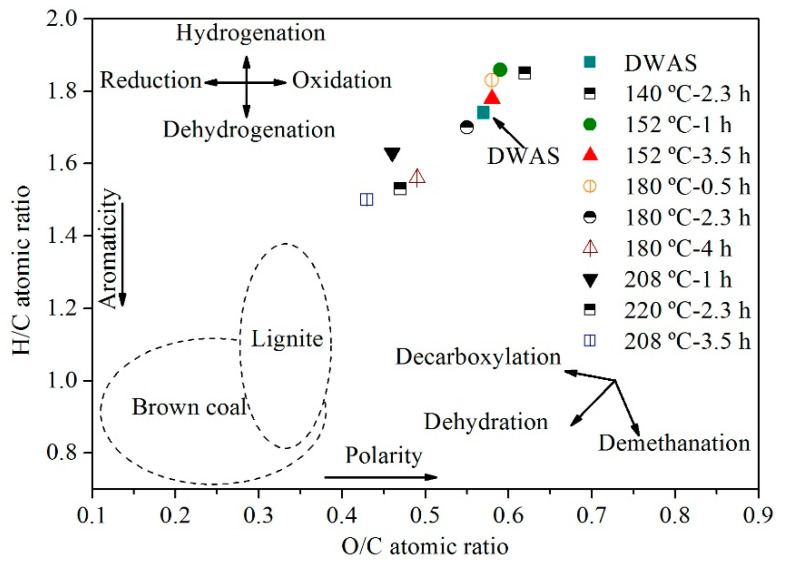
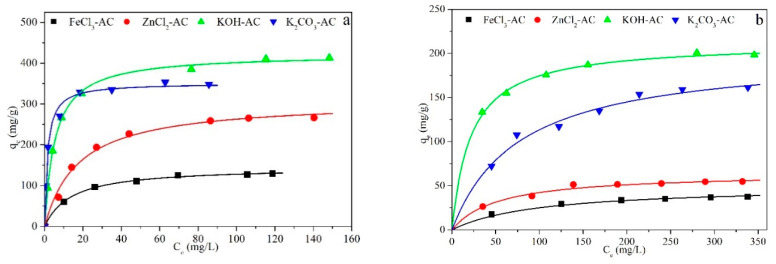
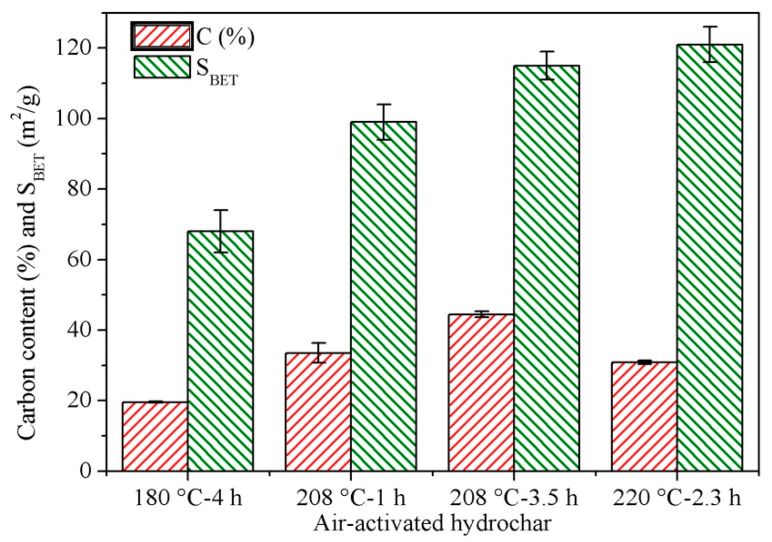
In this work, dewatered waste activated sludge (DWAS) was subjected to hydrothermal carbonization to obtain hydrochars that can be used as renewable solid fuels or activated carbon precursors. A central composite rotatable design was used to analyze the effect of temperature (140-220 °C) and reaction time (0.5-4 h) on the physicochemical properties of the products. The hydrochars exhibited increased heating values (up to 22.3 MJ/kg) and their air-activation provided carbons with a low BET area (100 m/g). By contrast, chemical activation with KCO, KOH, FeCl and ZnCl gave carbons with a well-developed porous network (BET areas of 410-1030 m/g) and substantial contents in mesopores (0.079-0.271 cm/g) and micropores (0.136-0.398 cm/g). The chemically activated carbons had a fairly good potential to adsorb emerging pollutants such as sulfamethoxazole, antipyrine and desipramine from the liquid phase. This was especially the case with KOH-activated hydrochars, which exhibited a maximum adsorption capacity of 412, 198 and 146 mg/g, respectively, for the previous pollutants.
在这项工作中,脱水剩余活性污泥(DWAS)经过水热碳化处理,得到了可以用作可再生固体燃料或活性炭前体的水热炭。采用中心复合旋转设计,分析了温度(140-220°C)和反应时间(0.5-4 h)对产物理化性质的影响。水热炭的发热值增加(最高可达 22.3 MJ/kg),其空气活化提供的炭具有较低的 BET 面积(100 m/g)。相比之下,用 KCO、KOH、FeCl 和 ZnCl 进行化学活化得到的炭具有发达的多孔网络(BET 面积为 410-1030 m/g)和大量中孔(0.079-0.271 cm/g)和微孔(0.136-0.398 cm/g)。化学活化炭对从液相中吸附新兴污染物(如磺胺甲恶唑、安替比林和去甲丙咪嗪)具有相当好的潜力。对于 KOH 活化的水热炭来说尤其如此,它对前三种污染物的最大吸附容量分别为 412、198 和 146 mg/g。