Mena-Vázquez Natalia, Rojas-Gimenez Marta, Jimenez Nuñez Francisco Gabriel, Manrique-Arija Sara, Rioja José, Ruiz-Limón Patricia, Ureña Inmaculada, Castro-Cabezas Manuel, Valdivielso Pedro, Fernández-Nebro Antonio
The Institute of Biomedical Research in Malaga (IBIMA), 29010 Málaga, Spain.
UGC de Reumatología, Hospital Regional Universitario de Málaga, 29009 Málaga, Spain.
J Clin Med. 2020 Aug 2;9(8):2483. doi: 10.3390/jcm9082483.
To describe postprandial lipemia in patients with rheumatoid arthritis (RA) and to analyze its association with subclinical atherosclerosis measured as carotid intima-media thickness (cIMT).
We performed an observational study of 40 patients with RA and 40 sex and age-matched controls. Patients with dyslipidemia were excluded. Pathologically increased cIMT was defined as a carotid thickness greater than the 90th percentile (>p90) for age and sex. Fasting and postprandial plasma lipids, cholesterol, triglycerides, apolipoprotein B48 (ApoB48), and total ApoB were evaluated. The other variables included were clinical and laboratory values, Framingham score, and the 28-joint Disease Activity Score (DAS28). Two multivariate models were constructed to identify factors associated with pathologic cIMT in patients with RA.
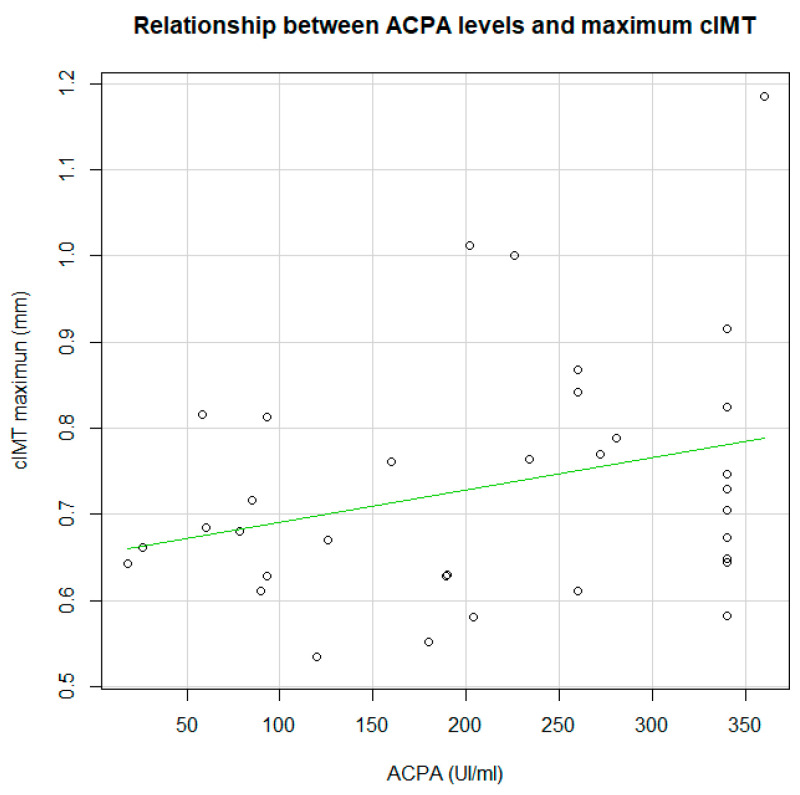
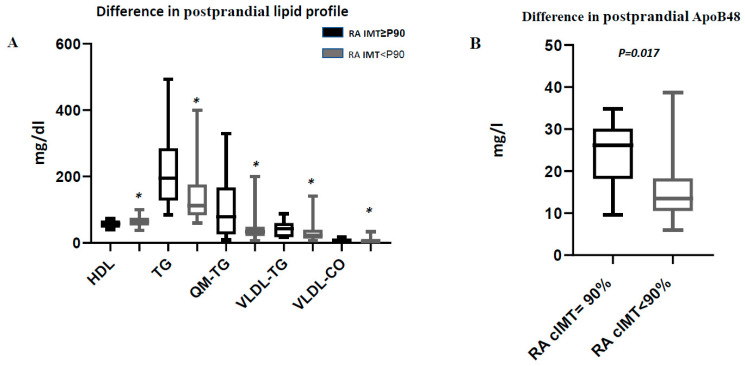
Fasting lipid values were similar in patients with RA and controls, although those of postprandial ApoB48 were higher (median (IQR), 14.4 (10.8-12.1) vs. 12.1 (2.3-9,8); = 0.042). Pathologic cIMT was recorded in 10 patients with RA (25%) and nine controls (22.5%). In patients with RA, pathologic cIMT was associated with postprandial ApoB48 (OR (95% CI), 1.15 (1.0-1.3)) and total ApoB (OR [95% CI], 1.12 [1.1-1.2]). The second model revealed a mean increase of 0.256 mm for cIMT in patients with elevated anticitrullinated protein antibodies (ACPAs).
Postprandial ApoB48 levels in patients with RA are higher than in controls. Postprandial ApoB48 and total ApoB levels and markers of severity, such as ACPAs, are associated with pathologic cIMT in patients with RA. Our findings could indicate that these atherogenic particles have a negative effect on the endothelium.
描述类风湿关节炎(RA)患者的餐后血脂异常,并分析其与通过颈动脉内膜中层厚度(cIMT)测量的亚临床动脉粥样硬化之间的关联。
我们对40例RA患者和40例年龄及性别匹配的对照进行了一项观察性研究。排除血脂异常患者。病理性cIMT增加定义为颈动脉厚度大于年龄和性别的第90百分位数(>p90)。评估空腹和餐后血浆脂质、胆固醇、甘油三酯、载脂蛋白B48(ApoB48)和总载脂蛋白B。纳入的其他变量包括临床和实验室值、弗雷明汉评分以及28关节疾病活动评分(DAS28)。构建两个多变量模型以确定RA患者中与病理性cIMT相关的因素。
RA患者和对照组的空腹血脂值相似,尽管餐后ApoB48值较高(中位数(四分位间距),14.4(10.8 - 12.1)对12.1(2.3 - 9.8);P = 0.042)。10例RA患者(25%)和9例对照(22.5%)记录有病理性cIMT。在RA患者中,病理性cIMT与餐后ApoB48(比值比(95%置信区间),1.15(1.0 - 1.3))和总载脂蛋白B(比值比[95%置信区间],1.12[1.1 - 1.2])相关。第二个模型显示抗瓜氨酸化蛋白抗体(ACPA)升高的患者cIMT平均增加0.256 mm。
RA患者的餐后ApoB48水平高于对照组。餐后ApoB48和总载脂蛋白B水平以及严重程度标志物,如ACPA,与RA患者的病理性cIMT相关。我们的研究结果可能表明这些致动脉粥样硬化颗粒对内皮有负面影响。