
通过对西班牙裔美国人和非裔美国人患者群体进行可用性测试优化远程医疗体验设计:观察性研究
Optimizing Telehealth Experience Design Through Usability Testing in Hispanic American and African American Patient Populations: Observational Study.
作者信息
King D'Arcy, Khan Sundas, Polo Jennifer, Solomon Jeffrey, Pekmezaris Renee, Hajizadeh Negin
机构信息
Donald and Barbara Zucker School of Medicine at Hofstra/Northwell, Manhasset, NY, United States.
出版信息
JMIR Rehabil Assist Technol. 2020 Aug 4;7(2):e16004. doi: 10.2196/16004.
BACKGROUND
Telehealth-delivered pulmonary rehabilitation (telePR) has been shown to be as effective as standard pulmonary rehabilitation (PR) at improving the quality of life in patients living with chronic obstructive pulmonary disease (COPD). However, it is not known how effective telePR may prove to be among low-income, urban Hispanic American and African American patient populations. To address this question, a collaborative team at Northwell Health developed a telePR intervention and assessed its efficacy among low-income Hispanic American and African American patient populations. The telePR intervention system components included an ergonomic recumbent bike, a tablet with a built-in camera, and wireless monitoring devices.
OBJECTIVE
The objective of the study was to assess patient adoption and diminish barriers to use by initiating a user-centered design approach, which included usability testing to refine the telePR intervention prior to enrolling patients with COPD into a larger telePR study.
METHODS
Usability testing was conducted in two phases to identify opportunities to streamline and improve the patient experience. The first phase included a prefield usability testing phase to evaluate technical, patient safety, and environmental factors comprising the system architecture. This was followed by an ergonomic evaluation of user interactions with the bicycle, telehealth tablets, and connected wearable devices to ensure optimal placement and practical support for all components of the intervention. The second phase of research included feasibility testing to observe and further optimize the system based on iterative rounds of telePR sessions.
RESULTS
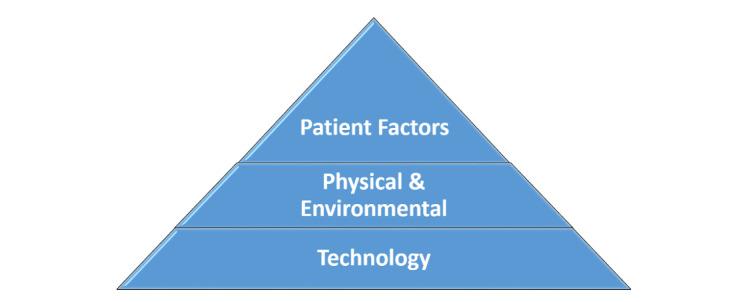
During usability and feasibility research, we identified and addressed multiple opportunities for system improvements. These included physical and environmental changes, modifications to accommodate individual patient factors, safety improvements, and technology upgrades. Each enrolled patient was subsequently identified and classified into one of the following 3 categories: (1) independent, (2) intermediate, or (3) dependent. This categorization was used to predict the level of training and support needed for successful participation in the telePR sessions. Feasibility results revealed that patients in the dependent category were unable to perform the rehab sessions without in-person support due to low technical acumen and difficulty with certain features of the system, even after modifications had been made. Intermediate and independent users, however, did exhibit increased independent utilization of telePR due to iterative improvements.
CONCLUSIONS
Usability testing helped reduce barriers to use for two subsets of our population, the intermediate and independent users. In addition, it identified a third subset, dependent users, for whom the telePR solution was deemed unsuitable without in-person support. The study established the need for the development of standard operating procedures, and guides were created for both patients and remote respiratory therapists to facilitate the appropriate use of the telePR system intervention. Observational research also led to the development of standard protocols for the first and all subsequent telePR sessions. The primary goals in developing standardization protocols were to establish trust, ensure a positive experience, and encourage future patient engagement with telePR sessions.
背景
远程医疗提供的肺康复(telePR)已被证明在改善慢性阻塞性肺疾病(COPD)患者生活质量方面与标准肺康复(PR)一样有效。然而,尚不清楚telePR在低收入的城市西班牙裔美国人和非裔美国人患者群体中效果如何。为解决这个问题,诺斯韦尔健康中心的一个合作团队开发了一种telePR干预措施,并评估了其在低收入西班牙裔美国人和非裔美国人患者群体中的疗效。telePR干预系统组件包括一台符合人体工程学的卧式自行车、一台内置摄像头的平板电脑和无线监测设备。
目的
本研究的目的是通过采用以用户为中心的设计方法来评估患者对该系统的接受程度并减少使用障碍,该方法包括在将COPD患者纳入更大规模的telePR研究之前进行可用性测试以优化telePR干预措施。
方法
可用性测试分两个阶段进行,以确定简化和改善患者体验的机会。第一阶段包括预现场可用性测试阶段,以评估构成系统架构的技术、患者安全和环境因素。随后对用户与自行车、远程医疗平板电脑和连接的可穿戴设备的交互进行了人体工程学评估,以确保对干预措施的所有组件进行最佳放置和实际支持。研究的第二阶段包括可行性测试,以基于telePR疗程的迭代轮次观察并进一步优化系统。
结果
在可用性和可行性研究过程中,我们确定并解决了多个系统改进机会。这些改进包括物理和环境方面的改变、为适应个体患者因素而进行的修改、安全改进以及技术升级。随后,每个登记的患者被识别并分类为以下3类之一:(1)独立型,(2)中间型,或(3)依赖型。这种分类用于预测成功参与telePR疗程所需的培训和支持水平。可行性结果显示,依赖型患者由于技术能力较低且难以操作系统的某些功能,即使在进行修改后,若无现场支持也无法完成康复疗程。然而,中间型和独立型用户由于迭代改进,确实表现出对telePR的独立使用增加。
结论
可用性测试有助于减少我们研究人群中两个亚组(中间型和独立型用户)的使用障碍。此外,它还识别出了第三个亚组,即依赖型用户,对于他们而言,若无现场支持,telePR解决方案被认为不合适。该研究确定了制定标准操作程序的必要性,并为患者和远程呼吸治疗师创建了指南,以促进telePR系统干预措施的恰当使用。观察性研究还促成了首次及所有后续telePR疗程标准协议的制定。制定标准化协议的主要目标是建立信任、确保良好体验并鼓励患者未来参与telePR疗程。


 Zotero 插件