Belimov Andrey A, Shaposhnikov Alexander I, Azarova Tatiana S, Makarova Natalia M, Safronova Vera I, Litvinskiy Vladimir A, Nosikov Vladimir V, Zavalin Aleksey A, Tikhonovich Igor A
All-Russia Research Institute for Agricultural Microbiology, Podbelskogo sh. 3, Pushkin, 196608 Saint-Petersburg, Russia.
Pryanishnikov Institute of Agrochemisty, Pryanishnikova str. 31A, 127434 Moscow, Russia.
Plants (Basel). 2020 Jul 31;9(8):975. doi: 10.3390/plants9080975.
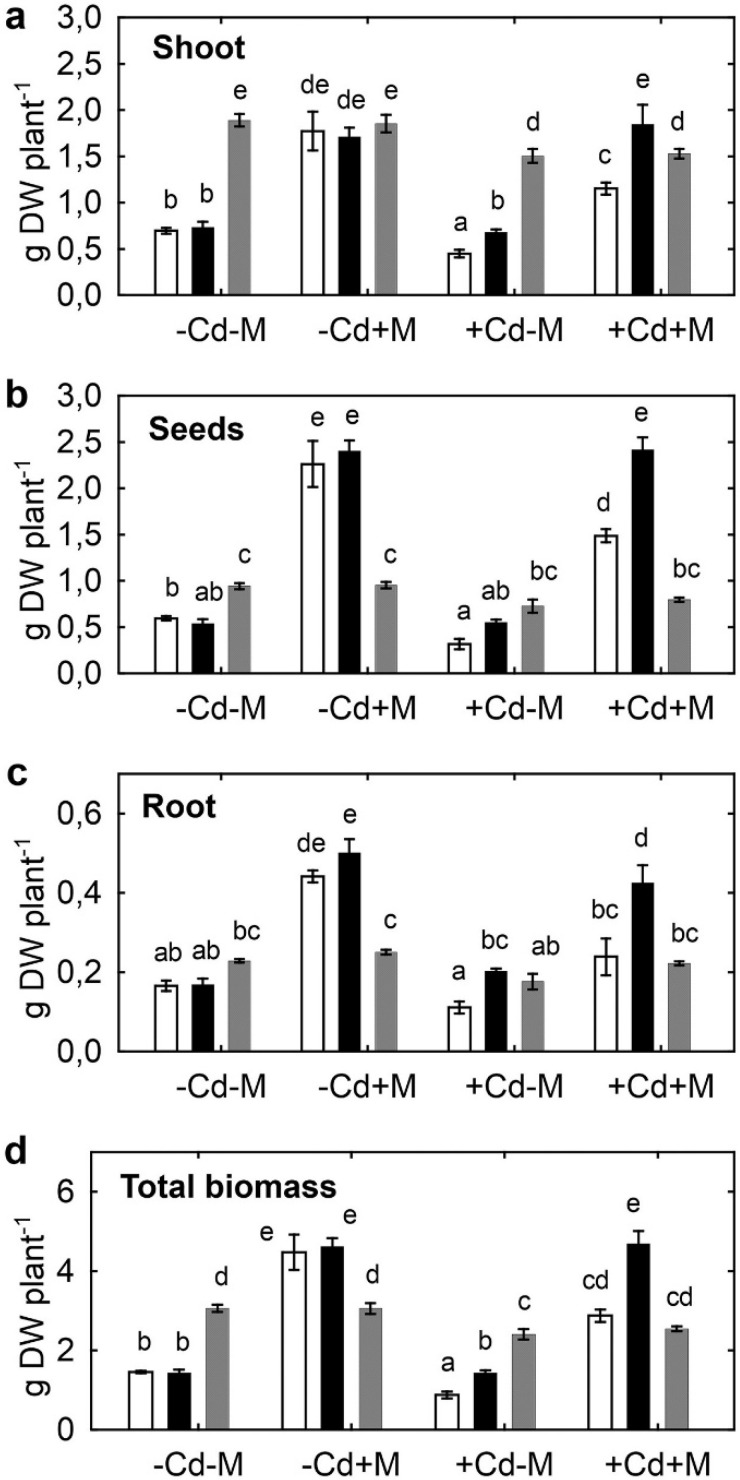
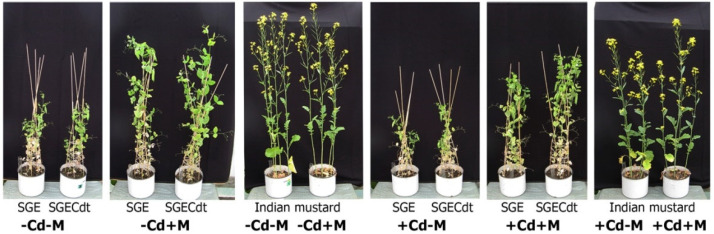
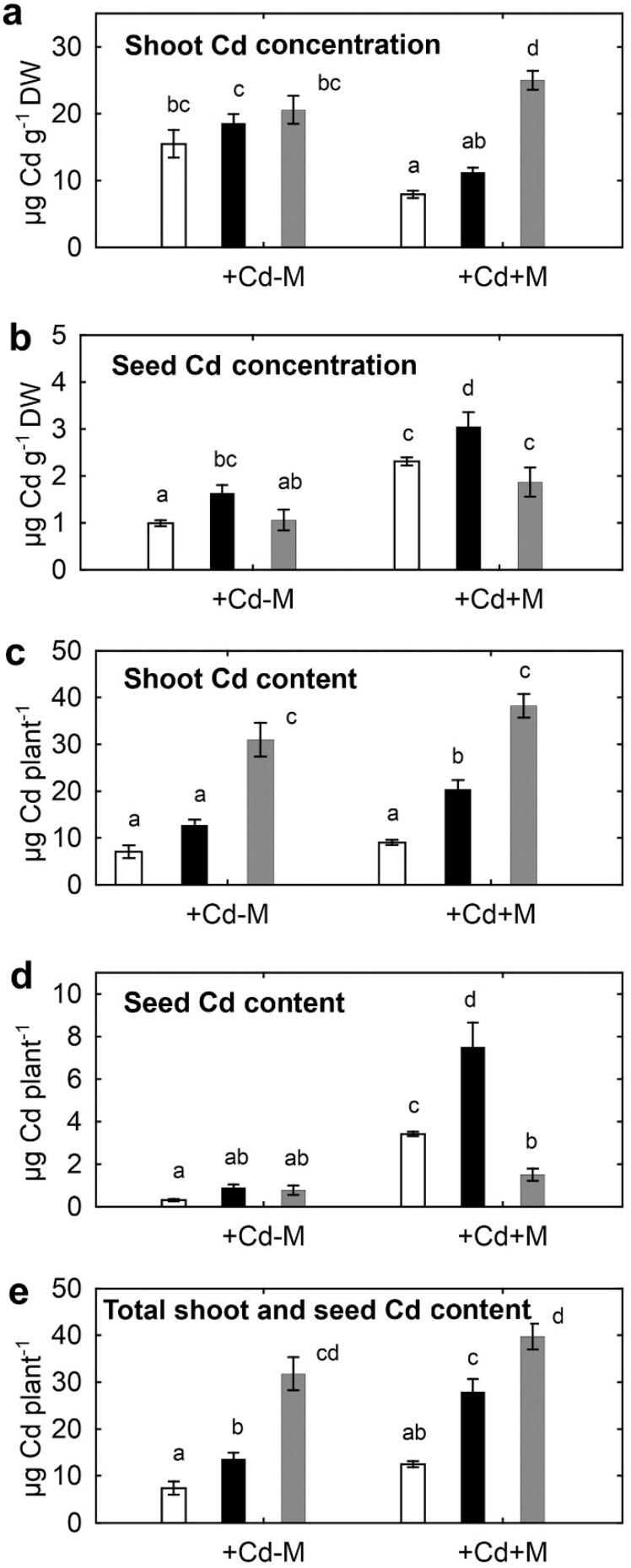
Cadmium (Cd) is one of the most widespread and toxic soil pollutants that inhibits plant growth and microbial activity. Polluted soils can be remediated using plants that either accumulate metals (phytoextraction) or convert them to biologically inaccessible forms (phytostabilization). The phytoremediation potential of a symbiotic system comprising the Cd-tolerant pea ( L.) mutant SGECd and selected Cd-tolerant microorganisms, such as plant growth-promoting rhizobacterium 5C-2, nodule bacterium bv. RCAM1066, and arbuscular mycorrhizal fungus sp. 1Fo, was evaluated in comparison with wild-type pea SGE and the Cd-accumulating plant Indian mustard (Brassica juncea L. Czern.) VIR263. Plants were grown in pots in sterilized uncontaminated or Cd-supplemented (15 mg Cd kg) soil and inoculated or not with the microbial consortium. Cadmium significantly inhibited growth of uninoculated and particularly inoculated SGE plants, but had no effect on SGECd and decreased shoot biomass of B. juncea. Inoculation with the microbial consortium more than doubled pea biomass (both genotypes) irrespective of Cd contamination, but had little effect on biomass. Cadmium decreased nodule number and acetylene reduction activity of SGE by 5.6 and 10.8 times, whereas this decrease in SGECd was 2.1 and 2.8 times only, and the frequency of mycorrhizal structures decreased only in SGE roots. Inoculation decreased shoot Cd concentration and increased seed Cd concentration of both pea genotypes, but had little effect on Cd concentration of . Inoculation also significantly increased concentration and/or accumulation of nutrients (Ca, Fe, K, Mg, Mn, N, P, S, and Zn) by Cd-treated pea plants, particularly by the SGECd mutant. Shoot Cd concentration of SGECd was twice that of SGE, and the inoculated SGECd had approximately similar Cd accumulation capacity as compared with . Thus, plant-microbe systems based on Cd-tolerant micro-symbionts and plant genotypes offer considerable opportunities to increase plant HM tolerance and accumulation.
镉(Cd)是分布最广且毒性最强的土壤污染物之一,会抑制植物生长和微生物活性。受污染的土壤可以通过植物进行修复,这些植物要么积累金属(植物提取),要么将它们转化为生物不可利用的形式(植物稳定)。与野生型豌豆SGE和镉积累植物印度芥菜(Brassica juncea L. Czern.)VIR263相比,评估了由耐镉豌豆(L.)突变体SGECd和选定的耐镉微生物组成的共生系统的植物修复潜力,这些微生物包括促植物生长根际细菌5C-2、根瘤菌bv. RCAM1066和丛枝菌根真菌sp. 1Fo。将植物种植在装有灭菌的未受污染或添加镉(15毫克镉/千克)土壤的花盆中,并接种或不接种微生物联合体。镉显著抑制未接种尤其是接种了微生物联合体的SGE植物的生长,但对SGECd没有影响,且降低了印度芥菜的地上部生物量。无论镉污染情况如何,接种微生物联合体使豌豆生物量(两种基因型)增加了一倍多,但对印度芥菜生物量影响很小。镉使SGE的根瘤数量和乙炔还原活性分别降低了5.6倍和10.8倍,而在SGECd中这种降低仅为2.1倍和2.8倍,且菌根结构频率仅在SGE根中降低。接种降低了两种豌豆基因型地上部镉浓度并增加了种子镉浓度,但对印度芥菜的镉浓度影响很小。接种还显著增加了镉处理豌豆植株中养分(钙、铁、钾、镁、锰、氮、磷、硫和锌)的浓度和/或积累量,尤其是SGECd突变体。SGECd地上部镉浓度是SGE的两倍,接种的SGECd与印度芥菜相比具有大致相似的镉积累能力。因此,基于耐镉微共生体和植物基因型的植物-微生物系统为提高植物对重金属的耐受性和积累量提供了相当大的机会。