Liu Yao, He Guandi, He Tengbing, Saleem Muhammad
College of Agricultural, Guizhou University, Guiyang 550025, China.
Key Laboratory of Plant Resource Conservation and Germplasm Innovation in Mountainous Region, (Ministry of Education) Guizhou University, Guiyang 550025, China.
Microorganisms. 2022 Dec 26;11(1):69. doi: 10.3390/microorganisms11010069.
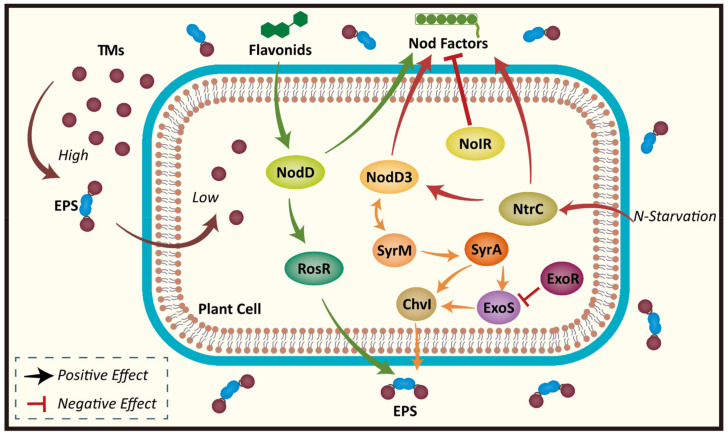
Plants typically interact with a variety of microorganisms, including bacteria, mycorrhizal fungi, and other organisms, in their above- and below-ground parts. In the biosphere, the interactions of plants with diverse microbes enable them to acquire a wide range of symbiotic advantages, resulting in enhanced plant growth and development and stress tolerance to toxic metals (TMs). Recent studies have shown that certain microorganisms can reduce the accumulation of TMs in plants through various mechanisms and can reduce the bioavailability of TMs in soil. However, relevant progress is lacking in summarization. This review mechanistically summarizes the common mediating pathways, detoxification strategies, and homeostatic mechanisms based on the research progress of the joint prevention and control of TMs by arbuscular mycorrhizal fungi (AMF)-plant and Rhizobium-plant interactions. Given the importance of tripartite mutualism in the plant-microbe system, it is necessary to further explore key signaling molecules to understand the role of plant-microbe mutualism in improving plant tolerance under heavy metal stress in the contaminated soil environments. It is hoped that our findings will be useful in studying plant stress tolerance under a broad range of environmental conditions and will help in developing new technologies for ensuring crop health and performance in future.
植物通常在其地上和地下部分与多种微生物相互作用,这些微生物包括细菌、菌根真菌和其他生物。在生物圈中,植物与各种微生物的相互作用使它们能够获得广泛的共生优势,从而促进植物生长发育并提高对有毒金属(TMs)的胁迫耐受性。最近的研究表明,某些微生物可以通过各种机制减少植物中TMs的积累,并降低土壤中TMs的生物有效性。然而,在总结方面仍缺乏相关进展。本综述基于丛枝菌根真菌(AMF)-植物和根瘤菌-植物相互作用对TMs联合防治的研究进展,从机制上总结了常见的介导途径、解毒策略和稳态机制。鉴于三方共生在植物-微生物系统中的重要性,有必要进一步探索关键信号分子,以了解植物-微生物共生在受污染土壤环境中重金属胁迫下提高植物耐受性方面的作用。希望我们的研究结果将有助于在广泛的环境条件下研究植物的胁迫耐受性,并有助于开发新技术以确保未来作物的健康和性能。